
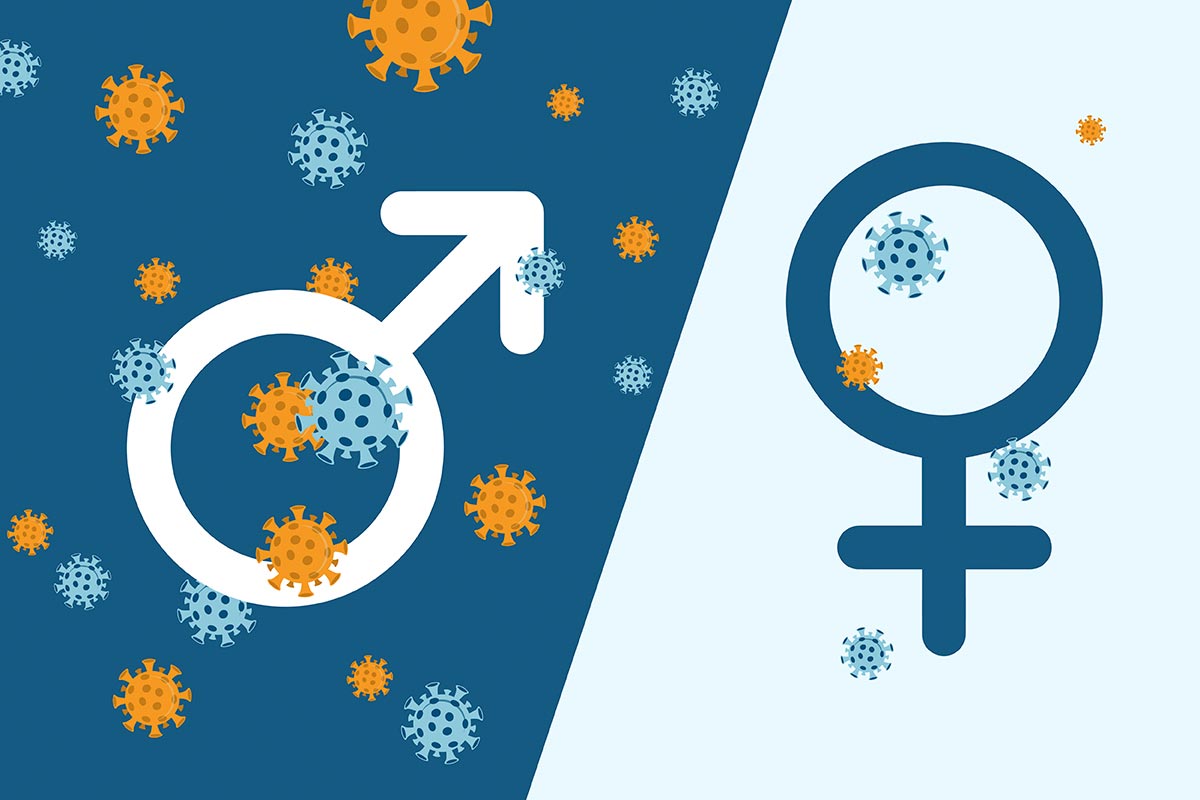
New Clues on Why More Men Than Women Develop Severe Disease
Throughout the pandemic, doctors have seen evidence that men with COVID-19 fare worse, on average, than women with the infection. One theory is that hormonal differences between men and women may make men more susceptible to severe disease. And since men have much more testosterone than women, some scientists have speculated that high levels of testosterone may be to blame.
But a new study from Washington University School of Medicine in St. Louis suggests that, among men, the opposite may be true: that low testosterone levels in the blood are linked to more severe disease. The study could not prove that low testosterone is a cause of severe COVID-19; low levels could simply serve as a marker of some other causal factors. Still, the researchers urge caution with ongoing clinical trials investigating hormonal therapies that block or lower testosterone or increase estrogen as a treatment for men with COVID-19.
The study was published on May 25, 2021, in JAMA Network Open.
“During the pandemic, there has been a prevailing notion that testosterone is bad,” said senior author Abhinav Diwan, MD, a professor of medicine. “But we found the opposite in men. If a man had low testosterone when he first came to the hospital, his risk of having severe COVID-19 — meaning his risk of requiring intensive care or dying — was much higher compared with men who had more circulating testosterone. And if testosterone levels dropped further during hospitalization, the risk increased.”
The researchers measured several hormones in blood samples from 90 men and 62 women who came to Barnes-Jewish Hospital with symptoms of COVID-19 and who had confirmed cases of the illness. For the 143 patients who were admitted to the hospital, the researchers measured hormone levels again at days 3, 7, 14 and 28, as long as the patients remained hospitalized over these time frames. In addition to testosterone, the investigators measured levels of estradiol, a form of estrogen produced by the body, and IGF-1, an important growth hormone that is similar to insulin and plays a role in maintaining muscle mass.
Testosterone as a Predictor of COVID-19 Outcomes
Among women, the researchers found no correlation between levels of any hormone and disease severity. Among men, only testosterone levels were linked to COVID-19 severity. A blood testosterone level of 250 nanograms per deciliter or less is considered low testosterone in adult men. At hospital admission, men with severe COVID-19 had average testosterone levels of 53 nanograms per deciliter; men with less severe disease had average levels of 151 nanograms per deciliter. By day three, the average testosterone level of the most severely ill men was only 19 nanograms per deciliter.
The lower the levels of testosterone, the more severe the disease. For example, those with the lowest levels of testosterone in the blood were at highest risk of going on a ventilator, needing intensive care or dying. Thirty-seven patients — 25 of whom were men — died over the course of the study.
The researchers noted that other factors known to increase the risk of severe COVID-19, including advanced age, obesity and diabetes, also are associated with lower testosterone. “The groups of men who were getting sicker were known to have lower testosterone across the board,” said first author Sandeep Dhindsa, MD, an endocrinologist at Saint Louis University. “We also found that those men with COVID-19 who were not severely ill initially, but had low testosterone levels, were likely to need intensive care or intubation over the next two or three days. Lower testosterone levels seemed to predict which patients were likely to become very ill over the next few days.”
Inflammation, Gene Activation, and Possible Adaptations
In addition, the researchers found that lower testosterone levels in men also correlated with higher levels of inflammation and an increase in the activation of genes that allow the body to carry out the functions of circulating sex hormones inside the cells. In other words, the body may be adapting to less testosterone circulating in the bloodstream by dialing up its ability to detect and use the hormone. The researchers don’t yet know the implications of this adaptation and are calling for more research.
“We are now investigating whether there is an association between sex hormones and cardiovascular outcomes in long COVID-19, when the symptoms linger over many months,” said Diwan, who is a cardiologist. “We also are interested in whether men recovering from COVID-19, including those with long COVID-19, may benefit from testosterone therapy. This therapy has been used in men with low levels of sex hormones, so it may be worth investigating whether a similar approach can help male COVID-19 survivors with their rehabilitation.”
Reference: “Association of Circulating Sex Hormones With Inflammation and Disease Severity in Patients With COVID-19” by Sandeep Dhindsa, MD; Nan Zhang, PhD; Michael J. McPhaul, MD; Zengru Wu, PhD; Amit K. Ghoshal, PhD; Emma C. Erlich, BA; Kartik Mani, MD; Gwendalyn J. Randolph, PhD; John R. Edwards, PhD; Philip A. Mudd, MD, PhD and Abhinav Diwan, MD, 25 May 2021, JAMA Network Open.
DOI: 10.1001/jamanetworkopen.2021.11398
This study used Washington University’s COVID-19 biorepository and was conducted as a collaboration of the university’s Institute of Clinical and Translational Sciences (ICTS), which includes Saint Louis University School of Medicine.
This work was supported by the National Institutes of Health (NIH), grant numbers R37 AI049653, P30 DK020579, HL107594 and HL143431; and a grant from The Foundation for Barnes-Jewish Hospital to facilitate data collection from the WU350 cohort, which supported these studies. These studies also were supported by the Washington University Institute of Clinical and Translational Sciences, grant number UL1TR002345 from the National Center for Advancing Translational Sciences (NCATS) of the NIH.
Never miss a breakthrough: Join the SciTechDaily newsletter.
Follow us on Google and Google News.