Close Menu
    Facebook X (Twitter) Instagram
    SciTechDaily
    • Biology
    • Chemistry
    • Earth
    • Health
    • Physics
    • Science
    • Space
    • Technology
    Facebook X (Twitter) Pinterest YouTube RSS
    SciTechDaily
    Home»Space»New Images From Dawn’s Closest Orbit of Ceres
    Space

    New Images From Dawn’s Closest Orbit of Ceres

    By Elizabeth Landau / Preston Dyches, NASA's Jet Propulsion LaboratoryDecember 22, 20156 Comments3 Mins Read
    Facebook Twitter Pinterest Telegram LinkedIn WhatsApp Email Reddit
    Share
    Facebook Twitter LinkedIn Pinterest Telegram Email Reddit
    Images From Dawn's Closest Orbit of Ceres
    This image of Ceres was taken in Dawn’s low-altitude mapping orbit around a crater chain called Gerber Catena. Credit: NASA/JPL-Caltech/UCLA/MPS/DLR/IDA

    New images from NASA’s Dawn spacecraft provide a better look at the surface of Ceres.

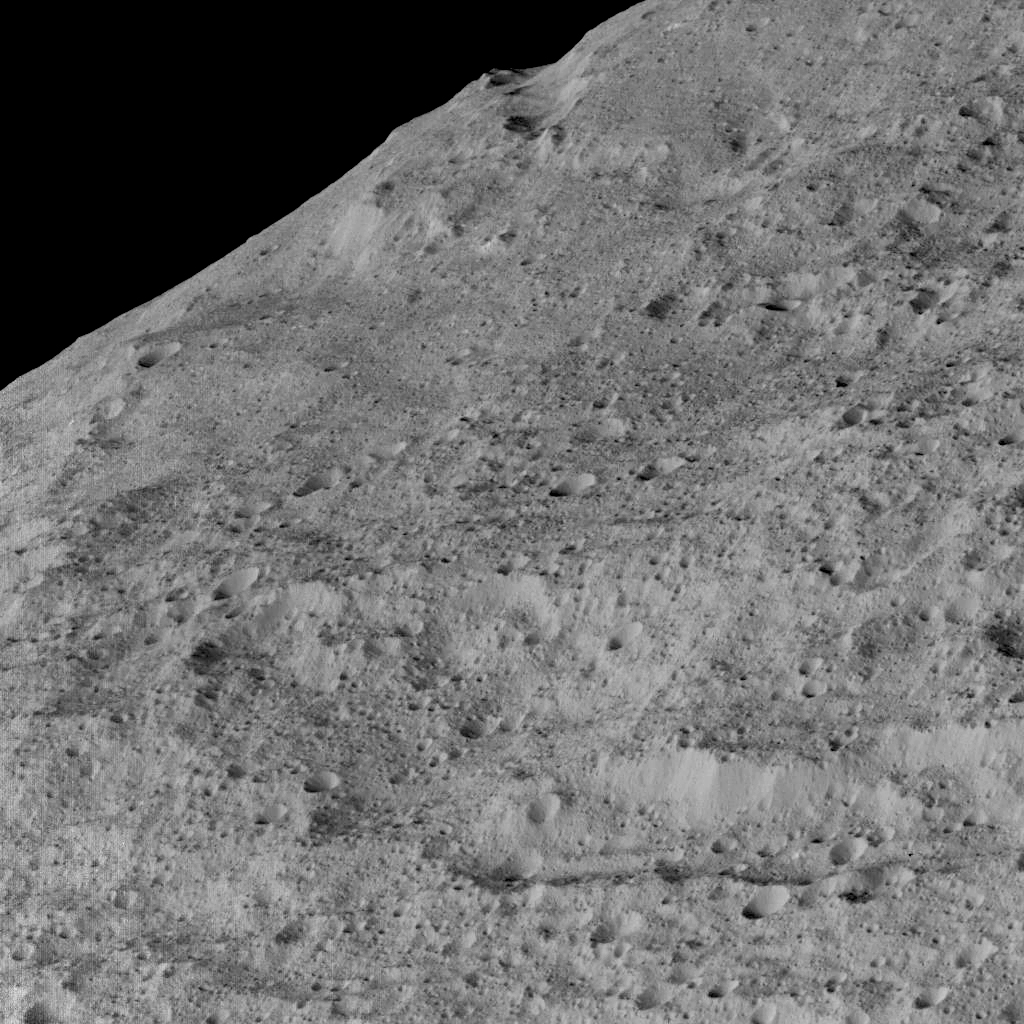
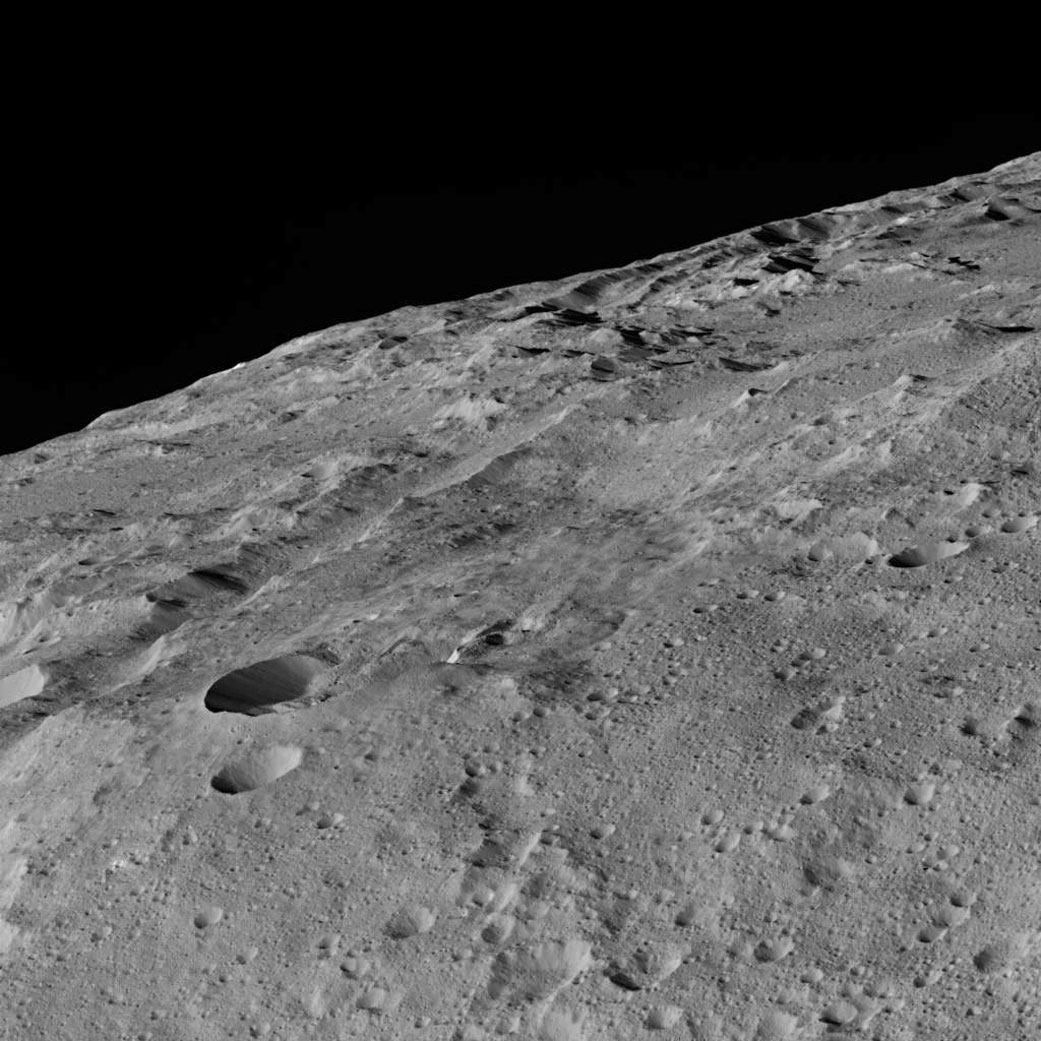
    NASA’s Dawn spacecraft, cruising in its lowest and final orbit at dwarf planet Ceres, has delivered the first images from its best-ever viewpoint. The new images showcase details of the cratered and fractured surface. 3-D versions of two of these views are also available.

    Dawn took these images of the southern hemisphere of Ceres on December 10, at an approximate altitude of 240 miles (385 kilometers), which is its lowest-ever orbital altitude. Dawn will remain at this altitude for the rest of its mission, and indefinitely afterward. The resolution of the new images is about 120 feet (35 meters) per pixel.

    Among the striking views is a chain of craters called Gerber Catena, located just west of the large crater Urvara. Troughs are common on larger planetary bodies, caused by contraction, impact stresses and the loading of the crust by large mountains — Olympus Mons on Mars is one example. The fracturing found all across Ceres’ surface indicates that similar processes may have occurred there, despite its smaller size (the average diameter of Ceres is 584 miles, or 940 kilometers). Many of the troughs and grooves on Ceres were likely formed as a result of impacts, but some appear to be tectonic, reflecting internal stresses that broke the crust.

    “Why they are so prominent is not yet understood, but they are probably related to the complex crustal structure of Ceres,” said Paul Schenk, a Dawn science team member at the Lunar and Planetary Institute, Houston.

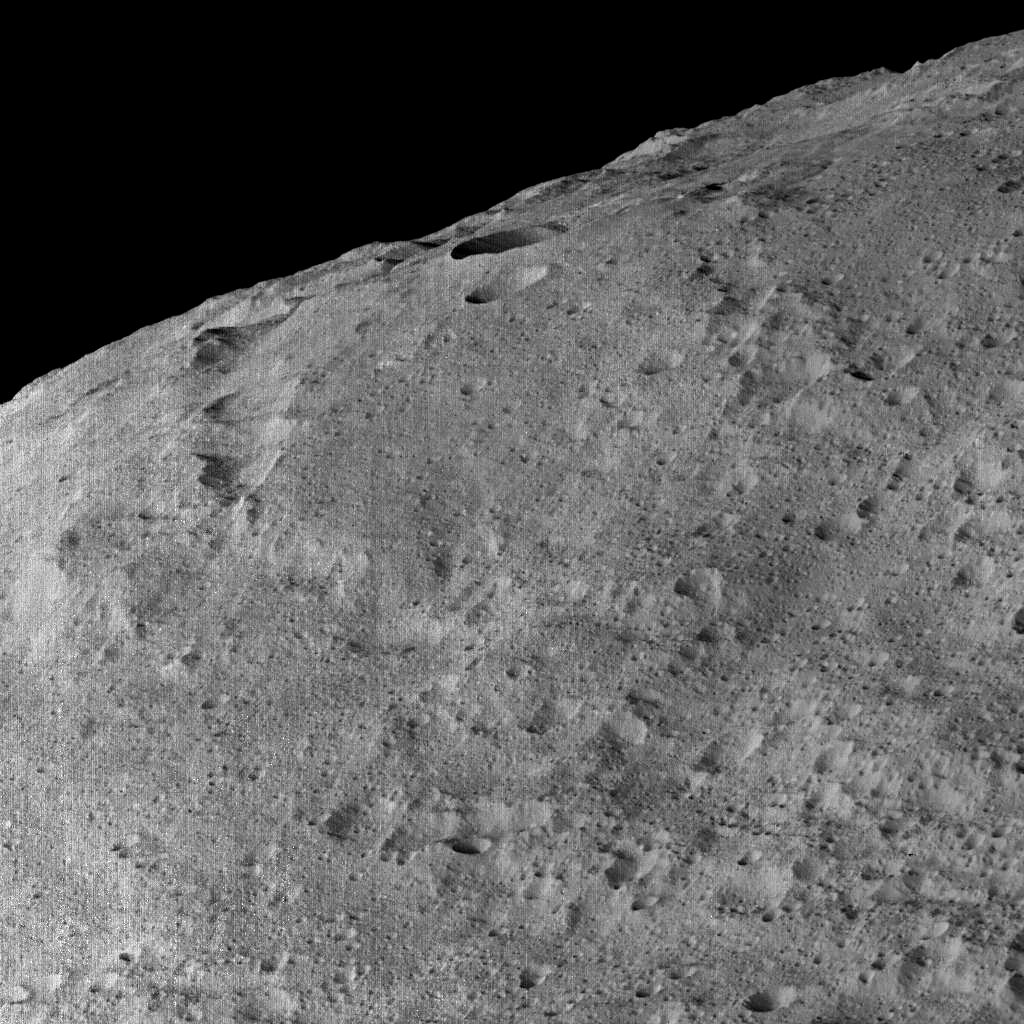
    3D Image Shows a Portion of Southern Hemisphere of Ceres
    This 3-D image, best viewed with red-blue glasses, shows a portion of Ceres’ southern hemisphere.
    New Dawn Images of Ceres
    Dawn took this image in its low-altitude mapping orbit from an approximate distance of 240 miles (385 kilometers) from Ceres.
    Ceres Images from Dawn Spacecraft
    This part of Ceres, near the south pole, has such long shadows because, from the perspective of this location, the sun is near the horizon.
    New Views of Ceres
    This view of Ceres, taken by NASA’s Dawn spacecraft on December 10, shows an area in the southern mid-latitudes of the dwarf planet.

    The images were taken as part of a test of Dawn’s backup framing camera. The primary framing camera, which is essentially identical, began its imaging campaign at this lowest orbit on December 16. Both cameras are healthy.

    Dawn’s other instruments also began their intense period of observations this month. The visible and infrared mapping spectrometer will help identify minerals by looking at how various wavelengths of light are reflected by the surface of Ceres. The gamma ray and neutron detector is also active. By measuring the energies and numbers of gamma rays and neutrons, two components of nuclear radiation, it will help scientists determine the abundance of some elements on Ceres.

    Earlier in December, Dawn science team members revealed that the bright material found in such notable craters as Occator is consistent with salt — and proposed that a type of magnesium sulfate called hexahydrite may be present. A different group of Dawn scientists found that Ceres also contains ammoniated clays. Because ammonia is abundant in the outer solar system, this finding suggests that Ceres could have formed in the vicinity of Neptune and migrated inward, or formed in place with material that migrated in from the outer solar system.

    “As we take the highest-resolution data ever from Ceres, we will continue to examine our hypotheses and uncover even more surprises about this mysterious world,” said Chris Russell, principal investigator of the Dawn mission, based at the University of California, Los Angeles.

    Dawn is the first mission to visit a dwarf planet, and the first mission outside the Earth-moon system to orbit two distinct solar system targets. It orbited protoplanet Vesta for 14 months in 2011 and 2012, and arrived at Ceres on March 6, 2015.

    Never miss a breakthrough: Join the SciTechDaily newsletter.
    Follow us on Google and Google News.

    Astronomy Ceres Dawn Spacecraft Planetary Science
    Share. Facebook Twitter Pinterest LinkedIn Email Reddit

    Related Articles

    A New View of Ceres, Dawn Shows Finer Detail

    Dawn Captures New Images of Ceres Bright Spots

    New Images by NASA’s Dawn Spacecraft Show Mysterious Bright Spots on Ceres

    New Color Map of Ceres Reveals Surface Diversity

    NASA’s Dawn Spacecraft Achieves Orbit Around Ceres

    Dawn Spacecraft Shows Crater Shapes on Ceres’ Surface

    NASA’s Dawn Captures Sharper Images of Ceres

    Dawn Spacecraft Captures Best-Ever View of Ceres

    NASA’s Dawn Spacecraft Closes in on Ceres, Delivers New Images

    6 Comments

    1. Richard Bedard on December 22, 2015 2:57 pm

      I have been trying to keep up dated with this one only and you seem to black it out these close pictures are nice why not the white spots this close they were supposed to be pictures back in July and you are showing close pictures of craters what the hell are you hiding i’m so dam tired of censored s#!t that its not Evan interesting any more you sure could f@#k up a wet dream .

      Reply
    2. richard on December 22, 2015 6:13 pm

      this small planet as water on it and thats what that white spot is.no wonder why nassa don’t want to take a closer look.

      Reply
    3. Bob on December 22, 2015 9:42 pm

      It looks in the Dec 10 pic Dawn took that a lot of the impacts came from one direction.

      Reply
    4. Spock on December 23, 2015 12:16 am

      Where are the close ups of Occator crater and the pyramid mountain??????

      cover up

      conspiracy

      Reply
      • vinay k on February 8, 2016 11:18 pm

        The way NASA seems to have clammed up on Occator once DAWN entered LAMO is pointing to a big cover up.

        Reply
    5. Loren Avey on December 23, 2015 5:14 am

      Fantastic!!

      Reply
    Leave A Reply Cancel Reply

    • Facebook
    • Twitter
    • Pinterest
    • YouTube

    Don't Miss a Discovery

    Subscribe for the Latest in Science & Tech!

    Trending News

    Could Low Vitamin D Be Making Your Pain Worse?

    Scientists Discover Once-Weekly Workout That Melts Belly Fat Surprisingly Effectively

    Scientists Just Tested a Thruster Powerful Enough for Human Missions to Mars

    Doctors Say Your Ice Pack Might Be Making Injuries Worse

    Scientists Discover 43-Foot Sea Reptile Twice the Size of a Great White Shark

    Bees and Birds Are Drinking Alcohol From Flowers

    Scientists Discover How Obesity May Trigger Alzheimer’s Disease

    Scientists Confirm Alcohol Causes Widespread Health Damage

    Follow SciTechDaily
    • Facebook
    • Twitter
    • YouTube
    • Pinterest
    • Newsletter
    • RSS
    SciTech News
    • Biology News
    • Chemistry News
    • Earth News
    • Health News
    • Physics News
    • Science News
    • Space News
    • Technology News
    Recent Posts
    • Just Minutes of Intense Exercise Could Slash Disease Risk by 50%
    • People Who Stop Ozempic Often Don’t Gain the Weight Back
    • Why More People in Their 30s Are Suddenly Getting Colon Cancer
    • Scientists Discover Sperm Seem To Bypass a Fundamental Law of Physics
    • The Secret Behind Indigenous Andeans’ “Digestive Superpower” May Be Potatoes
    Copyright © 1998 - 2026 SciTechDaily. All Rights Reserved.
    • Science News
    • About
    • Contact
    • Editorial Board
    • Privacy Policy
    • Terms of Use

    Type above and press Enter to search. Press Esc to cancel.