
Close Menu
    Facebook X (Twitter) Instagram
    SciTechDaily
    • Biology
    • Chemistry
    • Earth
    • Health
    • Physics
    • Science
    • Space
    • Technology
    Facebook X (Twitter) Pinterest YouTube RSS
    SciTechDaily
    Home»Biology»Lower Testosterone During Puberty Increases the Brain’s Sensitivity to the Sex Hormone in Adulthood
    Biology

    Lower Testosterone During Puberty Increases the Brain’s Sensitivity to the Sex Hormone in Adulthood

    By Society for NeuroscienceFebruary 15, 2021No Comments2 Mins Read
    Facebook Twitter Pinterest Telegram LinkedIn WhatsApp Email Reddit
    Share
    Facebook Twitter LinkedIn Pinterest Telegram Email Reddit
    Testosterone Brain Sensitivity
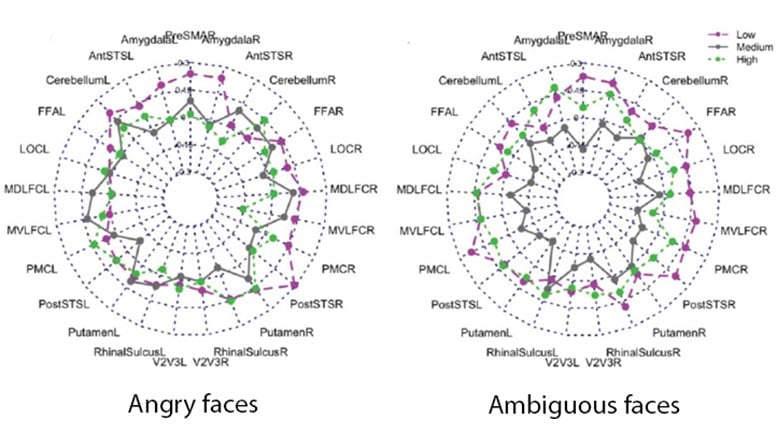
    Changes in blood flow in brain regions when viewing angry and ambiguous facial expressions. Purple = low puberty testosterone, gray = medium, and green = high. Credit: Liao et al., JNeurosci 2021

    For men with lower levels during puberty, higher testosterone increases brain response to faces.

    Young men with lower testosterone levels throughout puberty become more sensitive to how the hormone influences the brain’s responses to faces in adulthood, according to new research published in JNeurosci.

    During prenatal brain development, sex hormones like testosterone organize the brain in permanent ways. But research suggests that testosterone levels during another developmental period — puberty — may have long-lasting effects on brain function, too.

    Liao et al. examined the relationship between puberty testosterone levels and the brain’s response to faces. Liao’s team recruited 500 men around age 19 who had been participants in the Avon Longitudinal Study of Parents and Children, a British birth cohort study established in 1991-1992. The longitudinal study collected blood samples at several time points throughout puberty, which the research team used to determine testosterone levels. The study participants were asked to watch videos of facial expressions while in an fMRI scanner and provide a saliva sample on the day of the scan.

    For men with lowest testosterone levels during puberty, high levels of testosterone on the day of the fMRI scan were linked to greater brain activity in areas sensitive to faces. However, men with higher levels of testosterone throughout puberty did not show an increase in activity in these brain areas with high testosterone levels. These results highlight that an individual’s history, not just their state on a given day, may contribute to the individual differences often seen in brain responses.

    Reference: “Pubertal Testosterone and Brain Response To Faces in Young Adulthood: An Interplay Between Organizational and Activational Effects in Young Men” by Zhijie Liao, Steven Tilley, Andrei Mouraviev, Ammar Khairullah and Tomas Paus for the IMAGEN consortium, 15 February 2021, Journal of Neuroscience.
    DOI: 10.1523/JNEUROSCI.0190-20.2021

    Never miss a breakthrough: Join the SciTechDaily newsletter.
    Follow us on Google and Google News.

    Developmental Biology Endocrinology Society for Neuroscience
    Share. Facebook Twitter Pinterest LinkedIn Email Reddit

    Related Articles

    Researchers Reveal That a Doppler Effect Influences Segmentation

    Visual System of Marine Annelids Provides Insight Into the Evolution of Eyes

    New Demographic Data Show How Diversely Different Species Age

    A Natural Example of a Functioning Gear Mechanism Discovered in an Insect

    Human Heart Precursor Cells Regenerate Decellularized Mouse Heart

    Lab-Made Mouse Oocytes Produce Fertile and Viable Offspring

    African Spiny Mice Regenerate Lost Tissue

    Endocannabinoids Could Reduce or Eliminate Obesity

    Researchers Reduce Sperm Count Using Ultrasound

    Leave A Reply Cancel Reply

    • Facebook
    • Twitter
    • Pinterest
    • YouTube

    Don't Miss a Discovery

    Subscribe for the Latest in Science & Tech!

    Trending News

    Enormous Prehistoric Insects Puzzle Scientists

    Scientists Develop Bioengineered Chewing Gum That Could Help Fight Oral Cancer

    After 37 Years, the World’s Longest-Running Soil Warming Experiment Uncovers a Startling Climate Secret

    NASA Satellite Captures First-Ever High-Res View of Massive Pacific Tsunami

    ADHD Isn’t Just a Deficit: Study Reveals Powerful Hidden Strengths

    Scientists Discover Stem Cells That Could Regrow Teeth and Bone

    Early Cannabis Use May Stall Key Brain Skills in Teens

    Popular Vitamin D Supplement Has “Previously Unknown” Negative Effect, Study Finds

    Follow SciTechDaily
    • Facebook
    • Twitter
    • YouTube
    • Pinterest
    • Newsletter
    • RSS
    SciTech News
    • Biology News
    • Chemistry News
    • Earth News
    • Health News
    • Physics News
    • Science News
    • Space News
    • Technology News
    Recent Posts
    • Scientists Identify Two Simple Treatments for Cancer-Related Cognitive Impairment
    • Omega-3 Supplements Linked to Cognitive Decline in Surprising New Study
    • One in Five at Risk: Scientists Identify a Hidden Blood Particle Linked to Higher Risk of Stroke and Death
    • Darwin’s Islands Still Evolving: Giant Daisies Rewrite the Rules of Evolution
    • Ancient Document Confirms “Legendary” African King Actually Existed
    Copyright © 1998 - 2026 SciTechDaily. All Rights Reserved.
    • Science News
    • About
    • Contact
    • Editorial Board
    • Privacy Policy
    • Terms of Use

    Type above and press Enter to search. Press Esc to cancel.