
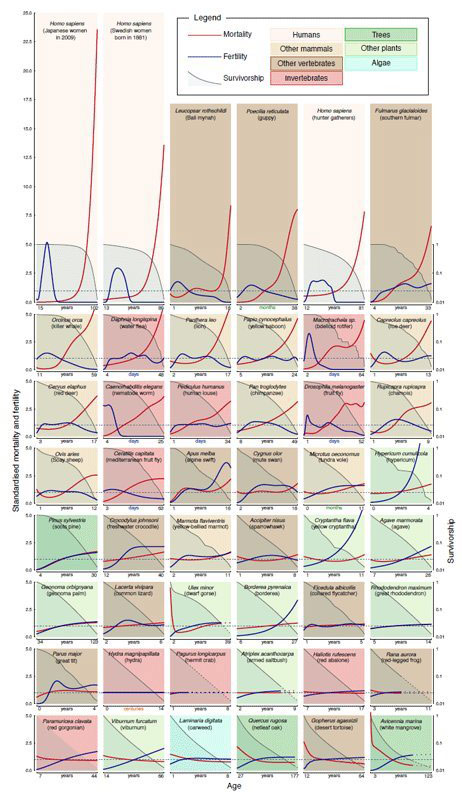
Based on the results of a long-term data collection project, a new study shows how different species age, unveiling diversity of aging processes that no existing evolutionary theory can account for.
Despite aging being one of the hottest topics in the media recently, scientists have no coherent explanation for it. New demographic data on humans, animals, and plants for the first time unveil such an extraordinary diversity of aging processes that no existing evolutionary theory can account for. Both life spans and mortalities vary from species to species. The fact that the probability of dying rises with age applies to humans, but is not principally true. This is shown by a catalog of 46 species with their respective mortality and fertility rates, which has now been published in the science journal Nature. It is the result of a long-term data collection project led by scientists at the Max Planck Institute for Demographic Research (MPIDR) in Rostock, Germany, and at the Max-Planck Odense Center on the Biodemography of Aging (MaxO) in Odense, Denmark.
Not only are previous explanations unable to deal with life spans ranging from a few days (fruit fly), to decades (humans), to centuries (hydra), but they are also unable to account for variations in the death rate. Common theories assert that the probability of dying rises with age, as for humans. However, the researchers cataloged species such as the white mangrove and the desert tortoise whose probability of dying actually decreases with age. In addition, fertility periods of some species also challenge common theories.
Previous attempts to explain aging claim that creatures only invest in self-preservation until they have reproduced successfully and raised their offspring. Following this line of reasoning, when the end of the fertility period approaches, the body should start to decay – which is known as senescence, or aging.
For humans this is only partly true. According to the Nature study, mortality of modern Japanese women rises constantly after childhood. But contradictorily, humans still live for a long time after fertility has ceased. Today, many people stay healthy until they are grandparents and their probability of dying is correspondingly small. Only at advanced ages is mortality growing rapidly. For example, in Japanese women 100 years old, mortality reaches more than 20 times their lifetime average.
This makes humans a real oddity. No other species in the researcher’s catalog has a mortality curve which rises that sharply. Even among other mammals, death rates reach no more than five times the lifetime average. Why evolution developed such big differences is a mystery to biologists.
For many species aging is turned upside down
Current theories are especially at odds with two groups of species for which the concept of aging appears to be turned upside down. On the one hand there are creatures whose mortality stays constant throughout their whole life, like hydra or the hermit crab. Their bodies do not seem to degenerate during their lifetime which can be understood as the absence of aging. There are even species whose probability of dying decreases as they grow older, like the red gorgonian (a coral), the netleaf oak, and the desert tortoise. Their risk of dying obviously never becomes zero, but when they are old they are more likely to survive until their next birthday than when they were in their youth.
There is another belief that the new data catalog disproves: the idea that species with a short life span die so soon because they age so quickly. This would mean that their mortality rises strongly throughout life. However, sometimes the contrary is the case, such as in the tundra vole. Its mortality increases only moderately until it reaches two times its lifetime average at old age. Nevertheless, this vole rarely survives beyond one year. Humans, however, are living for an entire century more and more often, despite the fact that their risk of dying skyrockets at old age (up to more than 20 times the lifetime average).
Data will pave the way for a unified theory of aging
“Surprisingly, one can hardly imagine a type of life course that is not found in nature,” says MaxO researcher Owen Jones. This applies not only for mortality but also for fertility. While women become infertile after a limited childbearing period in the first half of their lives, fertility rises until almost the end of the lifespan for the alpine swift. The yellow baboon has offspring throughout its life without any influence of age. “One reason why we still lack a unified theory of aging is that our view on aging was always biased because we had data only for a very restricted selection of species,” says biodemographer Alexander Scheuerlein from MPIDR. There have long been high quality demographic records for hundreds of mammals and birds but very few for other vertebrates or invertebrates. Extremely little is known about algae, fungi or bacteria. In order to understand why evolution created aging, much more comprehensive data on all species have to be collected, says Alexander Scheuerlein.
Reference: “Diversity of ageing across the tree of life” by Owen R. Jones, Alexander Scheuerlein, Roberto Salguero-Gómez, Carlo Giovanni Camarda, Ralf Schaible, Brenda B. Casper, Johan P. Dahlgren, Johan Ehrlén, María B. García, Eric S. Menges, Pedro F. Quintana-Ascencio, Hal Caswell, Annette Baudisch and James W. Vaupel, 8 December 2013, Nature.
DOI: 10.1038/nature12789
Never miss a breakthrough: Join the SciTechDaily newsletter.
Follow us on Google and Google News.
1 Comment
Aging in the living beings depends on a composite formula. It depends on their 1.food availability, 2.food procurement techniques, 3.organ development for processing their food depending on their availability and quantity and nature. 4.Escaping from predators and warring skills. 5.Injury in the warring attempts and diseases from food taken ,and finally 6.Adaptation to environment and nature and developing immunity. Thus food availability for small insects and bacteria will be aplenty and they can live for trillion generations even after the disappearance of mankind in this world, but their lifetime will be shorter indeed. The food availability which is Sunlight and Water will guarantee Plants living for trillion generations until nature plays a villain. Here the lifetime will be greater for no predators except the weather and human destruction of nature. Dinosaurs had plenty of plant food in the Jurassic Age in the tropical areas with thick wood. Failure of predators made them live long and they also happily lived for million generations for 150 million years until the Earth met with a catastrophic impact with a comet. Men had invented ways to procure food and grow themselves. But with scientific advancement their physical work got reduced and they deviated from nature and thereby their life time is curtailed. Growing more food meant for mixing more harmful chemicals which gives the lifetime curtailment also. Here it is a balanced longevity only.Our generations cannot last for more than a few hundred thousand years.” Men may come and men may go,but I will go on for ever”- will be the song of inferior creatures in the world which devised a simple way of living. Thank You.