
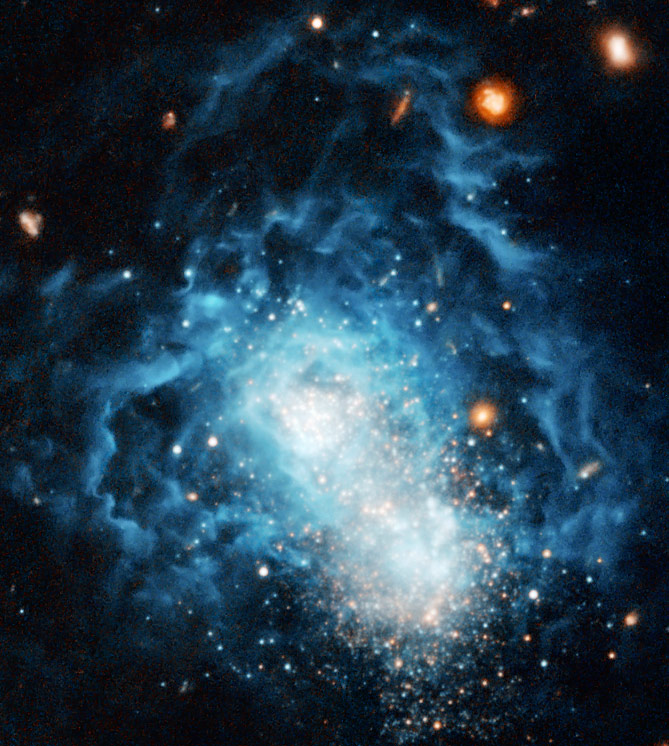
A new study from an international team of researchers has measured the lowest dust mass of a galaxy to date, leaving the researchers to believe that current theories to describe the formation of stars when the Universe was very young are incomplete, and are built on invalid assumptions.
Dust may be more rare than expected in galaxies of the early Universe, according to an international research team, led by Swinburne University of Technology astrophysicist Dr David Fisher.
In a galaxy named I Zw 18, the team measured the lowest dust mass of a galaxy that has ever been measured.
“It’s not just that the dust mass is low. We found that the dust mass is 100 times smaller than would be expected based on commonly assumed theories,” Dr Fisher said.
The galaxy, I Zw 18, is nearby, which makes it easier to study, but has properties that are very similar to galaxies of the high redshift Universe.
“It’s an extreme galaxy in the local Universe, but it tells us a lot about a stage that almost all galaxies have gone through, so it gives us a picture of what the first galaxies look like.”
Dr Fisher said the results imply that galaxies of the early Universe may have less dust than has been expected.
“This means, firstly, that they will look different than we expect and make different populations of stars than we expect. And secondly, that they will be much more difficult to observe, even with state-of-the-art facilities being built now such as the Atacama Large Millimeter/sub-millimeter Array (ALMA) of radio telescopes in northern Chile.
“IZw 18 is typical of very high redshift galaxies because it is very actively forming stars, and has a chemistry that is more like galaxies of the very early Universe with a very low abundance of metals and a lot of gas in the form of hydrogen,” he said.
“Our result implies that current theories to describe the formation of stars when the Universe was very young are incomplete, and are built on invalid assumptions.”
According to Dr Fisher, the amount of dust is very important for the formation of stars.
“What we think is going on, is that the harsh environment inside the galaxy we examined is adversely affecting the amount of dust in it.
“The radiation field measured inside I Zw 18 was roughly 200 times stronger than what we experience here in the Milky Way.” Dr Fisher said that based on the findings, theories should be amended to account for environment in making stars.
The team included researchers from the University of Maryland, Swinburne University of Technology, Princeton University, Max-Plank Institut für Astronomie, Germany; National Radio Astronomy Observatory, Virginia; Department of Physics and Astronomy, Macalester College, Saint Paul, Minnesota.
Reference: “The rarity of dust in metal-poor galaxies” by David B. Fisher, Alberto D. Bolatto, Rodrigo Herrera-Camus, Bruce T. Draine, Jessica Donaldson, Fabian Walter, Karin M. Sandstrom, Adam K. Leroy, John Cannon and Karl Gordon, 8 December 2013, Nature.
DOI: 10.1038/nature12765
arXiv:1310.4842
Never miss a breakthrough: Join the SciTechDaily newsletter.
Follow us on Google and Google News.
2 Comments
I suspect when they say “dust”, they are referring to something other than house hold dust. Are they referring to very thin clouds of Hydrogen gas as ‘dust’?
I have a fresh theory on the formation of spiral galaxies available at https://www.youtube.com/watch?v=qvW3bI5JCEc&feature=youtu.be There are some mistakes in my assumptions. But the part on the birth of stars and the mode of formation of spirals is really good and acceptable. Only deep and line by line study will enable any one to understand and appreciate the theory. Can you go through the theory and offer your comments?