
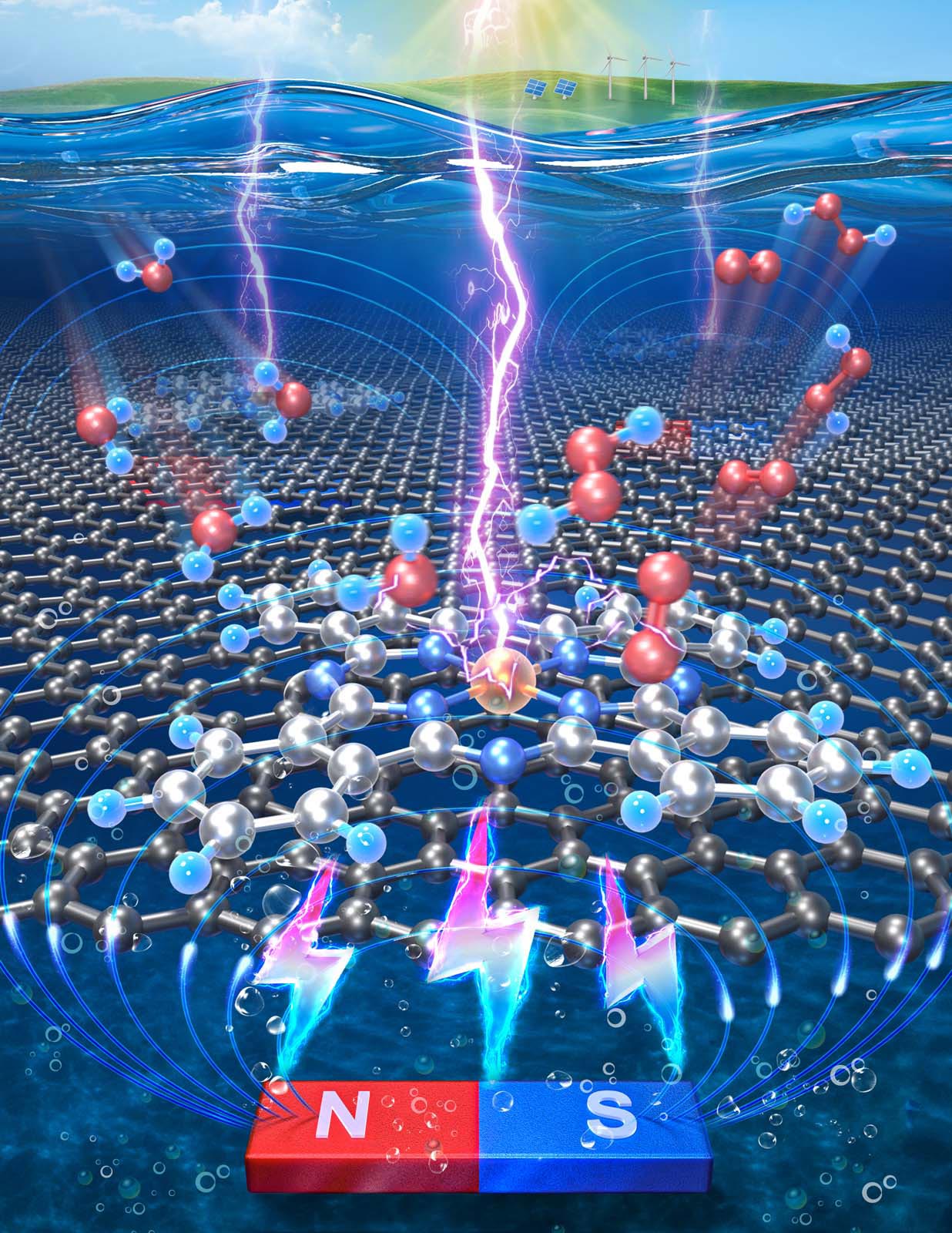
New catalyst achieves 90% efficiency in hydrogen peroxide production, enhancing safety and environmental sustainability.
Scientists have made a significant advancement in enhancing the efficiency of an electrochemical reaction used to produce hydrogen peroxide, a crucial chemical in disinfection, bleaching, and sewage treatment. The reaction, called the the oxygen reduction reaction (ORR), was improved by developing a new class of heterogeneous molecular catalysts with an integrated magnetic field.
Traditional hydrogen peroxide production methods pose several challenges; they are energy-intensive, and the concentrated product is difficult to transport safely. To address these issues, the research team looked towards an electrochemical method that is more efficient and environmentally friendly.

Innovative Catalyst Design
The research team designed a novel catalyst by anchoring cobalt phthalocyanine (CoPc) molecules on carbon black (CB) and then integrating them with polymer-protected magnetic (Mag) nanoparticles. This unique structure enables effective spin state manipulation of the cobalt active sites, significantly enhancing catalytic performance.
The researchers discovered the CoPc/CB-Mag catalyst achieved a remarkable H2O2 production efficiency of 90% and significantly enhanced the reaction’s efficiency. Notably, the catalyst requires only minimal amounts of magnetic materials – up to seven orders of magnitude less than previous approaches – making it both safer and more practical for large-scale applications.

Magnetic Enhancement of Catalytic Processes
“Our integrated magnetic field approach can shift the cobalt center from low-spin to high-spin state without modifying its atomic structure,” said Di Zhang of the Advanced Institute for Materials Research (WPI-AIMR), “This spin transition dramatically improves the catalyst’s intrinsic activities in both oxygen reduction and evolution reactions.”
To understand the fundamental mechanism behind this new catalyst, they used a technique called comprehensive density functional theory (DFT) calculations. Understanding why and how it works is important for future studies. “We found that the high-spin Co site exhibits stronger binding with oxygen-containing intermediates, which is crucial for efficient catalysis,” explained Associate Professor Hao Li, “The magnetic field-induced spin polarization also facilitates electron transfer and spin transitions during the reaction steps, boosting the catalytic kinetics.”
“The combination of experimental results and theoretical insights provides a comprehensive picture of how magnetic fields can enhance catalytic performance,” added Li, “This can serve as guidance when designing new catalysts in the future.”
Implications for Sustainable Industrial Practices
The findings could lead to the rational design of catalytic active materials, targeting for more efficient and environmentally friendly pathways to produce hydrogen peroxide and other value-added chemicals, contributing to global efforts in sustainable industrial processes and carbon-neutral energy technologies.
Reference: “Spin Manipulation of Heterogeneous Molecular Electrocatalysts by an Integrated Magnetic Field fo Efficient Oxygen Redox Reactions” by Zixun Yu, Di Zhang, Yangyang Wang, Fangzhou Liu, Fangxin She, Jiaxiang Chen, Yuefeng Zhang, Ruijie Wang, Zhiyuan Zeng, Li Song, Yuan Chen, Hao Li and Li Wei, 17 September 2024, Advanced Materials.
DOI: 10.1002/adma.202408461
Never miss a breakthrough: Join the SciTechDaily newsletter.
Follow us on Google and Google News.