
Close Menu
    Facebook X (Twitter) Instagram
    SciTechDaily
    • Biology
    • Chemistry
    • Earth
    • Health
    • Physics
    • Science
    • Space
    • Technology
    Facebook X (Twitter) Pinterest YouTube RSS
    SciTechDaily
    Home»Science»Making Stronger 3D-Printed Alloys Using Ultrasound
    Science

    Making Stronger 3D-Printed Alloys Using Ultrasound

    By RMIT UniversityJanuary 9, 2020No Comments3 Mins Read
    Facebook Twitter Pinterest Telegram LinkedIn WhatsApp Email Reddit
    Share
    Facebook Twitter LinkedIn Pinterest Telegram Email Reddit
    Titanium Alloy Grain Structure with Ultrasound
    3D printed Titanium alloys under an electron microscope: sample on the left with large, elongated crystals was printed conventionally, while sample on the right with finer, shorter crystals was printed sitting on a ultrasonic generator. Credit: RMIT University

    Researchers have used sound vibrations to shake metal alloy grains into tighter formation during 3D printing.

    A study just published in Nature Communications on January 9, 2020, shows high-frequency sound waves can have a significant impact on the inner micro-structure of 3D printed alloys, making them more consistent and stronger than those printed conventionally.

    Lead author and Ph.D. candidate from RMIT University’s School of Engineering, Carmelo Todaro, said the promising results could inspire new forms of additive manufacturing.

    “If you look at the microscopic structure of 3D printed alloys, they’re often made up of large and elongated crystals,” Todaro explained.

    “This can make them less acceptable for engineering applications due to their lower mechanical performance and increased tendency to crack during printing.”
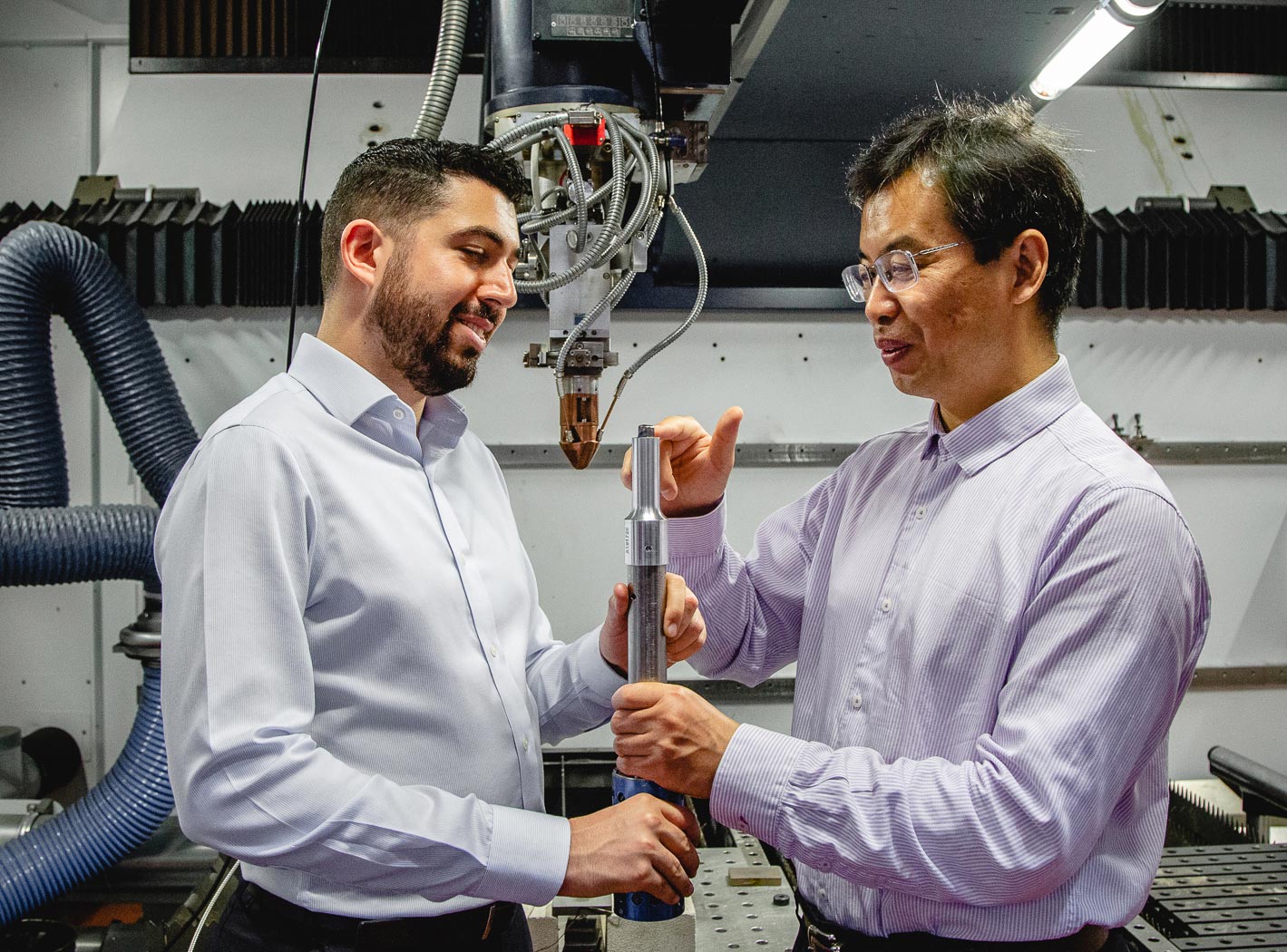
     

    Inspecting 3D Printed Titanium Alloy Cube
    Carmelo Todaro and Ma Qian inspect a 3D-printed Titanium alloy cube on the tip of an ultrasound rod. Credit: RMIT University

    “But the microscopic structure of the alloys we applied ultrasound to during printing looked markedly different: the alloy crystals were very fine and fully equiaxed, meaning they had formed equally in all directions throughout the entire printed metal part.”

    Testing showed these parts had a 12% improvement in tensile strength and yield stress compared with those made through conventional additive manufacturing.

    The team demonstrated their ultrasound approach using two major commercial-grade alloys: a titanium alloy commonly used for aircraft parts and biomechanical implants, known as Ti-6Al-4V, and a nickel-based superalloy often used in marine and petroleum industries called Inconel 625.
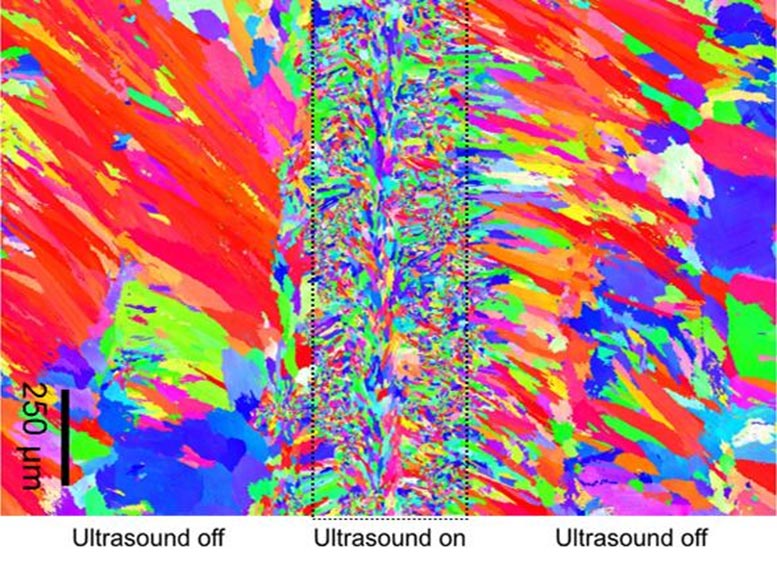
    Printing With Ultrasound On and Off
    Visualization of grain structure in 3D printed Inconel 625 achieved by turning the ultrasound on and off during printing. Credit: RMIT University

    By simply switching the ultrasound generator on and off during printing, the team also showed how specific parts of a 3D-printed object can be made with different microscopic structures and compositions, useful for what’s known as functional grading.

    Study co-author and project supervisor, RMIT’s Distinguished Professor Ma Qian, said he hoped their promising results would spark interest in specially designed ultrasound devices for metal 3D printing.

    “Although we used a titanium alloy and a nickel-based superalloy, we expect that the method can be applicable to other commercial metals, such as stainless steels, aluminum alloys, and cobalt alloys,” Qian said.

    “We anticipate this technique can be scaled up to enable 3D printing of most industrially relevant metal alloys for higher performance structural parts or structurally graded alloys.”

    Reference: “Grain structure control during metal 3D printing by high-intensity ultrasound” by C. J. Todaro, M. A. Easton, D. Qiu, D. Zhang, M. J. Bermingham, E. W. Lui, M. Brandt, D. H. StJohn and M. Qian, 9 January 2020, Nature Communications.
    DOI: 10.1038/s41467-019-13874-z

    This research was conducted at RMIT University’s Advanced Manufacturing Precinct and supported by an Australian Research Council Discovery Project grant.

    Never miss a breakthrough: Join the SciTechDaily newsletter.
    Follow us on Google and Google News.

    Materials Science Metal RMIT University
    Share. Facebook Twitter Pinterest LinkedIn Email Reddit

    Related Articles

    From Blacksmiths to Beamlines: 3D Atomic Revelations Transform Alloy Engineering

    Not Science Fiction: Scientists Around the World Shocked by Self-Healing in Metal

    “Absolutely Stunning” – Scientists Discover Metals That Can Heal Themselves

    A Magical Combination – Scientists Develop a New Class of Materials

    3D Printing Paves Way for “Designer” Titanium Alloys

    Ultimate Strength of Metals Accurately Predicted With New Theoretical Model

    Atomic-Level Imaging May Enable Metals With Unprecedented Properties

    Revolutionary New Discovery on Metal Malleability

    Discovery May Lead to New Crack-resistant Metal Alloys

    Leave A Reply Cancel Reply

    • Facebook
    • Twitter
    • Pinterest
    • YouTube

    Don't Miss a Discovery

    Subscribe for the Latest in Science & Tech!

    Trending News

    Scientists May Have Found the Key to Jupiter and Saturn’s Moon Mystery

    Scientists Uncover Brain Changes That Link Pain to Depression

    Saunas May Do More Than Raise Body Temperature – They Activate Your Immune System

    Exercise in a Pill? Metformin Shows Surprising Effects in Cancer Patients

    Hidden Oceans of Magma Could Be Protecting Alien Life

    New Study Challenges Alzheimer’s Theories: It’s Not Just About Plaques

    Artificial Sweeteners May Harm Future Generations, Study Suggests

    Splashdown! NASA Artemis II Returns From Record-Breaking Moon Mission

    Follow SciTechDaily
    • Facebook
    • Twitter
    • YouTube
    • Pinterest
    • Newsletter
    • RSS
    SciTech News
    • Biology News
    • Chemistry News
    • Earth News
    • Health News
    • Physics News
    • Science News
    • Space News
    • Technology News
    Recent Posts
    • As Cities Invade the Amazon, Yellow Fever Makes a Dangerous Comeback
    • “Asian Flush” May Be a Hidden Trigger for Deadly Heart Damage
    • AI Could Detect Early Signs of Alzheimer’s in Under a Minute – Far Before Traditional Tests
    • What if Dark Matter Has Two Forms? Bold New Hypothesis Could Explain a Cosmic Mystery
    • Researchers Expose Hidden Chemistry of “Ore-Forming” Elements in Biology
    Copyright © 1998 - 2026 SciTechDaily. All Rights Reserved.
    • Science News
    • About
    • Contact
    • Editorial Board
    • Privacy Policy
    • Terms of Use

    Type above and press Enter to search. Press Esc to cancel.