

A pocket-sized particle detector is making cosmic ray physics accessible from classrooms to major experiments.
Particles from deep space are passing through the world around you right now. They leave no sound, taste, smell, or sensation, but with the right detector, their arrival can be counted one by one.
These particles begin with cosmic rays, energetic particles that can be produced by exploding stars and other extreme astrophysical events far beyond the solar system. When cosmic rays strike atoms high in Earth’s atmosphere, they set off a chain reaction that creates secondary particles. One important result is the muon, a tiny particle able to travel through the atmosphere and even reach below the ground.
University of Delaware physics professor Spencer Axani has built a way to bring that invisible particle rain into classrooms and research labs. His invention, CosmicWatch, is a compact muon detector that can be used by experienced scientists and high school students alike.
The device is about the size of a box of animal crackers and can be assembled from roughly $100 in electronic parts. When a muon passes through, CosmicWatch lights up, records the event and stores the data for later analysis.
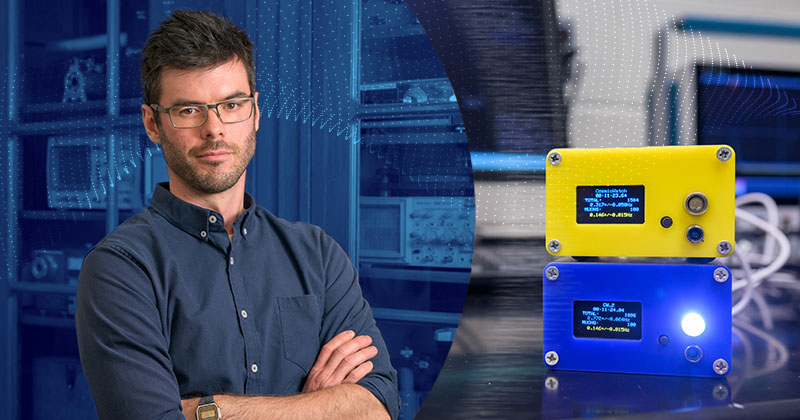
CosmicWatch was first designed as an affordable way to introduce students to particle physics. It has since found a second life in international astrophysics experiments, where its small size and low cost make measurements possible in places that would be harder to reach with conventional equipment.
“CosmicWatch detectors allow us to do far more physics at a dramatically lower cost, in a compact and portable form, opening the door to many new kinds of experiments and outreach opportunities,” Axani said.
Birth of a detector
Muons matter because they carry clues about the cosmic rays that created them. By measuring muons, physicists can infer the energy, mass, and direction of the original cosmic ray, helping them study powerful objects and events such as supernovae, gamma ray bursts, and blazars. Muon flux also helped provide one of the earliest experimental confirmations of Einstein’s theory of special relativity in the early 1940s.
Their usefulness is not limited to space. Because muons can pass through matter such as walls, rock, and human tissue without causing damage, they can be used to peer inside large structures that are otherwise difficult to examine. In 2016, muon technology helped reveal an unknown corridor inside the Great Pyramid of Giza.
The challenge has always been access. Many muon detectors are large, expensive, and difficult to move, which limits both classroom use and the range of experiments that can be attempted.
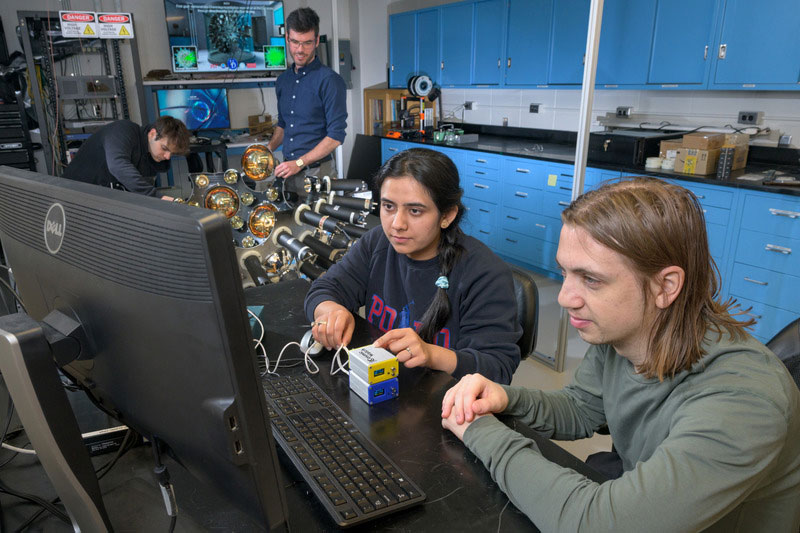
“A typical undergraduate physics lab course uses a rack of electronics about the size of a small bookshelf to measure muons,” Axani said.
Axani created CosmicWatch in 2017 while he was a graduate student at MIT. At first, his goal was practical: build a small, low-power muon detector for the IceCube observatory in Antarctica. IceCube is a vast detector buried beneath the ice that studies neutrinos, another kind of subatomic particle. A muon detector helps IceCube scientists separate background particles from the neutrinos they are trying to detect.
The project changed direction when Axani realized that the same design could become an educational tool. A portable, inexpensive detector could let students handle real particle physics data without needing a full lab of specialized electronics.
After joining the UD faculty in 2022, Axani continued refining the device and recently released its third version. The upgrades, described in an October article in the Journal of Instrumentation, allow CosmicWatch to monitor its local environment, survive high radiation levels and collect data more quickly.
“Even though I had studied cosmic rays, I didn’t fully appreciate the rich physics behind the working of these detectors to actually ‘see’ the world and atmospheric particle production,” said Masooma Sarfraz, a doctoral student in Axani’s lab and primary author on the journal article. “For a student like me who has been working on theoretical ideas, this was a perfect opportunity to dive into the experimental side. It also connects beautifully to my current broader research work with particle physics.”
The newest CosmicWatch is useful for calibrating large-scale detectors and is now being used in the NuDot experiment at UD and the Coherent CAPTAIN-Mills (CCM) dark matter detector in Los Alamos, New Mexico. Another version is being developed to measure primary cosmic rays aboard rockets and spacecraft.
Science in action
CosmicWatch remains a teaching tool at UD, where Axani uses it to introduce students to particle, nuclear, and astrophysics. Students build the detectors themselves, learn how high-speed electronics work, and then use the devices to run experiments they design.
UD physics professor Spencer Axani has invented a portable, low-cost detector that senses invisible particles from space called muons. Muons help scientists learn more about some of the most extreme phenomena in the universe, like exploding stars, gamma ray bursts and blazars. CosmicWatch is being used in international astrophysics experiments, and in high school and college classrooms across the country, introducing a new generation of scientists to the field of particle physics. Credit: University of Delaware
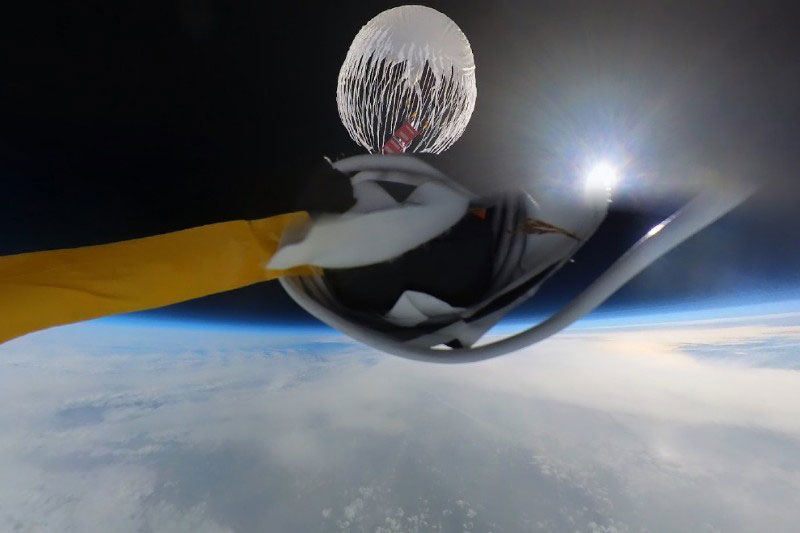
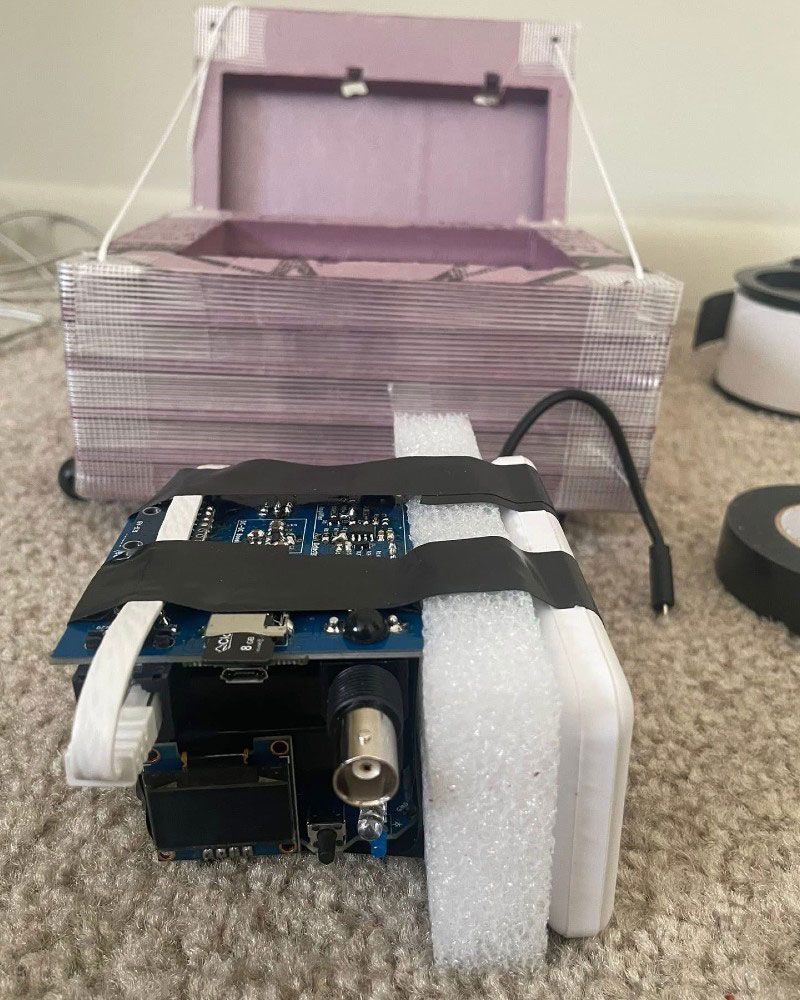
Musarate Shams, a doctoral student in the quantum science and engineering program, adapted his CosmicWatch by adding temperature and pressure sensors. He wanted to use it to investigate cosmic rays in Earth’s upper atmosphere.
In May, Shams sent the device up on a high-altitude balloon that climbed to 100,000 feet, near the edge of space. After studying the data, he was able to show how the flux of cosmic rays from outer space changes with altitude.
“It’s a very cool thing to build something in the lab in a couple of days that’s able to detect these cool particles from hundreds of light-years away,” he said.
CosmicWatch is also reaching classrooms beyond UD. Natasha Holmes, the Ann S. Bowers Associate Professor of Physics at Cornell University, has students in her introductory physics courses build the detectors and use them in experiments. For Holmes, the value is not just that students learn a concept, but that they work more like experimental physicists.
“The students seem really excited about doing this thing that is more like what particle physicists and experimental physicists actually do,” she said. “They get to learn some coding with it, and sometimes they break the devices and then we have to talk to them about being careful with your equipment. It’s very different from a typical physics lab. We’ve had students say they’re doing ‘real science’ after using it.”
Worldwide physics
Axani estimates that thousands of CosmicWatch detectors have been built since the first version was released eight years ago. He hopes the number could grow into a global citizen science network, with people around the world measuring local muon rates and sending their data to a shared site online.
He is also developing a related detector that could help groups of satellites respond to their environment. For example, the detectors could warn satellites about solar flares, allowing them to power down when needed.
The project began as an educational outreach effort, but it has since moved into research, calibration work, and possible space applications.
“Although it started as an educational program, it’s found a use in a lot of different areas of physics,” Axani said. “It’s pretty cool.”
Reference: “CosmicWatch: The Desktop Muon Detector (v3X)” by Spencer N. Axani, Masooma Sarfraz, Miles Garcia, Collin Owens, Katarzyna Frankiewicz and Janet M. Conrad, 22 October 2025, Journal of Instrumentation.
DOI: 10.1088/1748-0221/20/10/P10040
Never miss a breakthrough: Join the SciTechDaily newsletter.
Follow us on Google and Google News.
1 Comment
LOL. This could produce random numbers and we’d never hve any way to know since the particles it claims to count are completely invisible. And seriously, why would I carw?