
Major steps forward in understanding neutrino properties.
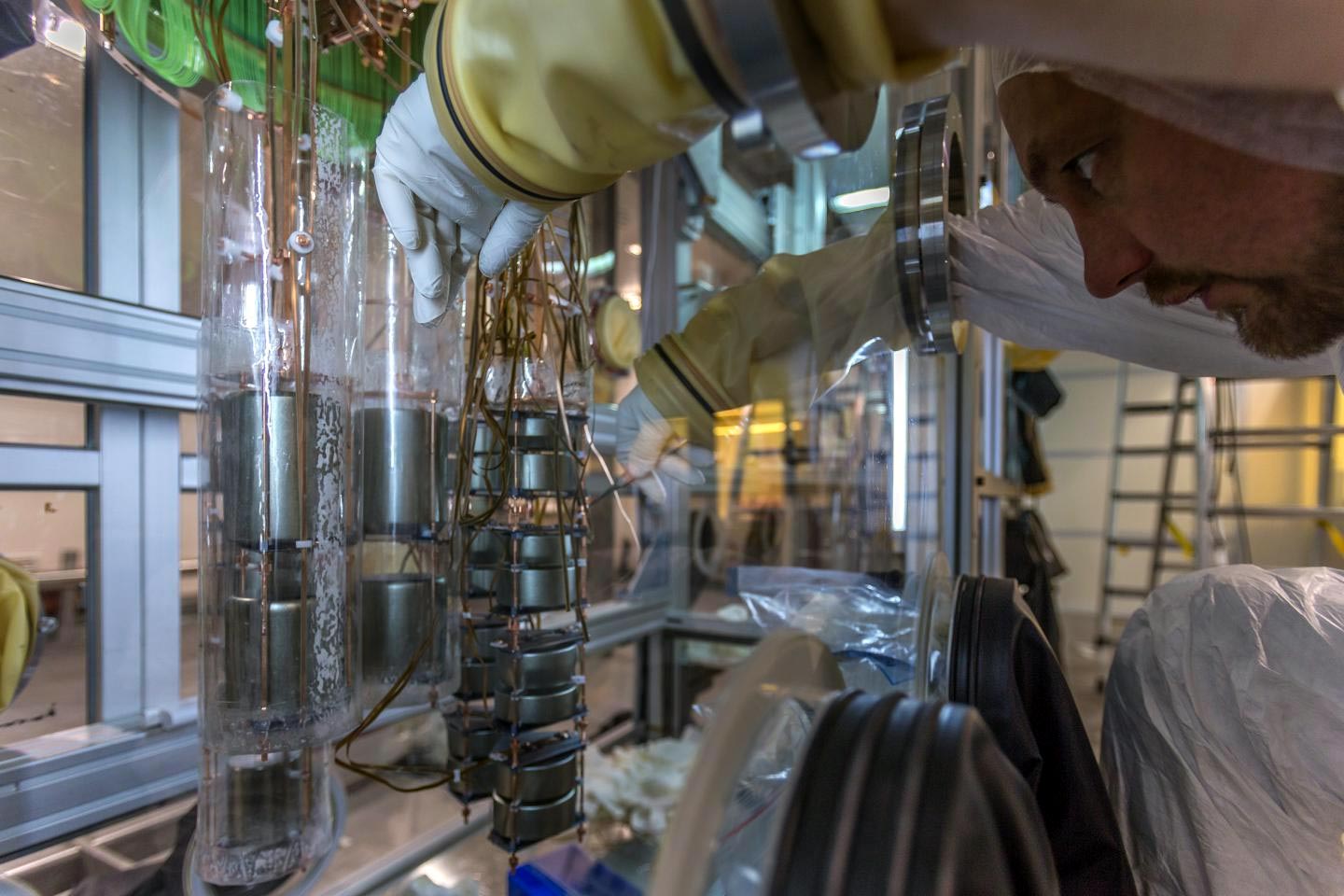
In the quest to prove that matter can be produced without antimatter, the GERDA experiment at the Gran Sasso Underground Laboratory is looking for signs of neutrinoless double beta decay. The experiment has the greatest sensitivity worldwide for detecting the decay in question. To further improve the chances of success, a follow-up project, LEGEND, uses an even more refined decay experiment.
While the Standard Model of Particle Physics has remained mostly unchanged since its initial conception, experimental observations for neutrinos have forced the neutrino part of the theory to be reconsidered in its entirety.
Neutrino oscillation was the first observation inconsistent with the predictions and proves that neutrinos have non-zero masses, a property that contradicts the Standard Model. In 2015, this discovery was rewarded with the Nobel Prize.
Are neutrinos their own antiparticles?
Additionally, there is the longstanding conjecture that neutrinos are so-called Majorana particles: Unlike all other constituents of matter, neutrinos might be their own antiparticles. This would also help explain why there is so much more matter than antimatter in the Universe.
The GERDA experiment is designed to scrutinize the Majorana hypothesis by searching for the neutrinoless double beta decay of the germanium isotope 76Ge: Two neutrons inside a 76Ge nucleus simultaneously transform into two protons with the emission of two electrons. This decay is forbidden in the Standard Model because the two antineutrinos – the balancing antimatter – are missing.
The Technical University of Munich (TUM) has been a key partner of the GERDA project (GERmanium Detector Array) for many years. Prof. Stefan Schönert, who heads the TUM research group, is the speaker of the new LEGEND project.
The GERDA experiment achieves extreme levels of sensitivity
GERDA is the first experiment to reach exceptionally low levels of background noise and has now surpassed the half-life sensitivity for the decay of 1026 years. In other words: GERDA proves that the process has a half-life of at least 1026 years, or 10,000,000,000,000,000 times the age of the Universe.
Physicists know that neutrinos are at least 100,000 times lighter than electrons, the next heaviest particles. What mass they have exactly, however, is still unknown and another important research topic.
In the standard interpretation, the half-life of the neutrinoless double beta decay is related to a special variant of the neutrino mass called the Majorana mass. Based on the new GERDA limit and those from other experiments, this mass must be at least a million times smaller than that of an electron, or in the terms of physicists, less than 0.07 to 0.16 eV/c2 [1].
Consistent with other experiments
Also, other experiments limit the neutrino mass: the Planck mission provides a limit on another variant of the neutrino mass: The sum of the masses of all known neutrino types is less than 0.12 to 0.66 eV/c2.
The tritium decay experiment KATRIN at the Karlsruhe Institute of Technology (KIT) is set up to measure the neutrino mass with a sensitivity of about 0.2 eV/c2 in the coming years. These masses are not directly comparable, but they provide a cross-check on the paradigm that neutrinos are Majorana particles. So far, no discrepancy has been observed.
From GERDA to LEGEND
During the reported data collection period, GERDA operated detectors with a total mass of 35.6 kg (78.5 lbs) of 76Ge. Now, a newly formed international collaboration, LEGEND, will increase this mass to 200 kg (440 lbs) of 76Ge by 2021 and further reduce the background noise. The aim is to achieve a sensitivity of 1027 years within the next five years.
Reference: “Probing Majorana neutrinos with double-ß decay” by M. Agostini, A. M. Bakalyarov, M. Balata, I. Barabanov, L. Baudis, C. Bauer, E. Bellotti, S. Belogurov, A. Bettini, L. Bezrukov, D. Borowicz, V. Brudanin, R. Brugnera, A. Caldwell, C. Cattadori, A. Chernogorov, T. Comellato, V. D’Andrea, E. V. Demidova, N. DiMarco, A. Domula, E. Doroshkevich, V. Egorov, R. Falkenstein, M. Fomina, A. Gangapshev, A. Garfagnini, M. Giordano, P. Grabmayr, V. Gurentsov, K. Gusev, J. Hakenmüller, A. Hegai, M. Heisel, S. Hemmer, R. Hiller, W. Hofmann, M. Hult, L. V. Inzhechik, J. Janicskó Csáthy, J. Jochum, M. Junker, V. Kazalov, Y. Kermaïdic, T. Kihm, I. V. Kirpichnikov, A. Kirsch, A. Kish, A. Klimenko, R. Kneißl, K. T. Knöpfle, O. Kochetov, V. N. Kornoukhov, P. Krause, V. V. Kuzminov, M. Laubenstein, A. Lazzaro, M. Lindner, I. Lippi, A. Lubashevskiy, B. Lubsandorzhiev, G. Lutter, C. Macolino, B. Majorovits, W. Maneschg, M. Miloradovic, R. Mingazheva, M. Misiaszek, P. Moseev, I. Nemchenok, K. Panas, L. Pandola, K. Pelczar, L. Pertoldi, P. Piseri, A. Pullia, C. Ransom, S. Riboldi, N. Rumyantseva, C. Sada, E. Sala, F. Salamida, C. Schmitt, B. Schneider, S. Schönert, A.-K. Schütz, O. Schulz, M. Schwarz, B. Schwingenheuer, O. Selivanenko, E. Shevchik, M. Shirchenko, H. Simgen, A. Smolnikov, L. Stanco, D. Stukov, L. Vanhoefer, A. A. Vasenko, A. Veresnikova, K. von Sturm, V. Wagner, A. Wegmann, T. Wester, C. Wiesinger, M. Wojcik, E. Yanovich, I. Zhitnikov, S. V. Zhukov, D. Zinatulina, A. Zschocke, A. J. Zsigmond, K. Zuber, G. Zuzel and GERDA Collaboration, 5 September 2019, Science.
DOI: 10.1126/science.aav8613
Never miss a breakthrough: Join the SciTechDaily newsletter.
Follow us on Google and Google News.