
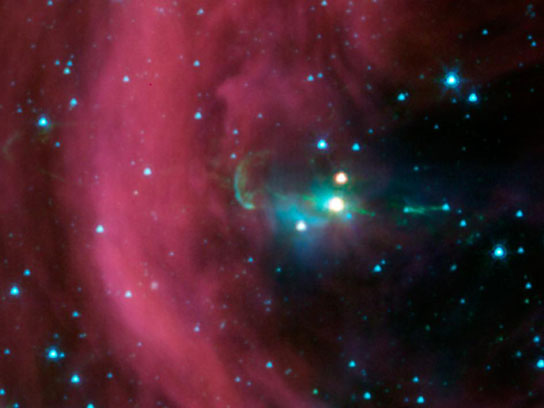
SAO astronomers provide the first unambiguous evidence that Class I masers may be excited by both young (hot core) and older (UC H II) MYSOs within the same protocluster.
Astronomers have come to realize that the process of star formation, once thought to consist essentially of just the simple coalescence of material by gravity, occurs in a complex series of stages. As the gas and dust in giant molecular clouds come together into stars, dramatic outflowing jets of material develop around each, as do circumstellar disks (possibly pre-planetary in nature). Other features are present as well: Astronomers in the 1960s were amazed to discover that these star-forming regions sometimes produce natural masers (masers are the bright, radio wavelength analogs of lasers). Clouds of water vapor or methanol vapor in regions of active star formation generate some of the most spectacular masers.
Although associated with the complex activity of star formation, the role of masers in the building of a new star is thought to be minor (although it is not understood). However masers, because they are so bright, provide valuable diagnostic probes of the regions where star formation is underway. Exactly what they reveal is less clear, but many astronomers have thought that methanol masers can signal the very earliest stages of star formation, perhaps less than about ten thousand years old.
One of the key questions masers can possibly help resolve is how stars more massive than the Sun form. Understanding the birth of such massive stars is essential not only in its own right, but also because these stars end up as supernovae that enrich the cosmos with elements essential to life. The birth of massive stars is, however, notoriously tricky to understand because their larger masses prompt the young star to mature very quickly, in less than about one hundred thousand years and much faster than lower-mass stars. As a result, many growth stages are blurred together. Masers are thought to offer a way to probe these earliest times of star formation.
SAO astronomers Claudia Cyganowski and Qizhou Zhang, with five colleagues, used the Submillmeter Array (SMA) to study regions of massive star formation identified in infrared images as having outflows typical of massive young stars. The SMA was able to identify all of the protostellar cores from their millimeter dust emission. They found one such protocluster of young stars that also contained a variety of types of methanol masers, enabling a comparative study of masers and star-formation activity.
Writing in the latest issue of the Astrophysical Journal Letters, the scientists report finding that, contrary to the conventional wisdom, methanol masers thought to be associated with very young stages of star formation are found occurring with more evolved embryos. The new results show for the first time that the mechanisms at work to make these methanol masers, shocks for example, are found in a much wider range of situations than previously suspected. The new results are not atypical of progress in astronomy.
Reference: “The Protocluster G18.67+0.03: A Test Case for Class I CH3OH Masers as Evolutionary Indicators for Massive Star Formation” by C. J. Cyganowski, C. L. Brogan, T. R. Hunter, Q. Zhang, R. K. Friesen, R. Indebetouw and C. J. Chandler, 5 November 2012, The Astrophysical Journal Letters.
DOI: 10.1088/2041-8205/760/2/L20
Never miss a breakthrough: Join the SciTechDaily newsletter.
Follow us on Google and Google News.
1 Comment
Stars give out not only light and magnetism (emitted by the electrons), and then X-rays (emitted by the innermost electrons from atoms getting shifted to higher orbits giving out enormous energy, and again gamma rays (emitted by transition in the nucleus of atoms) , heat from the molecular vibrations and lastly these molecular vibrations at a larger scale as emitted from methanol gases which are abundant to give out MASERS. Thus we have so many tools for study in physics and ethanol Masers are also one to probe. Thank You.