
Close Menu
    Facebook X (Twitter) Instagram
    SciTechDaily
    • Biology
    • Chemistry
    • Earth
    • Health
    • Physics
    • Science
    • Space
    • Technology
    Facebook X (Twitter) Pinterest YouTube RSS
    SciTechDaily
    Home»Space»NASA’s Interstellar Boundary Explorer Reveals: The Heliosphere Has Ripples!
    Space

    NASA’s Interstellar Boundary Explorer Reveals: The Heliosphere Has Ripples!

    By NASAMay 6, 2023No Comments2 Mins Read
    Facebook Twitter Pinterest Telegram LinkedIn WhatsApp Email Reddit
    Share
    Facebook Twitter LinkedIn Pinterest Telegram Email Reddit
    Boundary of Heliosphere Mapped for First Time
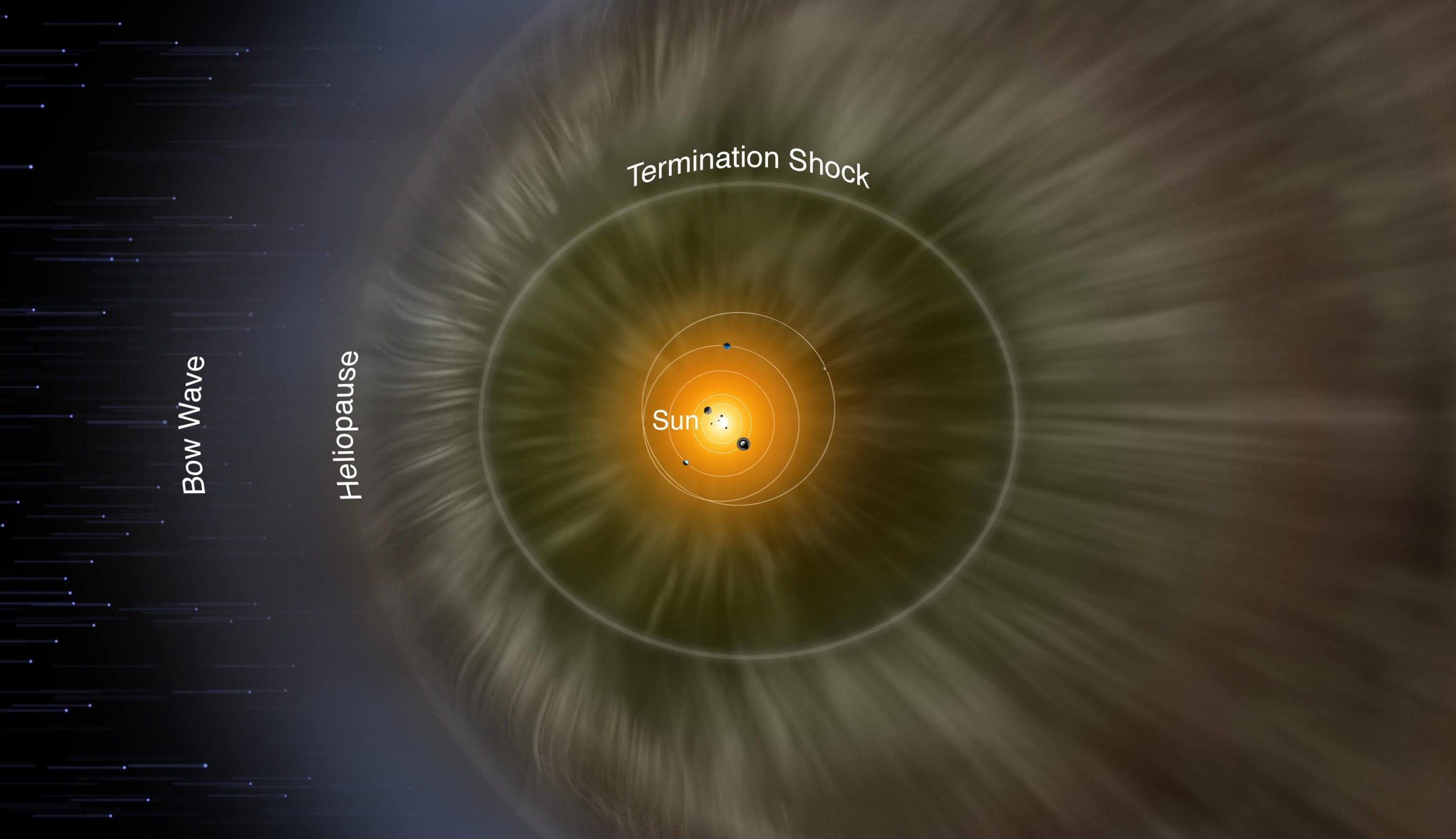
    A diagram of our heliosphere. For the first time, scientists have mapped the heliopause, which is the boundary between the heliosphere (brown) and interstellar space (dark blue). Credit: NASA/IBEX/Adler Planetarium

    NASA’s Interstellar Boundary Explorer, or IBEX mission, has helped researchers learn something new about the heliosphere – the magnetic bubble created by the Sun that we live in. It turns out, the heliosphere has ripples! These ripples also change – likely due to influences from the Sun itself.

    The paper explaining the results was published in the journal Nature Astronomy.

    Video Transcript:

    Did you know that we live in a giant magnetic bubble created by the Sun?

    This bubble is known as the heliosphere, and it was discovered in the 1950s.

    The heliosphere is huge – our best guess is that the boundary lies at least 10 billion miles from Earth!

    Scientists are still learning exactly what this bubble is shaped like, but NASA’s Interstellar Boundary Explorer, or IBEX mission, has helped researchers learn something new about it.

    They’ve found that this bubble has ripples!

    And not only that – the ripples appear to change!

    Scientists are now trying to find out why the heliosphere has this texture and why these ripples change over time.

    Scientists think these ripples could be caused by changes in the outward pressure of the solar wind, the constant stream of particles and magnetic fields flowing off the Sun.

    Since the Sun cycles between periods of high and low activity, the boundary of the heliosphere, called the heliopause, may change and oscillate over time.

    According to the researchers, the ripples on the heliopause may be caused by instabilities that evolve over the solar cycle.

    Future NASA missions will help us discover more about this mysterious bubble we live in.

    Reference: “Oblique and rippled heliosphere structures from the Interstellar Boundary Explorer” by Eric J. Zirnstein, Bishwas L. Shrestha, David J. McComas, Maher A. Dayeh, Jacob Heerikhuisen, Daniel B. Reisenfeld, Justyna M. Sokół and Paweł Swaczyna, 10 October 2022, Nature Astronomy.
    DOI: 10.1038/s41550-022-01798-6

    Never miss a breakthrough: Join the SciTechDaily newsletter.
    Follow us on Google and Google News.

    Heliosphere IBEX NASA
    Share. Facebook Twitter Pinterest LinkedIn Email Reddit

    Related Articles

    NASA Approves Two Heliophysics Missions to Explore Sun, Earth’s Aurora

    “Deflated Croissant” – Uncovering the True Shape of Our Solar System

    NASA’s Interstellar Boundary Explorer Charts 11 Years of Change to Heliosphere

    IBEX Reveals How Solar Wind Changes Our Heliosphere

    NASA’s Voyager 1 Continues to Help Solve the Interstellar Medium Mystery

    NASA’s Interstellar Boundary Explorer Provides New Details on Solar System Boundary

    IBEX Explores the Magnetic System Beyond the Solar Wind

    IBEX Reveals First View of the Solar System’s Tail, The Heliotail

    IBEX Measures Particles Outside Our Solar System

    Leave A Reply Cancel Reply

    • Facebook
    • Twitter
    • Pinterest
    • YouTube

    Don't Miss a Discovery

    Subscribe for the Latest in Science & Tech!

    Trending News

    Could Low Vitamin D Be Making Your Pain Worse?

    Scientists Discover Once-Weekly Workout That Melts Belly Fat Surprisingly Effectively

    Scientists Just Tested a Thruster Powerful Enough for Human Missions to Mars

    Doctors Say Your Ice Pack Might Be Making Injuries Worse

    Scientists Discover 43-Foot Sea Reptile Twice the Size of a Great White Shark

    Bees and Birds Are Drinking Alcohol From Flowers

    Scientists Discover How Obesity May Trigger Alzheimer’s Disease

    Scientists Confirm Alcohol Causes Widespread Health Damage

    Follow SciTechDaily
    • Facebook
    • Twitter
    • YouTube
    • Pinterest
    • Newsletter
    • RSS
    SciTech News
    • Biology News
    • Chemistry News
    • Earth News
    • Health News
    • Physics News
    • Science News
    • Space News
    • Technology News
    Recent Posts
    • Simple Family Routines May Be the Secret to a Smoother Start at School
    • Brain Study Overturns Long-Held Beliefs About How Humans Learn Speech
    • Ancient Goose Fossil Challenges Long-Held Theories About New Zealand Birds
    • A Tiny Bright-Blue Octopus Found in the Galápagos Is Completely New to Science
    • Scientists Stop Pancreatic Cancer Before It Starts in Landmark Preclinical Study
    Copyright © 1998 - 2026 SciTechDaily. All Rights Reserved.
    • Science News
    • About
    • Contact
    • Editorial Board
    • Privacy Policy
    • Terms of Use

    Type above and press Enter to search. Press Esc to cancel.