
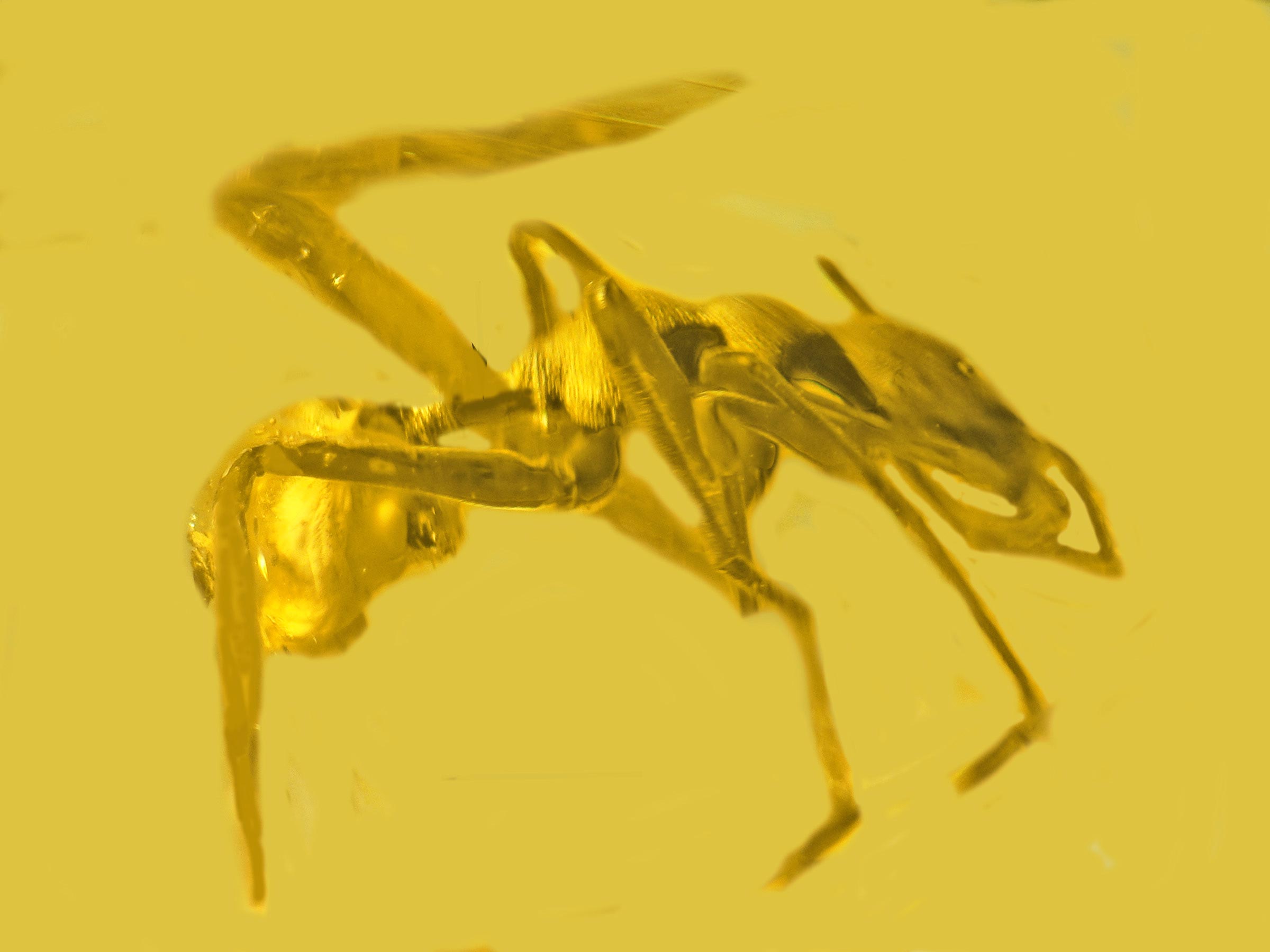
A fossilized ant-mimicking spider reveals the evolutionary tactics spiders use to avoid predators, emphasizing the adaptive benefits of mimicry in the spider kingdom.
Arachnophobia can make humans flee at the sight of a brown recluse, black widow, or even a daddy long legs, but animal predators of spiders know no such fear.
That’s why, paleobiologist George Poinar Jr. explains, some spider species have developed the defense of deception. They masquerade as a much less desirable prey – ants – and Poinar’s recent paper in Historical Biology presents an early record of an ant-mimicking spider in fossilized resin.
Ants: The Perfect Disguise for Spiders
“Ants are particularly good creatures for spiders to pretend to be – many animals find ants distasteful or dangerous to eat,” said Poinar, who has a courtesy appointment in the Oregon State University College of Science. “Ants are aggressive in their own defense – they have a strong bite as well as a stinging venom, and they can call in dozens of nestmates as allies. Spiders, meanwhile, have no chemical defenses and are loners, which makes them vulnerable to being hunted by larger spiders, wasps and birds – predators that would rather avoid ants. So if a spider can be like an ant, it’s more likely to be unbothered.”
Fossil Discovery and Evolutionary Adaptations
Spiders that disguise themselves as ants live in many locations around the globe but until now most had been able to avoid detection from fossil researchers as well as predators. The specimen that Poinar describes, which he named Myrmarachne colombiana, was entombed in a type of fossilized resin known as copal.
Copal is a less mature form of fossilized resin than amber, which is routinely dated to be 25 million or more years old. Still, copal can be up to 3 million years old.
The age of the resin in this case, however, could not be determined, said Poinar, an international expert in using plant and animal life forms preserved in amber to learn about the biology and ecology of the distant past.
The resin block he was working with, which came from Medellin, Colombia, was too small to age-test without risk of damaging the spider inside. Poinar notes there is no record of any currently living ant-mimicking spider making its home in Colombia.
“It is a challenge for spiders to accomplish this magical transformation to ants,” he said. “Ants have six legs and two long antennae, while spiders have eight legs and no antennae.”
To get around those anatomical differences, Poinar said, spiders typically position their two front legs in a way that approximates the look of antennae. But number of legs and absence/presence of antennae are not the only characteristics differentiating an ant’s appearance from a spider’s.
“The abdomen and cephalothorax of spiders are closely attached, while in ants the equivalent of these body parts are separated by a narrow segment called the petiole,” Poinar said. “And there are many other lesser structures that need to be modified in spiders for them to closely resemble ants. How is this accomplished? Most scientists say it begins with spider mutation, adaptation, and then natural selection.
“However, I think there is some spider reasoning and intelligence involved too since the spiders often model their body changes after specific ants in the same environment,” he said. “In the early days, we were told that all habits of insects were the result of instincts, but that is no longer the case.”
Spider Mimicry: A Widespread Phenomenon
Several groups of spiders have developed the ability to look and behave like various types of ants, he added. There are also spiders that try to blend in as other insects, such as flies, beetles, and wasps.
Most of the copycat spiders belong to a few families of hunting spiders, including Salticidae or jumping spiders. The specimen in the Colombian copal appears to be a jumping spider.
Spiders that practice mimicry also come from the Corinnidae (sun spider), Thomisidae (flower spider) and Zodariidae (spotted or ant spider) families.
Reference: “Myrmarachne colombiana sp. n. (Araneae: Salticidae), a new species of ant-mimic spider in copal from Colombia, South America” by George Poinar, 7 March 2024, Historical Biology.
DOI: 10.1080/08912963.2024.2320190
Never miss a breakthrough: Join the SciTechDaily newsletter.
Follow us on Google and Google News.
1 Comment
“However, I think there is some spider reasoning and intelligence involved too since the spiders often model their body changes after specific ants in the same environment,” he said.
Not sure that spiders can change their body shape (instead of just the body and leg posture) by reasoning. This attributes a level of intelligence and body adaptability which is, to me, unlikely.