
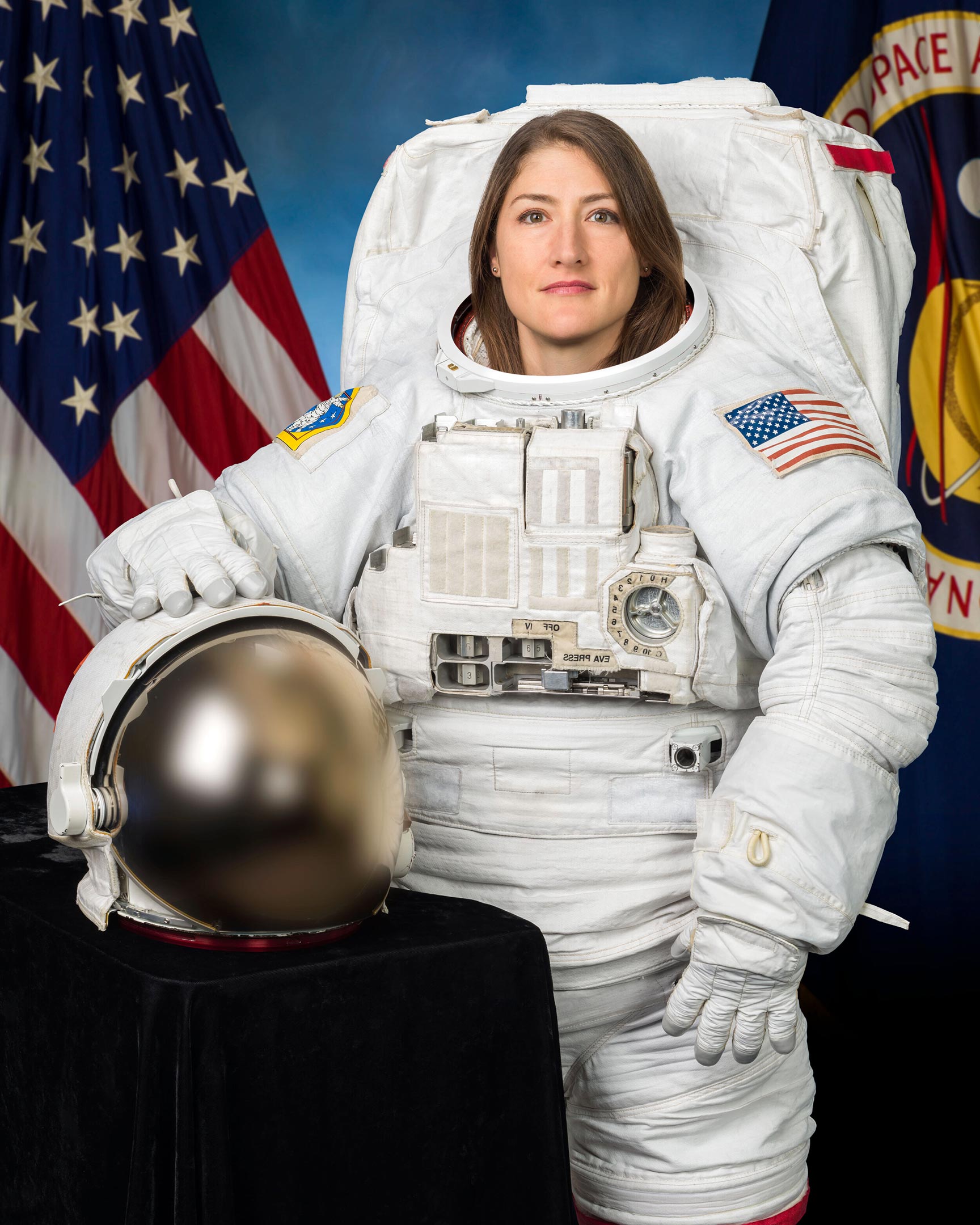
NASA astronaut Christina Koch is a member of the Artemis Team, a select group of astronauts charged with focusing on the development and training efforts for early Artemis missions.
Christina Hammock Koch was selected as an astronaut by NASA in 2013. She completed astronaut candidate training in 2015. Koch graduated from North Carolina State University with a Bachelor of Science in Electrical Engineering and Physics and a Master of Science in Electrical Engineering. She most recently served as flight engineer on the International Space Station for Expedition 59, 60 and 61. Koch set a record for the longest single spaceflight by a woman with a total of 328 days in space.
Koch’s career prior to becoming an Astronaut spanned two general areas: space science instrument development and remote scientific field engineering. Her career began as an Electrical Engineer at the NASA Goddard Space Flight Center (GSFC) Laboratory for High Energy Astrophysics, where she contributed to scientific instruments on several NASA space science missions.
Koch then became a Research Associate in the United States Antarctic Program from 2004 to 2007. This included a yearlong stay with a winter-over at the Admunsen-Scott South Pole Station and a season at Palmer Station. While in this role, she served as a member of the Firefighting and Search and Rescue Teams. From 2007 to 2009, Koch returned to space science instrument development as an Electrical Engineer at the Johns Hopkins University Applied Physics Laboratory’s Space Department. She contributed to instruments studying radiation for NASA missions, including Juno and the Van Allen Probes.
In 2010, Koch returned to remote scientific field work with tours including Palmer Station in Antarctica and multiple winter seasons at Summit Station in Greenland. In 2012, Koch continued work at remote scientific bases with the National Oceanic and Atmospheric Administration (NOAA). She served as a Field Engineer at NOAA’s Global Monitoring Division Baseline Observatory in Utqiagvik, Alaska and then as Station Chief of the American Samoa Observatory. Throughout her career, she was involved in in technical instructing, volunteer tutoring and educational outreach.
Koch participated in the NASA Academy program at Goddard Space Flight Center (GSFC) in 2001 and worked as an Electrical Engineer at GSFC from 2002 to 2004. Koch was selected in June 2013 as one of eight members of the 21st NASA astronaut class. Her Astronaut Candidate Training included scientific and technical briefings, intensive instruction in International Space Station (ISS) systems, plus training and certification in spacewalking, ISS robotics, T-38 and T-6 aircraft flight, and Russian language. In 2018, she was assigned to her first space flight, a long duration mission on the International Space Station.
Koch was a part of ISS Expeditions 59, 60 and 61. She launched on March 14, 2019 from the Baikonur Cosmodrome on a Soyuz spacecraft with NASA Astronaut Nick Hague and Russian Cosmonaut Alexey Ovchinin. She returned to Earth on February 6, 2020, on a Soyuz spacecraft with ESA Astronaut Luca Parmitano and Russian Cosmonaut Alexander Skvortsov. The crews she served on contributed to hundreds of experiments in biology, Earth science, human research, physical sciences and technology development. Some of the scientific highlights from her missions include improvements to the Alpha Magnetic Spectrometer, which studies dark matter, growing protein crystals for pharmaceutical research, and testing 3D biological printers to print tissues in microgravity. Koch conducted six spacewalks, including the first three all women spacewalks, totaling 42 hours and 15 minutes. She has spent a total of 328 days in space.
Through the Artemis program NASA and a coalition of international partners will return to the Moon to learn how to live on other worlds for the benefit of all. With Artemis missions NASA will send the first woman and the next man to the Moon in 2024 and about once per year thereafter.
Through the efforts of humans and robots, we will explore more of the Moon than ever before; to lead a journey of discovery that benefits our planet with life changing science, to use the Moon and its resources as a technology testbed to go even farther and to learn how to establish and sustain a human presence far beyond Earth.
Never miss a breakthrough: Join the SciTechDaily newsletter.
Follow us on Google and Google News.