
Close Menu
    Facebook X (Twitter) Instagram
    SciTechDaily
    • Biology
    • Chemistry
    • Earth
    • Health
    • Physics
    • Science
    • Space
    • Technology
    Facebook X (Twitter) Pinterest YouTube RSS
    SciTechDaily
    Home»Technology»Microscopic Biohybrid Robots Propelled by Muscles & Nerves Built by Researchers
    Technology

    Microscopic Biohybrid Robots Propelled by Muscles & Nerves Built by Researchers

    By University of Illinois at Urbana-ChampaignSeptember 16, 2019No Comments4 Mins Read
    Facebook Twitter Pinterest Telegram LinkedIn WhatsApp Email Reddit
    Share
    Facebook Twitter LinkedIn Pinterest Telegram Email Reddit
    Biobots
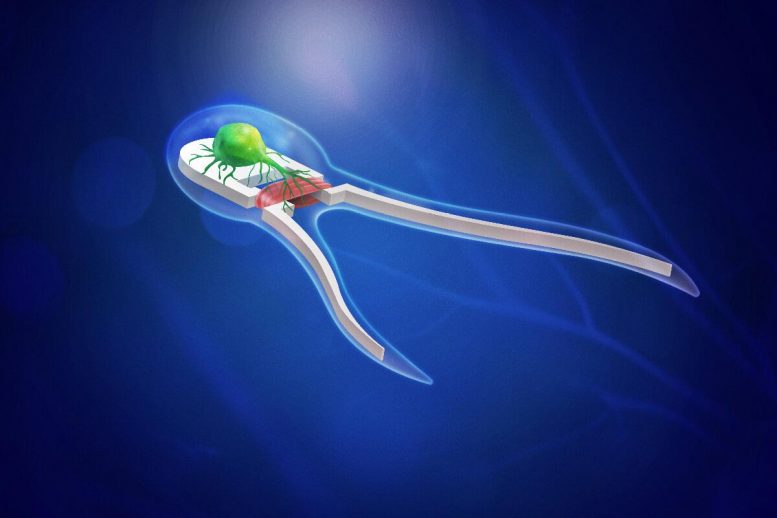
    This is an artist rendering of a new generation of biobots — soft robotic devices powered by skeletal muscle tissue stimulated by on-board motor neurons. Credit: Graphic courtesy Michael Vincent

    Researchers have developed soft robotic devices driven by neuromuscular tissue that triggers when stimulated by light — bringing mechanical engineering one step closer to developing autonomous biobots.

    In 2014, research teams led by mechanical science and engineering professor Taher Saif and bioengineering professor Rashid Bashir at the University of Illinois worked together to develop the first self-propelled biohybrid swimming and walking biobots powered by beating cardiac muscle cells derived from rats.

    “Our first swimmer study successfully demonstrated that the bots, modeled after sperm cells, could in fact swim,” Saif said. “That generation of singled-tailed bots utilized cardiac tissue that beats on its own, but they could not sense the environment or make any decisions.”

    In a new study published in the Proceedings of the National Academy of Sciences and led by Saif, the researchers demonstrate a new generation of two-tailed bots powered by skeletal muscle tissue stimulated by on-board motor neurons. The neurons have optogenetic properties: Upon exposure to light, the neurons will fire to actuate the muscles.

    “We applied an optogenetic neuron cell culture, derived from mouse stem cells, adjacent to the muscle tissue,” Saif said. “The neurons advanced towards the muscle and formed neuromuscular junctions, and the swimmer assembled on its own.”

    After confirming that the neuromuscular tissue was compatible with their synthetic biobot skeletons, the team worked to optimize the swimmer’s abilities.

    “We used computational models, led by mechanical science and engineering professor Mattia Gazzola, to determine which physical attributes would lead to the fastest and most efficient swimming,” Saif said. “For example, we looked at variations in the number of tails and tail lengths for the most efficient design of the biohybrid swimmer.”
    Biobot Research Team
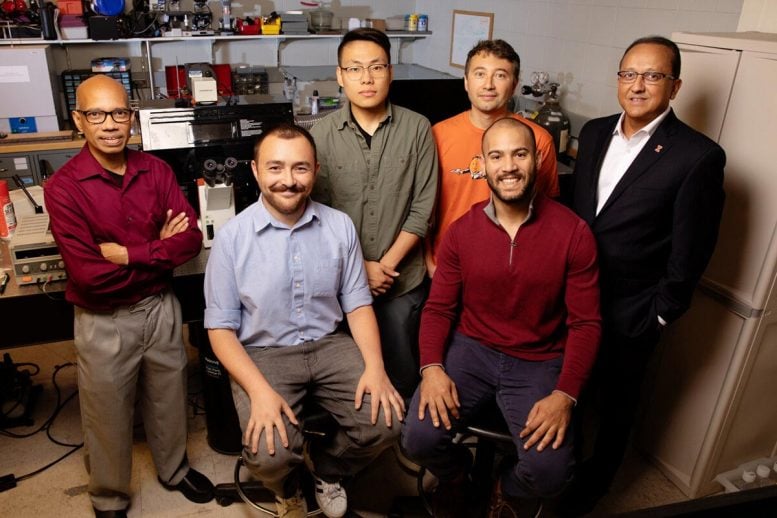
    The research team includes, from left, professor Taher Saif, graduate student Onur Aydin, graduate student Xiastian Zhang, professor Mattia Gazzola, graduate student Gelson J. Pagan-Diaz, seated, and professor and dean of the Grainger College of Engineering, Rashid Bashir. Credit: Photo by L. Brian Stauffer

    “Given the fact that biological actuators, or biobots, are not as mature as other technologies, they are unable to produce large forces. This makes their movement hard to control,” Gazzola said. “It is very important to carefully design the scaffold the biobots grow around and interact with to make the most out of technology and achieve locomotive functions. The computer simulations we run play a critical role in this task as we can span a number of possible designs and select only the most promising ones for testing in real life.”

    “The ability to drive muscle activity with neurons paves the way for further integration of neural units within biohybrid systems,” Saif said. “Given our understanding of neural control in animals, it may be possible to move forward with biohybrid neuromuscular design by using a hierarchical organization of neural networks.”

    Saif said he and his team envision this advance leading to the development of multicellular engineered living systems with the ability to respond intelligently to environmental cues for applications in bioengineering, medicine, and self-healing materials technologies.

    However, the team acknowledges that — like living organisms — no two biohybrid machines will develop to be exactly the same.

    “Just like twins are not truly identical, two machines designed to perform the same function will not be the same,” Saif said. “One may move faster or heal from damage differently from the other — a unique attribute of living machines.”

    ###

    The National Science Foundation Science and Technology Center – Emergent Behavior for Integrated Cellular Systems and NSF’s Emergent Frontiers in Research and Innovation grant supported this research.

    Reference: “Neuromuscular actuation of biohybrid motile bots” by Onur Aydin, Xiaotian Zhang, Sittinon Nuethong, Gelson J. Pagan-Diaz, Rashid Bashir, Mattia Gazzola and M. Taher A. Saif, 16 September 2019, Proceedings of the National Academy of Sciences.
    DOI: 10.1073/pnas.1907051116

    Never miss a breakthrough: Join the SciTechDaily newsletter.
    Follow us on Google and Google News.

    Biotechnology Robotics University of Illinois at Urbana-Champaign
    Share. Facebook Twitter Pinterest LinkedIn Email Reddit

    Related Articles

    Low-Cost, High-Accuracy GPS-Like System Developed for Flexible Medical Robots

    Unique Physical, Chemical Properties of Cicada Wings Revealed by Material Scientists

    New Stretchable Light-Emitting Devices Can Be Applied to Human Skin

    Two-Legged Robot Mimics Human Operator in Force-Feedback Exoskeleton Suit [Video]

    Fast-Acting Elastic Energy Robots Inspired by Chameleon’s Tongue Strike [Video]

    Army Research Into Artificial Muscle Nanomotors for More Effective Robots on the Future Battlefield

    Soft, Flexible Artificial Skin Produces a Realistic Sense of Touch [Video]

    Robotic Thread Magnetically Steered Through the Brain’s Blood Vessels [Video]

    Scientists Develop Electric Propulsion Technology for Nanorobots

    Leave A Reply Cancel Reply

    • Facebook
    • Twitter
    • Pinterest
    • YouTube

    Don't Miss a Discovery

    Subscribe for the Latest in Science & Tech!

    Trending News

    Scientists Warn That This Common Pet Fish Can Wreck Entire Ecosystems

    Scientists Make Breakthrough in Turning Plastic Trash Into Clean Fuel Using Sunlight

    This Popular Supplement May Interfere With Cancer Treatment, Scientists Warn

    Scientists Finally Solved One of Water’s Biggest Mysteries

    Could This New Weight-Loss Pill Disrupt the Entire Market? Here’s What You Should Know About Orforglipron

    Earth’s Crust Is Tearing Open in Africa, and It Could Form a New Ocean

    Breakthrough Bowel Cancer Trial Leaves Patients Cancer-Free for Nearly 3 Years

    Natural Compound Shows Powerful Potential Against Rheumatoid Arthritis

    Follow SciTechDaily
    • Facebook
    • Twitter
    • YouTube
    • Pinterest
    • Newsletter
    • RSS
    SciTech News
    • Biology News
    • Chemistry News
    • Earth News
    • Health News
    • Physics News
    • Science News
    • Space News
    • Technology News
    Recent Posts
    • Ancient Roman Ship Coating Reveals Secrets Hidden for 2,200 Years
    • Enormous Prehistoric Insects Puzzle Scientists
    • College Student Identifies Bizarre New Carnivorous Dinosaur Three Times Older Than T. rex
    • The Most Effective Knee Arthritis Treatments Aren’t What You Expect
    • Scientists Develop Bioengineered Chewing Gum That Could Help Fight Oral Cancer
    Copyright © 1998 - 2026 SciTechDaily. All Rights Reserved.
    • Science News
    • About
    • Contact
    • Editorial Board
    • Privacy Policy
    • Terms of Use

    Type above and press Enter to search. Press Esc to cancel.