
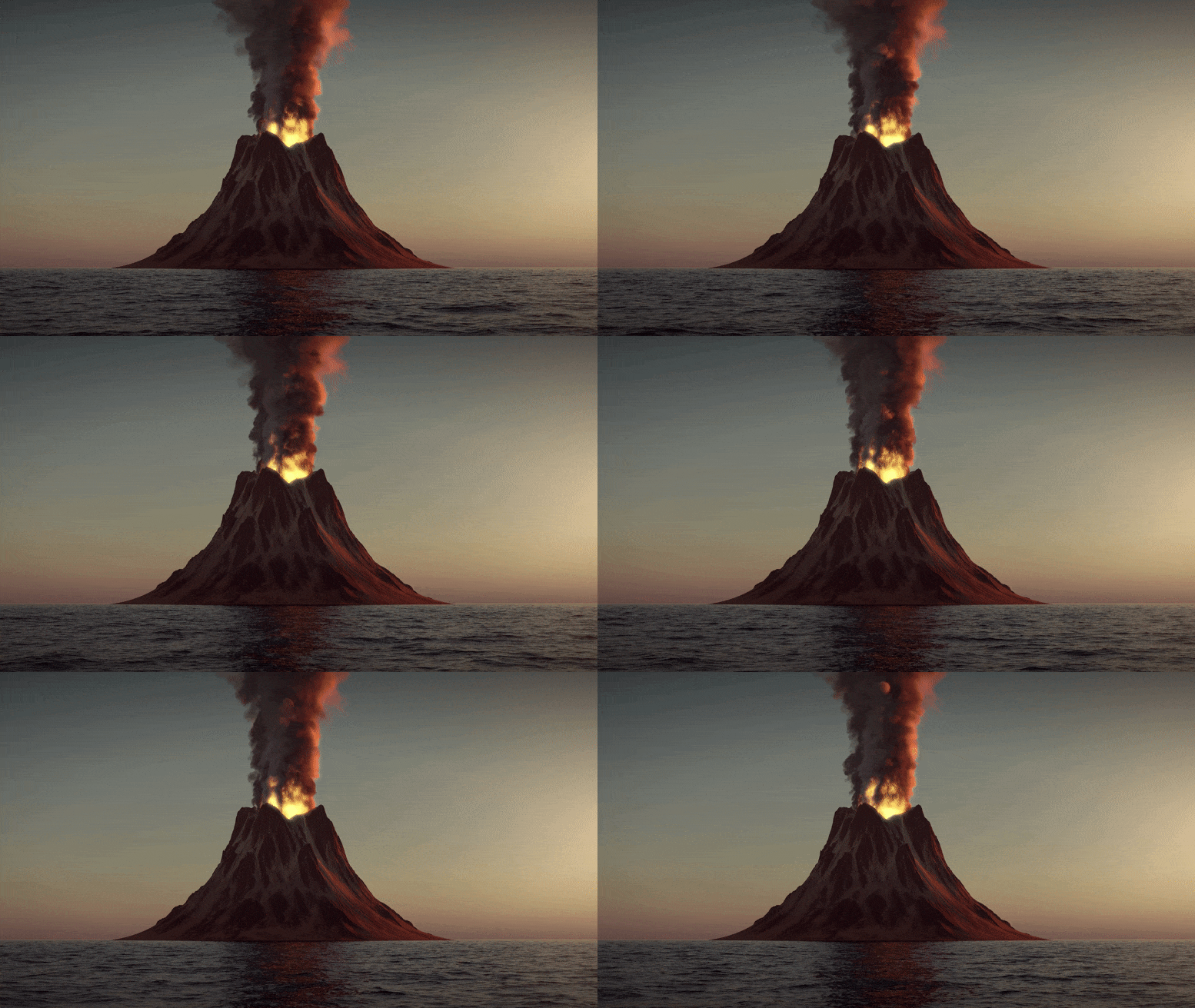
Predicting Supervolcano Eruptions Remains Elusive
Scientists say it is extremely challenging to try and predict when a supervolcano might erupt again due to the sheer diversity of events that have gone before.
Writing in Nature Reviews Earth and Environment, the team says there is not a single model which can describe how these catastrophic events play out, making it extremely difficult to determine how supervolcanoes may erupt in the future.
Supervolcanoes are defined as a volcanoes that have had at least one explosion of magnitude 8, the highest ranking on the Volcanic Explosivity Index, or VEI, meaning it has released more than 1000 cubic kilometers (240 cubic miles) of material.
When these huge volcanic systems explode, the associated ‘supereruption’ represents the most catastrophic of events caused by a natural hazard, resulting in widespread ash-fall blankets and ground-hugging pyroclastic flows, which can be hundreds of meters thick, covering thousands to tens of thousands of square kilometers.
Understanding the Geological Footprint
These events also leave huge holes in the ground called Calderas due to the collapse of the Earth’s surface through removal of such large volumes of magma.
However, these events are extremely rare, occurring roughly once every 100,000 years. To date, there are no unique explanations for the mechanisms, timings and extreme volumes of supereruptions.
In their study, the team, including scientists from Cardiff University, performed an in-depth review of field, geochemical and petrological evidence from 13 supereruptions that have occurred over the last two million years. They also reviewed geophysical studies of modern volcanic systems which provide a complimentary current snapshot of the magmatic system.
The events ranged from the most recent eruption at the Taupō volcano in New Zealand, over 24,000 years ago, to the oldest at Yellowstone in the USA roughly two million years ago.
Analysis of the data revealed no single, unified model that described how each of the 13 events played out and showed that the supereruptions could start mildly over weeks to months or go into vigorous activity immediately. Individual supereruptions could occupy periods of days to weeks, or be prolonged over decades.
A Kaleidoscope of Eruption Styles
Evidence from the Youngest Toba Tuff, Indonesia, which erupted 74,000 years ago, suggests the eruption began abruptly, with immediate collapse of the chamber roof. In contrast, the Oruanui eruption, New Zealand, which erupted 25,400 years ago, started slowly, depositing a large ash blanket before Caldera collapse, and progressed intermittently including pauses of several months.
The source of the magma that eventually spews out from the volcano also varies, from single bodies of magma to multiple magma bodies that are simultaneously or sequentially tapped.
“Supereruptions can start literally with a bang and collapse of the chamber roof or begin gradually, with hesitancy before escalating into catastrophic activity,” said co-author of the study Dr. George Cooper, from Cardiff University’s School of Earth and Environmental Sciences.
“Overall, the eruption can be rapid, uninterrupted events over a few days or an episodic sequence prolonged over decades.
“The uncertainty associated with these events, therefore, makes it very challenging to determine when and how these volcanos may potentially erupt in the future.”
The team has called on more research to be undertaken to help answer these questions, including the use of machine learning algorithms situated at monitoring stations to help interpret signals that show the movement of stored magma towards the surface in the hours or days leading up to an eruption.
They also call for more education amongst the public, specifically regarding the nature and frequency of eruptions at these large volcanoes.
“Yellowstone is an example where misinformation has led to the public perception that a catastrophic eruption may be imminent, whereas, in reality, it is extremely unlikely. Therefore, we need to improve our understanding and communication as to the difference between normal non-eruptive unrest, versus indicators that an eruption may be about to happen,” continued Dr. Cooper.
Reference: “No single model for supersized eruptions and their magma bodies” by Colin J. N. Wilson, George F. Cooper, Katy J. Chamberlain, Simon J. Barker, Madison L. Myers, Finnigan Illsley-Kemp and Jamie Farrell, 27 July 2021, Nature Reviews Earth & Environment.
DOI: 10.1038/s43017-021-00191-7
Never miss a breakthrough: Join the SciTechDaily newsletter.
Follow us on Google and Google News.
4 Comments
“Tipping Point”: Most over-used phrase of the 21st century.
I’m confused…according to my research only yellowstone has had a vei 8 all the others are 7 and below so how are those super eruptions?
“… all the others are 7 and below so how are those super eruptions?”
I think that you are mistaken that Yellowstone is the largest volcanic eruption.
The index is a logarithmic scale of the volume erupted.
https://en.wikipedia.org/wiki/Volcanic_Explosivity_Index
See also:
https://en.wikipedia.org/wiki/Supervolcano
Nicely written article and not misleading or “sensational.” I find Volcanoes absolutely fascinating and want to learn more about them continuously.