
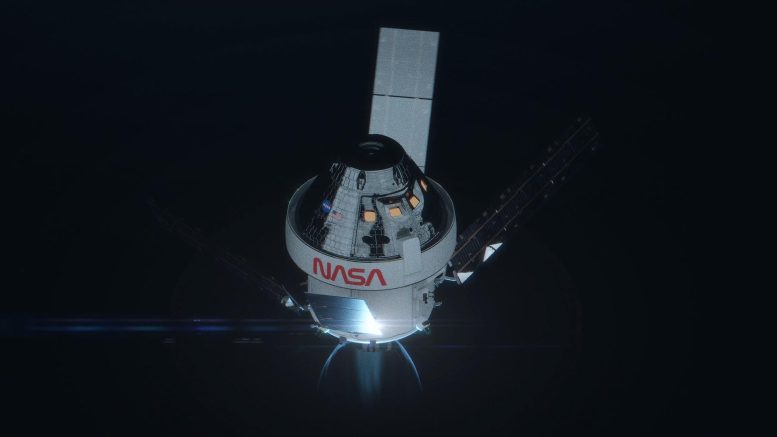
NASA Artemis I – Flight Day 19: Orion Prepares for Close Lunar Flyby, Teams Examining Power Conditioning Issue
On Flight Day 19 of the Artemis I mission, Orion performed the second return trajectory correction burn on Sunday, December 4, at 10:43 a.m. CST, using the auxiliary thrusters and increasing the spacecraft’s velocity by 1.16 mph (1.71 feet per second).
Orion experienced an issue with a power conditioning distribution unit (PCDU) shortly after acquiring signal with the Deep Space Network’s Canberra ground station at 12:41 a.m. CST. Specifically, the problem was that four of the latching current limiters responsible for downstream power suddenly switched off. These lower-level switches connect to the propulsion and heater subsystems. After teams confirmed the system was healthy, they successfully repowered the downstream components. There was no interruption of power to any critical systems, and there were no adverse effects on Orion’s navigation or communication systems.
Teams are examining whether a potential contributor to this issue is related to a power configuration test implemented by the flight teams to investigate previous instances in which one of eight umbilical latching current limiter units opened without a command. The umbilical was successfully commanded closed each time and there was no loss of power flowing to avionics on the spacecraft.
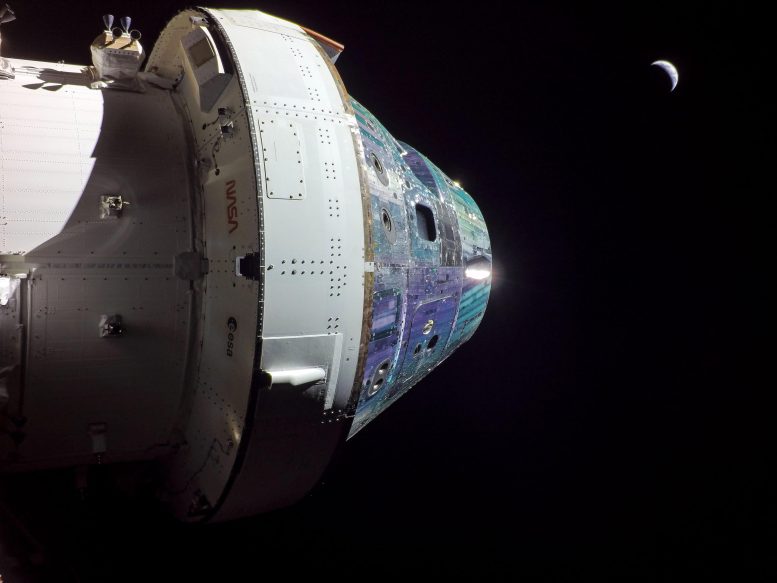
The spacecraft obtained additional data using its optical navigation system, which is a sensitive camera to take images of the Moon and Earth to help orient the spacecraft by looking at the size and position of the celestial bodies in the images. Engineers also continue to work plans to accomplish several additional test objectives during Orion’s journey back to Earth. A host of test objectives provide information to engineers about how Orion operates in space, allowing them opportunities to validate performance models and learn as much as possible about the spacecraft.
In preparation for Orion’s return to Earth, the team from NASA’s Exploration Ground Systems Program and the U.S. Navy, who will recover Orion from the Pacific Ocean, completed its final training day at sea, using a mock capsule in the water for divers and small boats to practice open water recovery procedures.
On Monday, December 5, Orion will make its closest approach to the Moon, flying 79.2 miles above the lunar surface. It will perform the return powered flyby burn at 10:43 a.m. CST, which will last about 3 minutes and 27 seconds, changing the velocity of the spacecraft by approximately 655 mph (961 feet per second) or 1,054 km/h (293 meters per second). The return powered flyby is the last large maneuver of the mission, with only smaller trajectory corrections to target Earth remaining.
Live coverage of the close lunar flyby and burn will begin at 8 a.m. CST on NASA TV, the agency’s website, and the NASA app. During the coverage, lighting will be different than it was during Orion’s initial close lunar flyby on November 21. The spacecraft will lose communications with Earth for approximately 31 minutes beginning at 10:40 a.m. CST, as it flies behind the far side of the Moon.
At 4 p.m. CST on December 5, NASA leaders will discuss the results of the return powered flyby burn and the deployment of recovery assets to sea ahead of Orion’s splashdown on December 11. Live coverage will be available on all NASA channels.
Just after 4:30 p.m. CST on December 4, Orion was traveling 222,213 miles (357,617 km) from Earth and 23,873 miles (38,420 km) from the Moon, cruising at 3,076 mph (4,950 km/h).
Never miss a breakthrough: Join the SciTechDaily newsletter.
Follow us on Google and Google News.
12 Comments
I have the solution to power problems on Earth and beyond. I developed a magnet motor that produces usable torque and RPM and will end the need to plug-in or have a power grid. Every building and EV can be 100% self producing green energy. Please contact me for further information.
Is your last name Galt?
I’m interested
The lag in power is quite rational,so can be corrected in the Deep Space Network System linking Artemis 1 Orion spacecraft to JWST to Voyager 1.Thanks to the Einstein’s Field Equation working good with Star Dynamics.
Female astronauts have fewer opportunities in space than men because of strict lifetime radiation exposure restrictions, A six-month mission on the International Space Station exposes astronauts to 40 times the average yearly dose of background radiation that a person would receive living on Earth,
A six-month mission on the International Space Station exposes astronauts to 40 times yearly dose of background radiation that a person would receive on Earth,
While the level of risk allowed for women becouse they have a lower threshold for space radiation exposure than men,
“Depending on when you fly a space mission, a female will fly only 45 to 50 percent of the missions that a male can fly,”
And what happened to putting the best candidates in space like we did in the ’60s when we had a head-to-head competition to determine who had the best ability for which Mission instead of trying to fill political agendas to put a person of color and a female on the moon!
I developed a self cooling cup holder capable of keeping a 24 ounce beer cold for as long as it should be. Works well with those NASA approved under garments. Happy holidays!!!
Not a star in sight!
So fake.
You obviously know nothing about cameras and contrasting light intensities. Educate yourself the next time before showing your ignorance.
Alex, due to the lighting conditions in the photos, camera settings need to be set to avoid over exposure. Faint light light sources like stars would, therefore, not be visjble.
Alex, shine a really bright spotlight (bright as the sun) under the eave a house some clear night. Take your camera and take a shot of the sky with that lit portion of the eave in the frame. See if you can spot stars in the image. Note that the side of the vehicle, visible in the image is in full sun. If there were stars shown, I’d say the image was doctored.
In the end there will be no limitless energy or super motors etc
WHY? Because BIG BUSINESS can’t come up with an excuse to raise rates and infinitum when the generating medium is behaving as designed.
Just like grid and infrastructure
100 years of billing u to DEATH and no investment in it’s upkeep or improvement. Business as usual
Poor conspiracy driven Alex. And how many stars can YOU see during the day?