
Close Menu
    Facebook X (Twitter) Instagram
    SciTechDaily
    • Biology
    • Chemistry
    • Earth
    • Health
    • Physics
    • Science
    • Space
    • Technology
    Facebook X (Twitter) Pinterest YouTube RSS
    SciTechDaily
    Home»Space»NASA Artemis I: Orion Spacecraft Fine-Tunes Trajectory and Downlinks Data
    Space

    NASA Artemis I: Orion Spacecraft Fine-Tunes Trajectory and Downlinks Data

    By NASADecember 3, 2022No Comments3 Mins Read
    Facebook Twitter Pinterest Telegram LinkedIn WhatsApp Email Reddit
    Share
    Facebook Twitter LinkedIn Pinterest Telegram Email Reddit
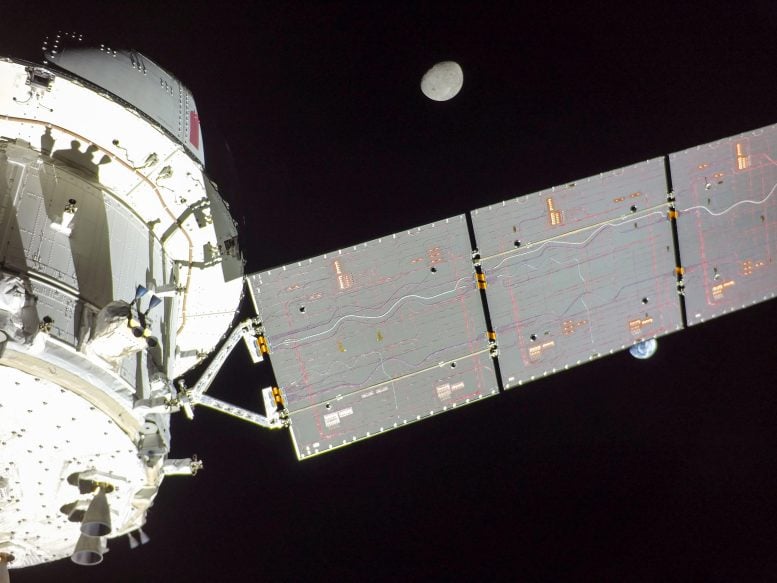
    Orion's Solar Array Divides Earth and Moon
    Orion’s solar arrays split the difference between Earth and the Moon on flight day 14 of the Artemis I mission in this image captured by a camera on the tip of one of the spacecraft’s four solar arrays. Credit: NASA

    After departing distant retrograde orbit on the afternoon of Thursday, December 1, Orion completed a planned trajectory correction burn to fine-tune its course toward the Moon. The five-second burn (see video below) occurred at 9:54 p.m. CST on Thursday, and changed the spacecraft’s velocity by about 0.3 mph or less than half a foot per second.

    On Artemis I, Flight Day 17 (Friday, December 2), teams collected additional images with Orion’s optical navigation camera and downlinked a wide variety of data files to the ground. This included downloading data from the Hybrid Electronic Radiation Assessor, or HERA. The radiation detector measures charged particles that pass through its sensors.

    Measurements from HERA and several other radiation-related sensors and experiments aboard Artemis I will help NASA better understand the space radiation environment future crews will experience and develop effective protections. On crewed missions, HERA will be part of the spacecraft’s caution and warning system and will sound a warning in the case of a solar energetic particle event, notifying the crew to take shelter. NASA is also testing a similar HERA unit aboard the International Space Station (ISS).

    Orion carries other experiments to gather data on radiation, including several radiation area monitors about the size of a matchbox that record the total radiation dose during the mission, dosimeters provided by ESA (European Space Agency) mounted inside the cabin to collect radiation data with time stamps to allow scientists to assess dose rates during various mission phases, and three “purposeful passengers” collecting additional information on what crews will experience during future missions. Four space biology investigations, collectively called Biology Experiement-1, are examining the impact of deep space radiation on seeds, fungi, yeast, and algae.

    Orion will reenter the lunar sphere of influence on Saturday, December 3, making the Moon the main gravitational force acting on the spacecraft. It will exit the lunar sphere of influence for a final time on Tuesday, December 6, one day after its return powered flyby about 79 miles (127 km) above the lunar surface.
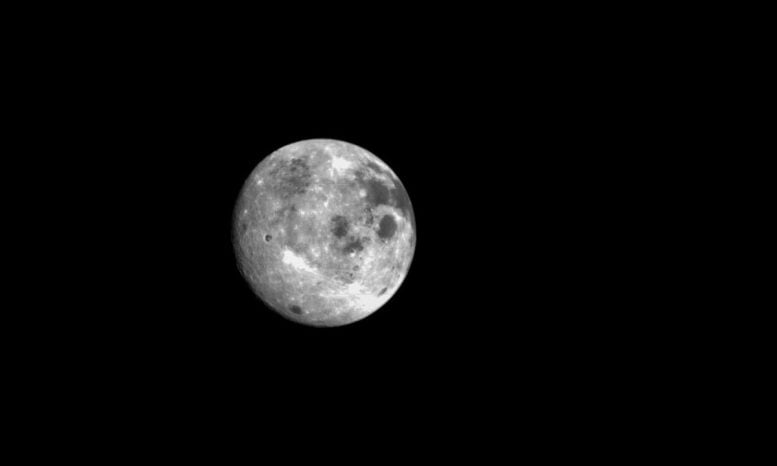
    Orion's Optical Navigation Camera Captures Moon
    Orion’s optical navigation camera captured this image of the Moon on flight day 16 of the Artemis I mission. Orion uses the optical navigation camera to capture imagery of the Earth and the Moon at different phases and distances, providing an enhanced body of data to certify its effectiveness under different lighting conditions as a way to help orient the spacecraft on future missions with crew. Credit: NASA

    A total of about 7,940 pounds of propellant has been used, which is about 150 pounds less that the amount expected before launch. Approximately 2,040 pounds of margin is available beyond what flight controllers plan to use for the remainder of the mission, which is nearly 130 pounds more than expected amounts before launch. About 97 gigabytes of data have been sent to the ground by the spacecraft.

    Just after 1 p.m. CST on December 2, Orion was traveling 229,812 miles (369,847 km) from Earth and 50,516 miles (81,298 km) from the Moon, cruising at 2,512 miles per hour (4,043 km/h).

    Never miss a breakthrough: Join the SciTechDaily newsletter.
    Follow us on Google and Google News.

    ARTEMIS Mission NASA Orion Spacecraft
    Share. Facebook Twitter Pinterest LinkedIn Email Reddit

    Related Articles

    NASA’s Super Guppy Arrives in California With Key Component for Artemis Moon Mission

    One Step Closer: Orion Spacecraft Stacked on Top SLS Rocket for NASA’s Artemis I Mission

    A European Push to the Moon and Beyond

    Artemis I: NASA’s Bold Plans to Travel Beyond the Moon [Video]

    Welding Underway on Orion Crew Module for First Artemis Mission Landing Astronauts on the Moon

    Orion Spacecraft Ready to Fuel Up for NASA’s Artemis I Mission Beyond the Moon

    NASA Selects New Orion Program Manager: Catherine Koerner

    Orion Spacecraft Passes Tests – Ready for Final Artemis I Launch Preparations

    Orion Spacecraft Returns to Kennedy Space Center for Final Preparations Before Artemis I Launch

    Leave A Reply Cancel Reply

    • Facebook
    • Twitter
    • Pinterest
    • YouTube

    Don't Miss a Discovery

    Subscribe for the Latest in Science & Tech!

    Trending News

    AI Could Detect Early Signs of Alzheimer’s in Under a Minute – Far Before Traditional Tests

    What if Dark Matter Has Two Forms? Bold New Hypothesis Could Explain a Cosmic Mystery

    This Metal Melts in Your Hand – and Scientists Just Discovered Something Strange

    Beef vs. Chicken: Surprising Results From New Prediabetes Study

    Alzheimer’s Breakthrough: Scientists Discover Key Protein May Prevent Toxic Protein Clumps in the Brain

    Quantum Reality Gets Stranger: Physicists Put a Lump of Metal in Two Places at Once

    Scientists May Have Found the Key to Jupiter and Saturn’s Moon Mystery

    Scientists Uncover Brain Changes That Link Pain to Depression

    Follow SciTechDaily
    • Facebook
    • Twitter
    • YouTube
    • Pinterest
    • Newsletter
    • RSS
    SciTech News
    • Biology News
    • Chemistry News
    • Earth News
    • Health News
    • Physics News
    • Science News
    • Space News
    • Technology News
    Recent Posts
    • Ancient “Rock” Microbes May Reveal How Complex Life Began
    • Hidden “Trade Winds” Inside Cells Could Explain Cancer Spread
    • Humans Owe Their Eyes to a Tiny One-Eyed “Cyclops”
    • Researchers Capture Quantum Interference in One of Nature’s Rarest Atoms
    • Ancient DNA Reveals Irish Goats Have a 3,000-Year-Old Lineage Still Alive Today
    Copyright © 1998 - 2026 SciTechDaily. All Rights Reserved.
    • Science News
    • About
    • Contact
    • Editorial Board
    • Privacy Policy
    • Terms of Use

    Type above and press Enter to search. Press Esc to cancel.