
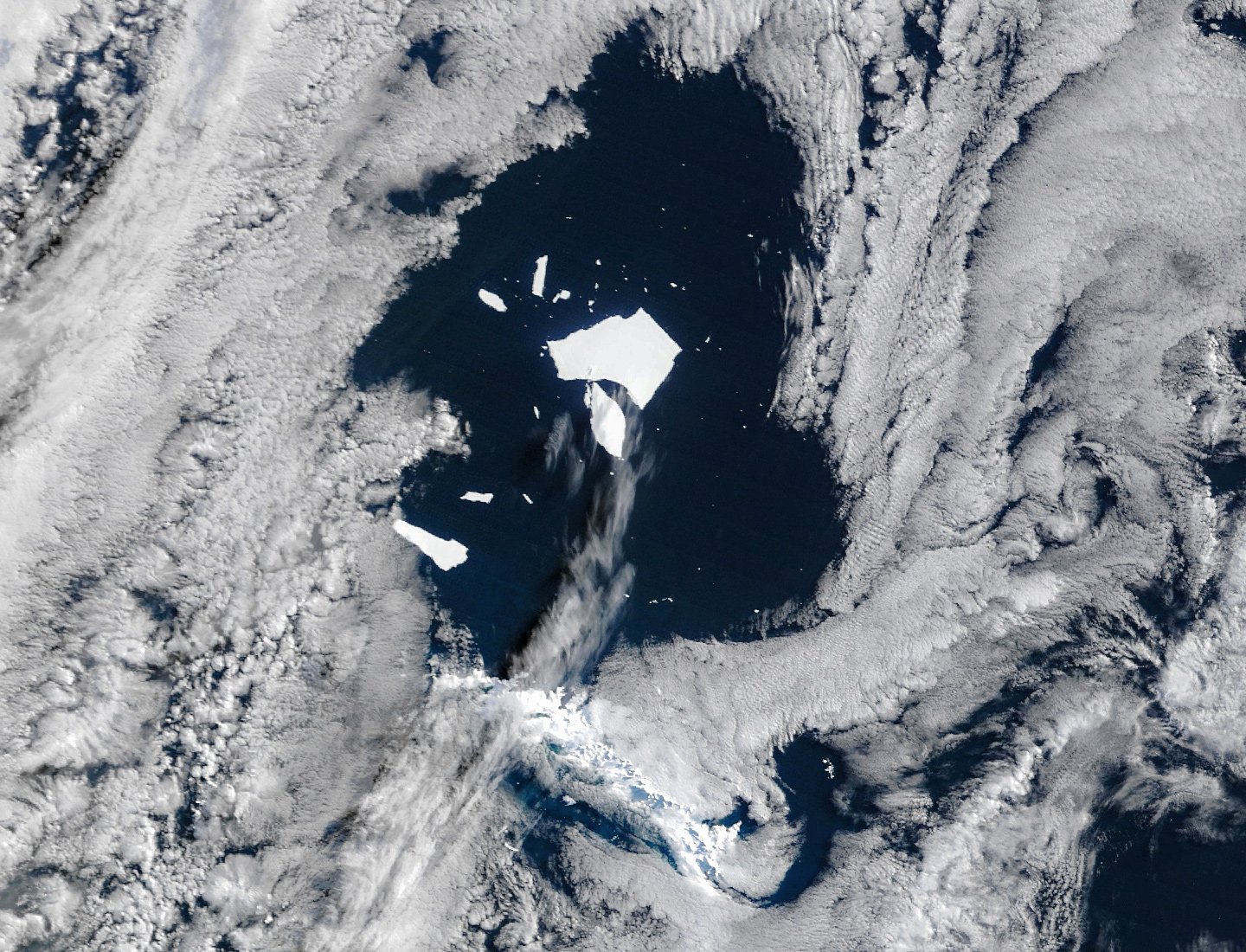
Once the world’s largest iceberg, A-23A is finally succumbing to the Southern Ocean.
After breaking free from Antarctica in 1986, it remained grounded for decades before beginning a turbulent northward journey. NASA’s satellites have been tracking its slow unraveling as it splinters into massive offspring and countless smaller bergs, some drifting dangerously into shipping lanes.
A Giant Iceberg Nears Its End
Like countless icebergs that drift away from Antarctica into the South Atlantic, Iceberg A-23A is slowly breaking apart with the arrival of spring in the Southern Hemisphere. What makes this event remarkable is that it marks the approaching end of one of the largest and longest-lasting icebergs on record.
On September 11, 2025, NASA’s Terra satellite captured an image with its MODIS (Moderate Resolution Imaging Spectroradiometer) instrument, revealing the steady breakup of A-23A. The largest surviving piece measured just over 1,500 square kilometers (580 square miles). Despite its immense size, making it the world’s second-largest iceberg still afloat at the time, the berg had already lost nearly two-thirds of its original area since it began its northward journey from Antarctica several years earlier.
Splintering Into Giant Offspring
Close by, additional massive fragments that split from A-23A could be seen. At the time of the image, Iceberg A-23G covered 324 square kilometers (125 square miles), while Iceberg A-23I stretched across 344 square kilometers (133 square miles). The U.S. National Ice Center is responsible for naming, monitoring, and documenting Antarctic icebergs that reach at least 20 square nautical miles (69 square kilometers) in area or 10 nautical miles (19 kilometers) in length.
These breakups were first spotted in satellite observations by Jan Lieser of Australia’s Bureau of Meteorology and Christopher Shuman of the University of Maryland (retired). Their findings were later verified by Britney Fajardo of the U.S. National Ice Center using imagery collected by MODIS.
Hidden Dangers in Smaller Icebergs
“We can see and monitor these large icebergs—including A-23A and its named offspring—quite well with spaceborne sensors,” Lieser said. However, he noted that these behemoths often shed thousands of small- to medium-sized icebergs that can drift far from their source and into shipping lanes.
The Landsat satellites can observe some of these smaller icy fragments when weather permits, as can synthetic aperture radar (SAR) systems, which “see” icebergs during the polar night and in all weather conditions. Instruments like these provide less frequent but higher-resolution imagery that complements daily observations from MODIS on the Terra and Aqua satellites.
A-23A’s Long and Strange Journey
Before Iceberg A-23A began disintegrating, it survived a long journey of starts and stops. After breaking from the Filchner Ice Shelf in 1986, it lodged on the seafloor of the southern Weddell Sea for decades. It finally broke free in the early 2020s and began drifting northward. In March 2024, it was caught in a rotating ocean vortex in the Drake Passage, only to spin out and become lodged again—this time on the shallow coastal shelf south of South Georgia Island in May 2025.
After freeing itself once more, the iceberg drifted to its current location north of the island on what might be its final ride. Like so many other large bergs that have ventured into “iceberg alley,” it will eventually succumb to the relentless effects of warmer air and water.
NASA Earth Observatory image by Michala Garrison, using MODIS data from NASA EOSDIS LANCE and GIBS/Worldview.
Never miss a breakthrough: Join the SciTechDaily newsletter.
Follow us on Google and Google News.