
Close Menu
    Facebook X (Twitter) Instagram
    SciTechDaily
    • Biology
    • Chemistry
    • Earth
    • Health
    • Physics
    • Science
    • Space
    • Technology
    Facebook X (Twitter) Pinterest YouTube RSS
    SciTechDaily
    Home»Earth»NASA’s ECOSTRESS Detects Amazon Fires from International Space Station
    Earth

    NASA’s ECOSTRESS Detects Amazon Fires from International Space Station

    By Esprit Smith, Jet Propulsion LaboratoryAugust 29, 20191 Comment2 Mins Read
    Facebook Twitter Pinterest Telegram LinkedIn WhatsApp Email Reddit
    Share
    Facebook Twitter LinkedIn Pinterest Telegram Email Reddit
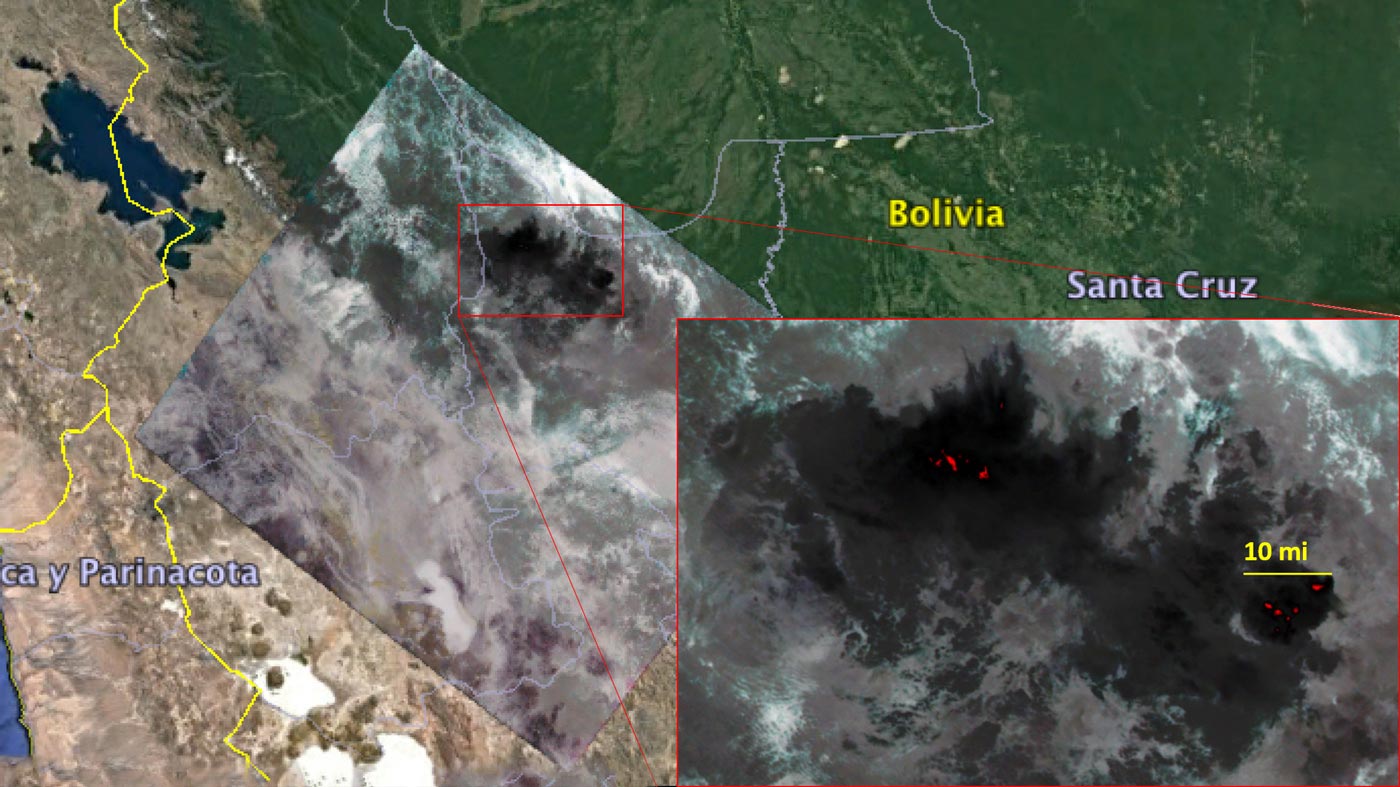
    ECOSTRESS Imagery of Fires Burning in the Bolivian Amazon
    ECOSTRESS imagery of fires burning in the Bolivian Amazon on August 23, 2019. Red areas show regions hotter than the sensor was designed to measure (approximately 220 degrees Fahrenheit, or 104 degrees Celsius). Dark wispy areas indicate thick smoke. Credit: NASA/JPL-Caltech

    NASA’s Ecosystem Spaceborne Thermal Radiometer Experiment on Space Station (ECOSTRESS) captured imagery of fires in the Amazon regions of Brazil and Bolivia on August 23, 2019.

    The red areas in the images – in eastern Bolivia and northern Brazil – are where surface temperatures exceeded the maximum measurable temperature of the instrument’s sensor (approximately 220 degrees Fahrenheit, or 104 degrees Celsius), highlighting the burning areas along the fire fronts. The dark, wispy areas indicate thick smoke – thick enough to obscure much of the fire from view. The measurements cover areas of about 77 by 77 yards (70 by 70 meters) each, or about the size of a football field.

    ECOSTRESS Imagery of Fires Burning in the Brazilian Amazon
    ECOSTRESS imagery of fires burning in the Brazilian Amazon on August 23, 2019. Red areas show regions hotter than the sensor was designed to measure (approximately 220 degrees Fahrenheit, or 104 degrees Celsius). Dark wispy areas indicate thick smoke. Credit: NASA/JPL-Caltech

    The primary mission of ECOSTRESS is to measure the temperature of plants from the vantage point of the International Space Station. However, it can also detect other heat-related phenomena like heat waves, volcanoes and fires. Due to the space station’s unique orbit, ECOSTRESS acquires imagery of the same areas at different times of day as it passes by overhead – instead of crossing over each area at the same time of day like satellites in some other orbits do. This is particularly important when trying to acquire cloud-free imagery over perennially cloudy areas like the Amazon.

    ECOSTRESS launched to the space station on June 29, 2018. NASA’s Jet Propulsion Laboratory in Pasadena, California, built and manages the ECOSTRESS mission for the Earth Science Division in the Science Mission Directorate at NASA Headquarters in Washington. ECOSTRESS is an Earth Venture Instrument mission; the program is managed by NASA’s Earth System Science Pathfinder program at NASA’s Langley Research Center in Hampton, Virginia.

    Never miss a breakthrough: Join the SciTechDaily newsletter.
    Follow us on Google and Google News.

    Amazon JPL NASA Wildfires
    Share. Facebook Twitter Pinterest LinkedIn Email Reddit

    Related Articles

    NASA Monitors Atmospheric Carbon Monoxide From California Wildfires

    NASA Tracks California’s Wildfires From Space and in the Air

    NASA Finds Conditions Ripe for Active Amazon Fire, Atlantic Hurricane Seasons

    NASA’s Terra Satellite Sees Arizona’s Massive Bighorn Fire Burn Scar From Space

    NASA: Amazon Fires Were Fueled by Drought-Stressed Forest

    Human Activities Are Drying Out the Amazon – Ecosystems Vulnerable to Fires and Drought

    NASA’s Terra Satellite Images California’s Kincade Fire Burn Scar From Space

    NASA Satellite Image: Amazon Fires Shroud South America in Smoke

    Carbon Monoxide From Brazil Fires Mapped by NASA Satellite

    1 Comment

    1. Walter on August 29, 2019 3:23 am

      I’ve heard that these fires aren’t too different from natural wildfires that occur every year. Yet it seems like were being bombarded by news about them this year for some reason. What gives?

      Reply
    Leave A Reply Cancel Reply

    • Facebook
    • Twitter
    • Pinterest
    • YouTube

    Don't Miss a Discovery

    Subscribe for the Latest in Science & Tech!

    Trending News

    Scientists Finally Uncover How a “Forever Chemical” Causes Birth Defects

    Scientists Uncover the Earliest Brain Changes That May Predict Alzheimer’s Decades Before Symptoms

    Surprising New Study Challenges a Century-Old Theory of Habit Formation

    Scientists Turn Seawater Into Drinking Water Without Toxic Brine

    Vitamin D Drug Shows Surprising Promise Against One of the Deadliest Cancers

    NASA’s X-59 Sonic Boom Killer Is Ready for Its Biggest Test Yet

    The Best Exercise Combination for Longevity, According to a 30-Year Study

    Popular Weight-Loss Drug Found To Slow Biological Aging in Landmark Human Trial

    Follow SciTechDaily
    • Facebook
    • Twitter
    • YouTube
    • Pinterest
    • Newsletter
    • RSS
    SciTech News
    • Biology News
    • Chemistry News
    • Earth News
    • Health News
    • Physics News
    • Science News
    • Space News
    • Technology News
    Recent Posts
    • Record-Breaking Black Hole Wind Blasts Through Space at 30% the Speed of Light
    • Interstellar Comet 3I/ATLAS Reveals Strange Chemistry Beyond Our Solar System
    • A Newly Found Cellular Shift May Explain Why Aging Leads to Disease
    • A Normal Kidney Test Could Still Signal Serious Risk
    • Scientists Discover Gut Signal That Turns Off Sugar Cravings
    Copyright © 1998 - 2026 SciTechDaily. All Rights Reserved.
    • Science News
    • About
    • Contact
    • Editorial Board
    • Privacy Policy
    • Terms of Use

    Type above and press Enter to search. Press Esc to cancel.