

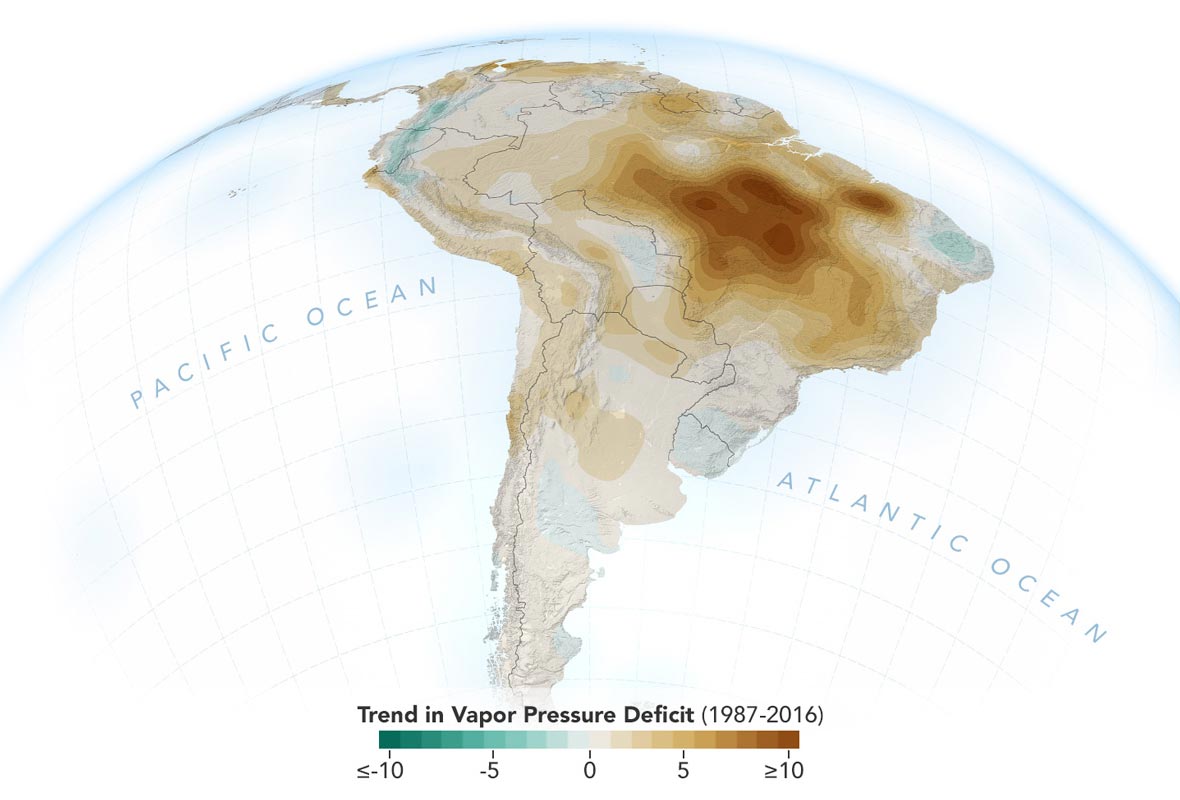
A new NASA study shows that over the last 20 years, the atmosphere above the Amazon rainforest has been drying out, increasing the demand for water and leaving ecosystems vulnerable to fires and drought. It also shows that this increase in dryness is primarily the result of human activities.
Scientists at NASA’s Jet Propulsion Laboratory in Pasadena, California, analyzed decades of ground and satellite data over the Amazon rainforest to track both how much moisture was in the atmosphere and how much moisture was needed to maintain the rainforest system.
“We observed that in the last two decades, there has been a significant increase in dryness in the atmosphere as well as in the atmospheric demand for water above the rainforest,” said JPL’s Armineh Barkhordarian, lead author of the study. “In comparing this trend to data from models that estimate climate variability over thousands of years, we determined that the change in atmospheric aridity is well beyond what would be expected from natural climate variability.”
So if it’s not natural, what’s causing it?
Barkhordarian said that elevated greenhouse gas levels are responsible for approximately half of the increased aridity. The rest is the result of ongoing human activity, most significantly, the burning of forests to clear land for agriculture and grazing. The combination of these activities is causing the Amazon’s climate to warm.
When a forest burns, it releases particles called aerosols into the atmosphere — among them, black carbon, commonly referred to as soot. While bright-colored or translucent aerosols reflect radiation, darker aerosols absorb it. When the black carbon absorbs heat from the sun, it causes the atmosphere to warm; it can also interfere with cloud formation and, consequently, rainfall.
Why It Matters
The Amazon is the largest rainforest on Earth. When healthy, it absorbs billions of tons of carbon dioxide (CO2) a year through photosynthesis — the process plants use to convert CO2, energy, and water into food. By removing CO2 from the atmosphere, the Amazon helps to keep temperatures down and regulate climate.
But it’s a delicate system that’s highly sensitive to drying and warming trends.
Trees and plants need water for photosynthesis and to cool themselves down when they get too warm. They pull in water from the soil through their roots and release water vapor through pores on their leaves into the atmosphere, where it cools the air and eventually rises to form clouds. The clouds produce rain that replenishes the water in the soil, allowing the cycle to continue. Rainforests generate as much as 80% of their own rain, especially during the dry season.
But when this cycle is disrupted by an increase in dry air, for instance, a new cycle is set into motion — one with significant implications, particularly in the southeastern Amazon, where trees can experience more than four to five months of dry season.
“It’s a matter of supply and demand. With the increase in temperature and drying of the air above the trees, the trees need to transpire to cool themselves and to add more water vapor into the atmosphere. But the soil doesn’t have extra water for the trees to pull in,” said JPL’s Sassan Saatchi, co-author of the study. “Our study shows that the demand is increasing, the supply is decreasing and if this continues, the forest may no longer be able to sustain itself.”
Scientists observed that the most significant and systematic drying of the atmosphere is in the southeast region, where the bulk of deforestation and agricultural expansion is happening. But they also found episodic drying in the northwest Amazon, an area that typically has no dry season. Normally always wet, the northwest has suffered severe droughts over the past two decades, a further indication of the entire forest’s vulnerability to increasing temperatures and dry air.
If this trend continues over the long term and the rainforest reaches the point where it can no longer function properly, many of the trees and the species that live within the rainforest ecosystem may not be able to survive. As the trees die, particularly the larger and older ones, they release CO2 into the atmosphere; and the fewer trees there are, the less CO2 the Amazon region would be able to absorb — meaning we’d essentially lose an important element of climate regulation.
The study, “A Recent Systematic Increase in Vapor Pressure Deficit Over Tropical South America,” was published in October in Scientific Reports. The science team used data from NASA’s Atmospheric Infrared Sounder (AIRS) instrument aboard the Terra satellite.
Related: Amazon Fires Were Fueled by Drought-Stressed Forest
Reference: “A Recent Systematic Increase in Vapor Pressure Deficit over Tropical South America” by Armineh Barkhordarian, Sassan S. Saatchi, Ali Behrangi, Paul C. Loikith and Carlos R. Mechoso, 25 October 2019, Scientific Reports.
DOI: 10.1038/s41598-019-51857-8
Never miss a breakthrough: Join the SciTechDaily newsletter.
Follow us on Google and Google News.