
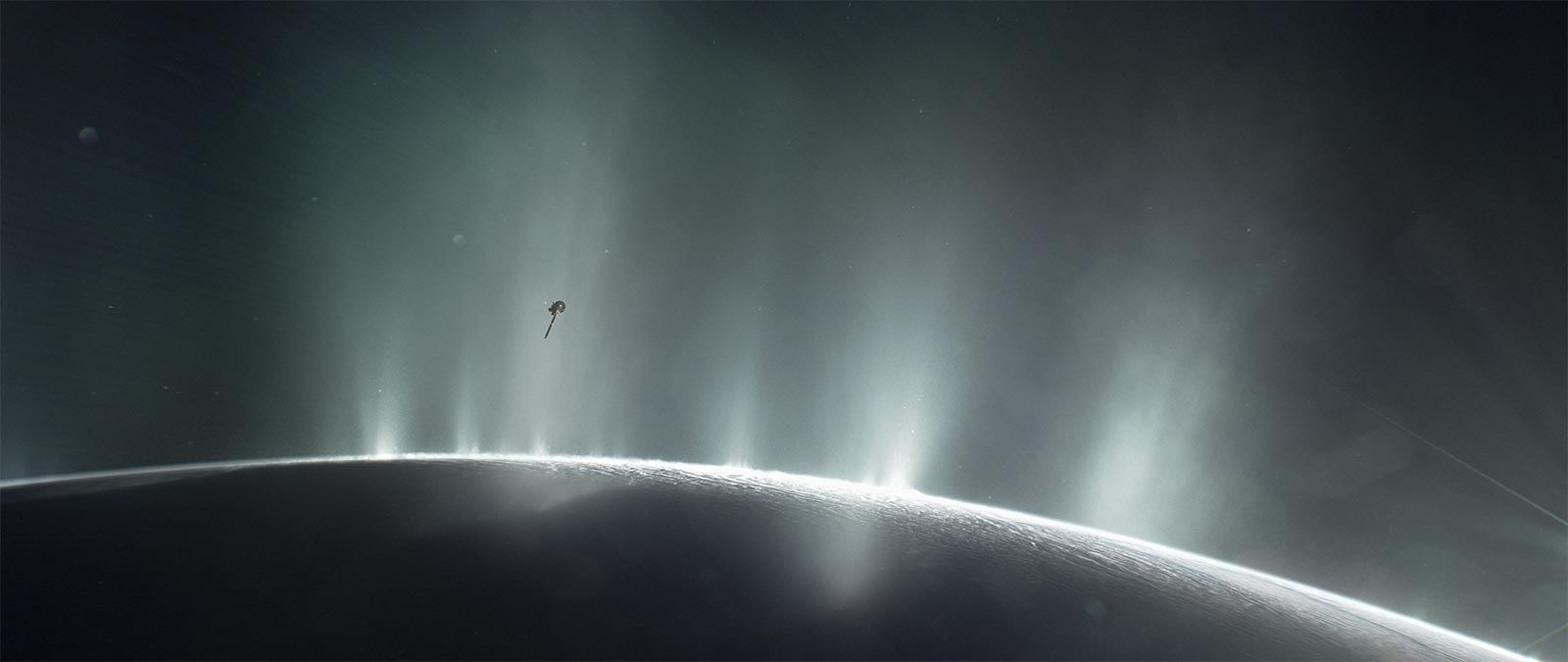
NASA researchers have found that amino acids, potential indicators of life, could survive near the surface of Europa and Enceladus, moons of Jupiter and Saturn respectively.
Experiments indicate that these organic molecules can withstand radiation just under the ice, making them accessible to future robotic landers without deep drilling.
Exploring Life Potential on Icy Moons
Europa, a moon of Jupiter, and Enceladus, a moon of Saturn, have evidence of oceans beneath their ice crusts. A NASA experiment suggests that if these oceans support life, signatures of that life in the form of organic molecules (e.g. amino acids, nucleic acids, etc.) could survive just under the surface ice despite the harsh radiation on these worlds. If robotic landers are sent to these moons to look for life signs, they would not have to dig very deep to find amino acids that have survived being altered or destroyed by radiation.
“Based on our experiments, the ‘safe’ sampling depth for amino acids on Europa is almost 8 inches (around 20 centimeters) at high latitudes of the trailing hemisphere (hemisphere opposite to the direction of Europa’s motion around Jupiter) in the area where the surface hasn’t been disturbed much by meteorite impacts,” said Alexander Pavlov of NASA’s Goddard Space Flight Center in Greenbelt, Maryland, lead author of a paper on the research published July 18 in the journal Astrobiology. “Subsurface sampling is not required for the detection of amino acids on Enceladus – these molecules will survive radiolysis (breakdown by radiation) at any location on the Enceladus surface less than a tenth of an inch (under a few millimeters) from the surface.”

The frigid surfaces of these nearly airless moons are likely uninhabitable due to radiation from both high-speed particles trapped in their host planet’s magnetic fields and powerful events in deep space, such as exploding stars. However, both have oceans under their icy surfaces that are heated by tides from the gravitational pull of the host planet and neighboring moons. These subsurface oceans could harbor life if they have other necessities, such as an energy supply as well as elements and compounds used in biological molecules.
Experimental Approaches and Findings
The research team used amino acids in radiolysis experiments as possible representatives of biomolecules on icy moons. Amino acids can be created by life or by non-biological chemistry. However, finding certain kinds of amino acids on Europa or Enceladus would be a potential sign of life because they are used by terrestrial life as a component to build proteins. Proteins are essential to life as they are used to make enzymes which speed up or regulate chemical reactions and to make structures. Amino acids and other compounds from subsurface oceans could be brought to the surface by geyser activity or the slow churning motion of the ice crust.

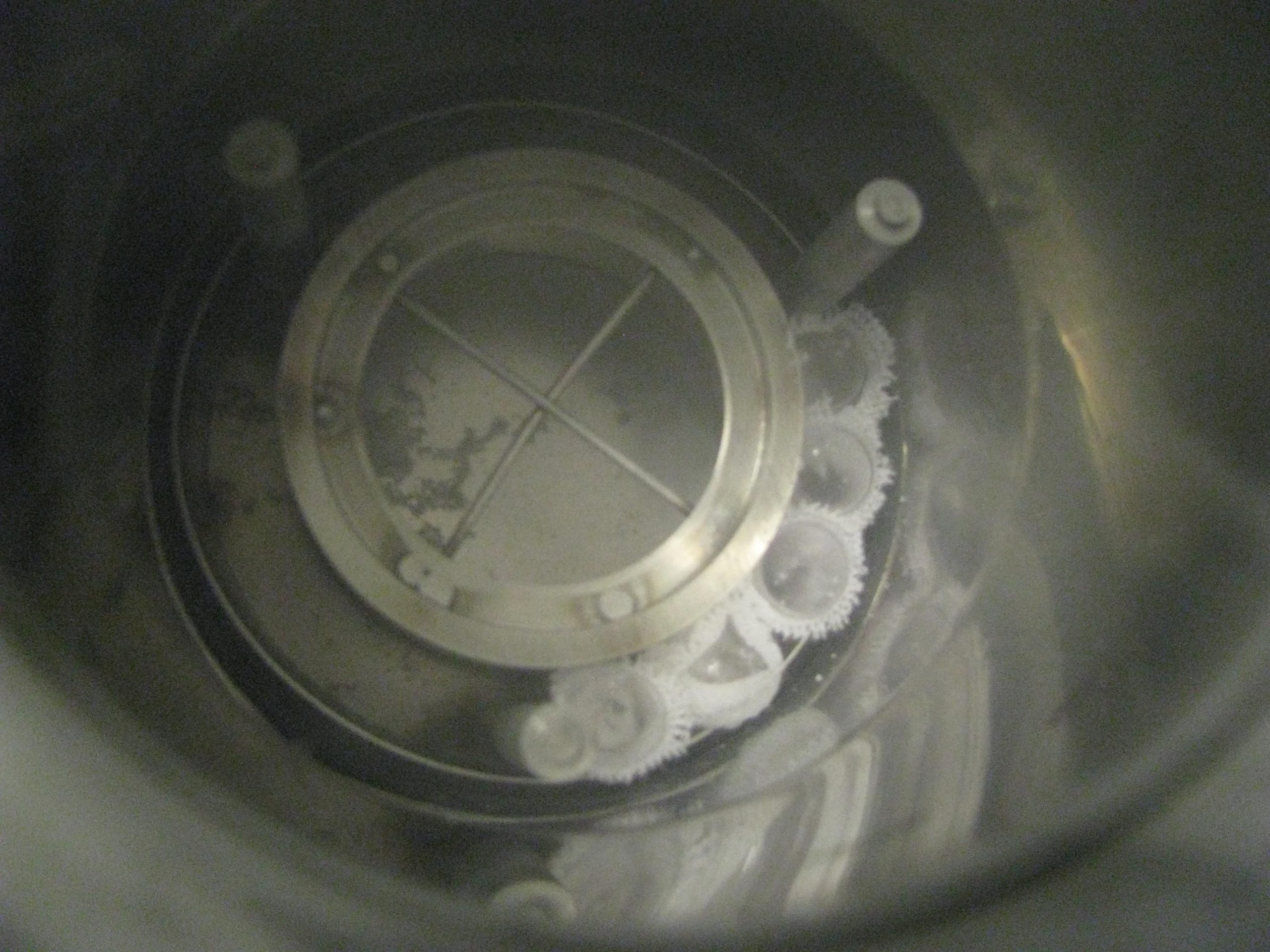
To evaluate the survival of amino acids on these worlds, the team mixed samples of amino acids with ice chilled to about minus 321 Fahrenheit (-196 Celsius) in sealed, airless vials and bombarded them with gamma-rays, a type of high-energy light, at various doses. Since the oceans might host microscopic life, they also tested the survival of amino acids in dead bacteria in ice. Finally, they tested samples of amino acids in ice mixed with silicate dust to consider the potential mixing of material from meteorites or the interior with surface ice.
Implications for Future Space Missions
The experiments provided pivotal data to determine the rates at which amino acids break down, called radiolysis constants. With these, the team used the age of the ice surface and the radiation environment at Europa and Enceladus to calculate the drilling depth and locations where 10 percent of the amino acids would survive radiolytic destruction.
Although experiments to test the survival of amino acids in ice have been done before, this is the first to use lower radiation doses that don’t completely break apart the amino acids, since just altering or degrading them is enough to make it impossible to determine if they are potential signs of life. This is also the first experiment using Europa/Enceladus conditions to evaluate the survival of these compounds in microorganisms and the first to test the survival of amino acids mixed with dust.
The team found that amino acids degraded faster when mixed with dust but slower when coming from microorganisms.
“Slow rates of amino acid destruction in biological samples under Europa and Enceladus-like surface conditions bolster the case for future life-detection measurements by Europa and Enceladus lander missions,” said Pavlov. “Our results indicate that the rates of potential organic biomolecules’ degradation in silica-rich regions on both Europa and Enceladus are higher than in pure ice and, thus, possible future missions to Europa and Enceladus should be cautious in sampling silica-rich locations on both icy moons.”
A potential explanation for why amino acids survived longer in bacteria involves the ways ionizing radiation changes molecules — directly by breaking their chemical bonds or indirectly by creating reactive compounds nearby which then alter or break down the molecule of interest. It’s possible that bacterial cellular material protected amino acids from the reactive compounds produced by the radiation.
Reference: “Variable and Large Losses of Diagnostic Biomarkers After Simulated Cosmic Radiation Exposure in Clay- and Carbonate-Rich Mars Analog Samples” by Anaïs Roussel, Amy C. McAdam, Alex A. Pavlov, Christine A. Knudson, Cherie N. Achilles, Dionysis I. Foustoukos, Jason P. Dworkin, S. Andrejkovičová, Dina M. Bower and Sarah Stewart Johnson, 18 July 2024, Astrobiology.
DOI: 10.1089/ast.2023.0123
The research was supported by NASA under award number 80GSFC21M0002, NASA’s Planetary Science Division Internal Scientist Funding Program through the Fundamental Laboratory Research work package at Goddard, and NASA Astrobiology NfoLD award 80NSSC18K1140.
Never miss a breakthrough: Join the SciTechDaily newsletter.
Follow us on Google and Google News.