

The ice-covered Jovian moon generates 1,000 tons of oxygen every 24 hours – enough to keep a million humans breathing for a day.
Scientists with NASA’s Juno mission to Jupiter have calculated the rate of oxygen being produced at the Jovian moon Europa to be substantially less than most previous studies. Published on March 4 in Nature Astronomy, the findings were derived by measuring hydrogen outgassing from the icy moon’s surface using data collected by the spacecraft’s Jovian Auroral Distributions Experiment (JADE) instrument.
The paper’s authors estimate the amount of oxygen produced to be around 26 pounds every second (12 kilograms per second). Previous estimates range from a few pounds to over 2,000 pounds per second (over 1,000 kilograms per second). Scientists believe that some of the oxygen produced in this manner could work its way into the moon’s subsurface ocean as a possible source of metabolic energy.
Europa’s Potential for Life
With an equatorial diameter of 1,940 miles (3,100 kilometers), Europa is the fourth largest of Jupiter’s 95 known moons and the smallest of the four Galilean satellites. Scientists believe a vast internal ocean of salty water lurks beneath its icy crust, and they are curious about the potential for life-supporting conditions to exist below the surface.
It is not just the water that has astrobiologists’ attention: The Jovian moon’s location plays an important role in biological possibilities as well. Europa’s orbit places it right in the middle of the gas giant’s radiation belts. Charged, or ionized, particles from Jupiter bombard the icy surface, splitting water molecules in two to generate oxygen that might find its way into the moon’s ocean.
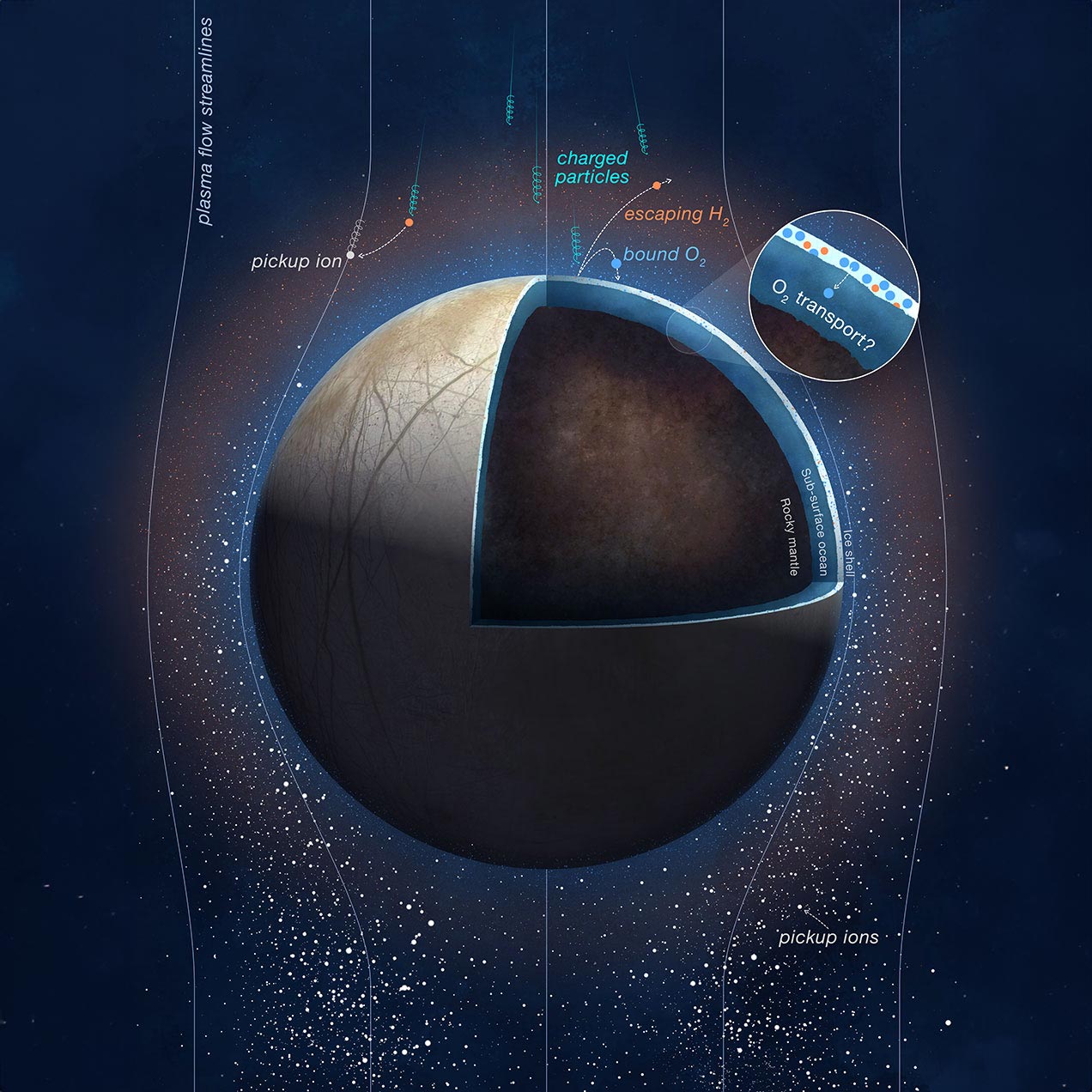
“Europa is like an ice ball slowly losing its water in a flowing stream. Except, in this case, the stream is a fluid of ionized particles swept around Jupiter by its extraordinary magnetic field,” said JADE scientist Jamey Szalay from Princeton University in New Jersey. “When these ionized particles impact Europa, they break up the water-ice molecule by molecule on the surface to produce hydrogen and oxygen. In a way, the entire ice shell is being continuously eroded by waves of charged particles washing up upon it.”
Capturing the Bombardment
As Juno flew within 220 miles (354 kilometers) of Europa at 2:36 p.m. PDT on September 29, 2022, JADE identified and measured hydrogen and oxygen ions that had been created by the bombarding charged particles and then “picked up” by Jupiter’s magnetic field as it swept past the moon.
“Back when NASA’S Galileo mission flew by Europa, it opened our eyes to the complex and dynamic interaction Europa has with its environment. Juno brought a new capability to directly measure the composition of charged particles shed from Europa’s atmosphere, and we couldn’t wait to further peek behind the curtain of this exciting water world,” said Szalay. “But what we didn’t realize is that Juno’s observations would give us such a tight constraint on the amount of oxygen produced in Europa’s icy surface.”
Juno carries 11 state-of-the-art science instruments designed to study the Jovian system, including nine charged-particle and electromagnetic-wave sensors for studying Jupiter’s magnetosphere.
“Our ability to fly close to the Galilean satellites during our extended mission allowed us to start tackling a breadth of science, including some unique opportunities to contribute to the investigation of Europa’s habitability,” said Scott Bolton, Juno’s principal investigator from the Southwest Research Institute in San Antonio. “And we’re not done yet. More moon flybys and the first exploration of Jupiter’s close ring and polar atmosphere are yet to come.”
Oxygen production is one of many facets that NASA’s Europa Clipper mission will investigate when it arrives at Jupiter in 2030. The mission has a sophisticated payload of nine science instruments to determine if Europa has conditions that could be suitable for life.
Now Bolton and the rest of the Juno mission team are setting their sights on another Jovian world, the volcano-festooned moon Io. On April 9, the spacecraft will come within about 10,250 miles (16,500 kilometers) of its surface. The data Juno gathers will add to findings from past Io flybys, including two extremely close approaches of about 932 miles (1,500 kilometers) on December 30, 2023, and February 3, 2024.
Reference: “Oxygen production from dissociation of Europa’s water-ice surface” by J. R. Szalay, F. Allegrini, R. W. Ebert, F. Bagenal, S. J. Bolton, S. Fatemi, D. J. McComas, A. Pontoni, J. Saur, H. T. Smith, D. F. Strobel, S. D. Vance, A. Vorburger and R. J. Wilson, 4 March 2024, Nature Astronomy.
DOI: 10.1038/s41550-024-02206-x
NASA’s Jet Propulsion Laboratory, a division of Caltech in Pasadena, California, manages the Juno mission for the principal investigator, Scott Bolton, of the Southwest Research Institute in San Antonio. Juno is part of NASA’s New Frontiers Program, which is managed at NASA’s Marshall Space Flight Center in Huntsville, Alabama, for the agency’s Science Mission Directorate in Washington. The Italian Space Agency (ASI) funded the Jovian InfraRed Auroral Mapper. Lockheed Martin Space in Denver built and operates the spacecraft.
Never miss a breakthrough: Join the SciTechDaily newsletter.
Follow us on Google and Google News.