
Close Menu
    Facebook X (Twitter) Instagram
    SciTechDaily
    • Biology
    • Chemistry
    • Earth
    • Health
    • Physics
    • Science
    • Space
    • Technology
    Facebook X (Twitter) Pinterest YouTube RSS
    SciTechDaily
    Home»Earth»New NASA Weather Sensors Capture Vital Data on Hurricane Ian From Space Station
    Earth

    New NASA Weather Sensors Capture Vital Data on Hurricane Ian From Space Station

    By Jet Propulsion LaboratorySeptember 30, 2022No Comments3 Mins Read
    Facebook Twitter Pinterest Telegram LinkedIn WhatsApp Email Reddit
    Share
    Facebook Twitter LinkedIn Pinterest Telegram Email Reddit
    NASA-Built Weather Sensors Capture Vital Data on Hurricane Ian
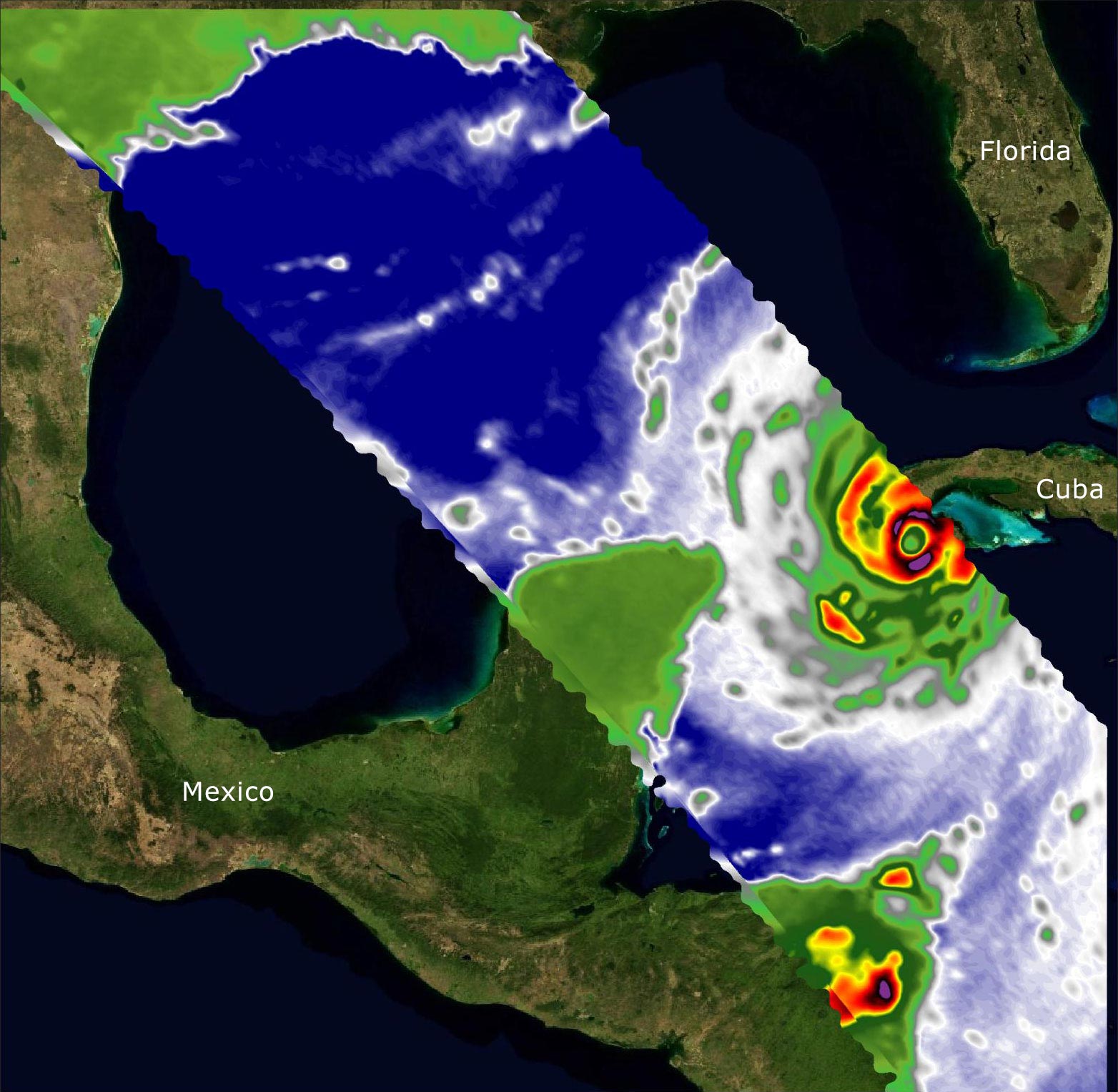
    From aboard the International Space Station, NASA-built instruments Compact Ocean Wind Vector Radiometer (COWVR) and Temporal Experiment for Storms and Tropical Systems (TEMPEST) captured wind and water vapor data from Hurricane Ian as the storm neared Cuba. Credit: NASA/JPL-Caltech

    A pair of microwave radiometers gathered data on Hurricane Ian as they passed over the Caribbean Sea aboard the International Space Station (ISS).

    Two recently launched instruments captured images of Hurricane Ian on Tuesday, September 27, 2022, as the storm approached Cuba on its way north toward the U.S. mainland. Designed and built at NASA’s Jet Propulsion Laboratory in Southern California, these instruments were created to provide forecasters data on weather over the open ocean.

    COWVR (short for Compact Ocean Wind Vector Radiometer) and TEMPEST (Temporal Experiment for Storms and Tropical Systems) observe the planet’s atmosphere and surface from aboard the ISS, which passed in low-Earth orbit over the Caribbean Sea at about 12:30 a.m. EDT.

    According to the National Hurricane Center, Ian made landfall in Cuba’s Pinar del Rio province at 4:30 a.m. EDT. At that time, it was a Category 3 hurricane, with estimated wind speeds of 125 mph (205 kph).

    The image at the top of the page combines microwave emissions measurements from both COWVR and TEMPEST. White sections indicate the presence of clouds. Green portions indicate rain. Yellow, red, and black indicate where air and water vapor were moving most swiftly. Ian’s center is seen just off of Cuba’s southern coast, and the storm is shown covering the island with rain and wind.

    COWVR and TEMPEST sent the data for this image back to Earth in a direct stream via NASA’s tracking and data relay satellite (TDRS) constellation. The data were processed at JPL and made available to forecasters less than two hours after collection.

    COWVR, which is comparable in size to a minifridge, measures natural microwave emissions over the ocean. The magnitude of the emissions increases with the amount of rain in the atmosphere, and the strongest rain produces the strongest microwave emissions. About the size of a cereal box, TEMPEST tracks microwaves at a much shorter wavelength. This allows it to see ice particles within the hurricane’s cloudy regions that are thrust into the upper atmosphere by the storm.

    Both microwave radiometers were developed to demonstrate that smaller, more energy-efficient, more simply designed sensors can perform most of the same measurements as current space-based weather instruments that are heavier, consume more power, and cost much more to construct.

    COWVR’s development was funded by the U.S. Space Force, and TEMPEST was developed with NASA funding. The U.S. Space Test Program-Houston 8 (STP-H8) is responsible for hosting the instruments on the space station under Space Force funding in partnership with NASA. Data from the instruments is being used by government and university weather forecasters and scientists. The mission will inform the development of future space-based weather sensors, and researchers are working on mission concepts that would take advantage of the low-cost microwave sensor technologies to study long-standing questions, such as how heat from the ocean fuels global weather patterns.

    Never miss a breakthrough: Join the SciTechDaily newsletter.
    Follow us on Google and Google News.

    Hurricane JPL NASA Storms Weather
    Share. Facebook Twitter Pinterest LinkedIn Email Reddit

    Related Articles

    Hurricane Ida Leaves a Trail of Oil in the Gulf of Mexico

    A Changed Landscape in Southern Louisiana After Hurricane Ida: Large New Patches of Open Water

    NASA Satellite Observes Massive Power Outages in New Orleans

    Stunning NASA Image Captures Tropical Storm Ida at It Passes Over the Southern U.S.

    Dramatic NASA Satellite Video Examines Hurricane Ida’s Eye in 3D

    Hurricane Ida Batters Louisiana: 5th-Strongest Storm Ever To Make Landfall in the Continental U.S.

    Incredible View of Tropical Storm Elsa Captured From Space

    Prior Weather Linked to Rapid Intensification of Hurricanes Near Landfall

    NASA’s Atmospheric Infrared Sounder Tracks Hurricane Douglas, Tropical Storm Hanna From Space

    Leave A Reply Cancel Reply

    • Facebook
    • Twitter
    • Pinterest
    • YouTube

    Don't Miss a Discovery

    Subscribe for the Latest in Science & Tech!

    Trending News

    New Research Shows Vitamin B12 May Hold the Key to Healthy Aging

    These Simple Daily Habits Can Quickly Improve Blood Pressure and Heart Risk Factors

    A Common Nutrient May Play a Surprising Role in Anxiety

    Doing This After 9 p.m. Could Double Your Risk of Gut Issues

    Scientists Discover How Coffee Impacts Memory, Mood, and Gut Health

    Why Did the Neanderthals Disappear? Scientists Reveal Humans Had a Hidden Advantage

    Physicists Propose Strange Experiment Where Time Goes Quantum

    Magnesium Magic: New Drug Melts Fat Even on a High-Fat, High-Sugar Diet

    Follow SciTechDaily
    • Facebook
    • Twitter
    • YouTube
    • Pinterest
    • Newsletter
    • RSS
    SciTech News
    • Biology News
    • Chemistry News
    • Earth News
    • Health News
    • Physics News
    • Science News
    • Space News
    • Technology News
    Recent Posts
    • This New Memory Technology Could Make Devices Last Months on One Charge
    • Scientists Turn Cancer’s Own Bacteria Against It in Breakthrough Therapy
    • Cannabis Can Make You Remember Things That Never Happened
    • Doctors Are Surprised by What This Vaccine Is Doing to the Heart
    • Quantum Breakthrough Turns Simple Forces Into Powerful New Interactions
    Copyright © 1998 - 2026 SciTechDaily. All Rights Reserved.
    • Science News
    • About
    • Contact
    • Editorial Board
    • Privacy Policy
    • Terms of Use

    Type above and press Enter to search. Press Esc to cancel.