
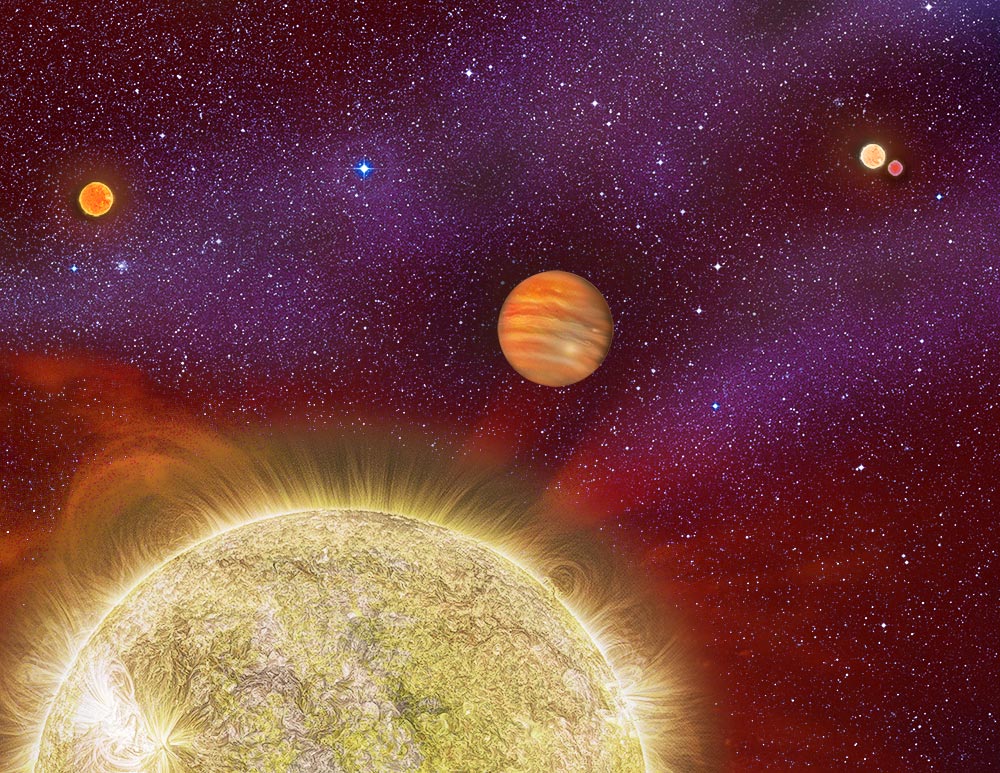
TESS has discovered 97 quadruple star systems, thanks to a collaboration between scientists and citizen scientists. These findings help scientists study stellar evolution and planetary formation in complex star systems.
NASA’s Transiting Exoplanet Survey Satellite (TESS) has found over 5000 candidate exoplanet candidates, and 197 confirmed exoplanets since its mission began in late 2018. TESS is good at finding exoplanets, but the spacecraft is a powerful scientific platform, and it’s made other discoveries, too. Scientists working with TESS recently announced 97 quadruple star candidates, nearly doubling the number of known quadruple systems.
TESS’s mission is to find exoplanets. More specifically, its mission is to find exoplanets around nearby bright stars. The Transiting Exoplanet Survey Satellite can also study those planets’ mass, density, size, and orbit.
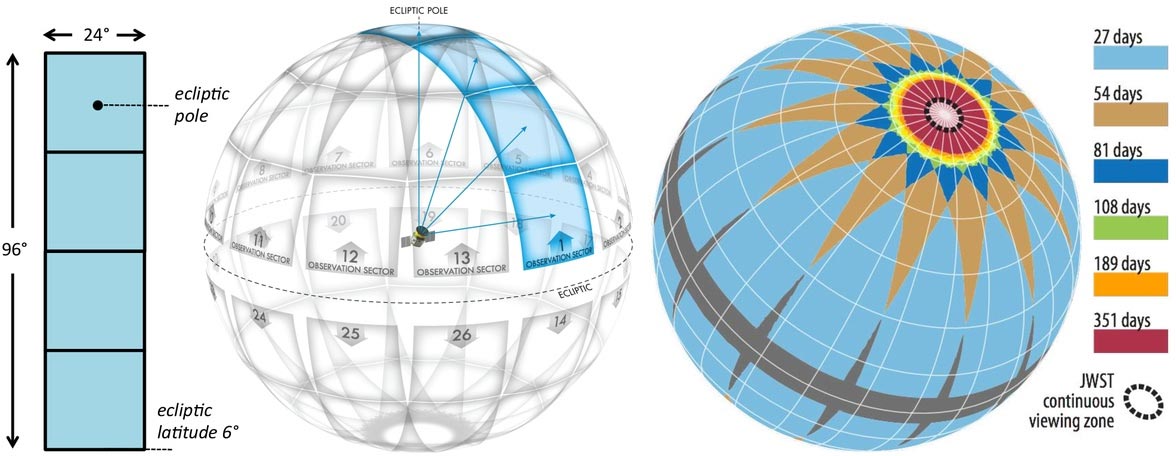
But TESS’s field of view is wide, much wider than its predecessor, the Kepler Space Telescope. Its array of wide-field cameras has surveyed 85% of the sky and gathered an enormous quantity of data. Scientists use machine learning and a cohort of eager citizen scientists to comb through that data.
Collaboration Between Scientists and Citizen Scientists
According to a new paper, the latest results from TESS data is a catalog of 97 “…uniformly-vetted candidates for quadruple star systems,” according to a new paper. The paper is “97 Eclipsing Quadruple Star Candidates Discovered in TESS Full Frame Images.” The paper is available at the pre-press site arxiv.org and will be published in The Astrophysical Journal Supplement. The paper’s lead author is Veselin Kostov from NASA’s Goddard Space Flight Center.
“The candidates were identified in TESS Full Frame Image data from Sectors 1 through 42 through a combination of machine learning techniques and visual examination, with major contributions from a dedicated group of citizen scientists,” the authors write.
To find these systems, it took a collaboration between some of the usual suspects—the NASA Goddard Space Flight Center (GSFC) Astrophysics Science Division and the MIT Kavli Institute. But the professionals at those research institutions needed some help. That help came from seven experienced citizen scientists who assisted in the painstaking effort of pixel-by-pixel analysis of light curves. “To rule out false positives due to nearby field stars or systematic effects, we evaluate the pixel-by-pixel light curve of the target…” the authors write in their paper.
The researchers focused their effort on identifying triple and quadruple star systems, but the results go beyond those multiple star systems. They also found “…the first sextuply-eclipsing sextuple stellar system and the first transiting circumbinary planet detected from one sector of TESS data,” the authors explain.
Quadruple star systems contain two pairs of eclipsing binary (EB) stars. However, they’re only EBs if they eclipse one another from our vantage point. All those transits and eclipses can be difficult to entangle, which explains the helping hand from dedicated citizen scientists.
The researchers were interested only in specific quadruple star systems, and they deliberately excluded others. “We note that the targets listed in this catalog are quadruple candidates that each originate from a single TESS source, i.e. the two-component EBs are unresolved in TESS data,” they write. These quad systems are in the catalog because they exhibit changes observable in human timescales. “The reason is that for the purposes of this work, our interests are in close quadruple systems that can exhibit dynamically interesting interactions on a human timescale (months to years),” they explain.
That explanation is a bit wordy, but it boils down to this: TESS pixel width can be vast. If TESS locates a pair of EBs separated by two TESS pixels, and if the EBs are 500 parsecs away from us, that means the EBs are separated from each other by up to 20,000 AU. At that vast distance from one another, it could take generations of human observations to notice any interactions between the stars. Systems must be closer to one another to exhibit interesting interactions observable in months or years, so they must be in the same TESS pixel. This is what necessitated the painstaking pixel-by-pixel analysis.
The systems in the catalog survived a stringent vetting process. The team also encountered many false positives. A field star near the target often appeared to be another EB until deeper analysis ruled it out. Other times they detected two EB pairs, but they were not interconnected and were too distant from each other to constitute a quadruple star system. There were also triple-star systems whose eclipse pattern mimicked a quadruple-star system. All in all, there were five false-positive scenarios.
In their summary, the authors write that “The target stars have been identified through visual inspection and exhibit two sets of eclipses with two distinct periods, each with primary and, in most cases, secondary eclipses. All targets have been uniformly-vetted and passed a series of tests, including pixel-by-pixel and
photocenter motion analysis.”
Importance of Multiple Star Systems for Stellar Evolution
Why are astronomers interested in quadruple systems?
Multiple star systems can reveal a lot about stellar evolution pathways. Astronomers and astrophysicists are interested in stellar stages of evolution like short-period binaries, common-envelope events, Type Ia Supernovae, and black hole mergers.
The arrangement of the stars in multiple systems is also evidence of how the stars formed. “For example, the mass ratios between the individual components of a quadruple system, the period ratios between the constituent binary systems and the mutual inclination provide important insight into whether the system formed through a ‘top-down’ scenario via core or disk fragmentation or ‘bottom-up’ aggregation via gravitational capture,” they write.
Another exciting aspect of multiple star systems concerns planets. Astronomers have found some planets around multiple star systems, but their origins and fates are unclear.
In 2015 astronomers discovered a massive planet in the quadruple star system 30 Arietis. According to that discovery, the system is home to an enormous gas giant ten times more massive than Jupiter. It was the second known planet instance in a quadruple star system.
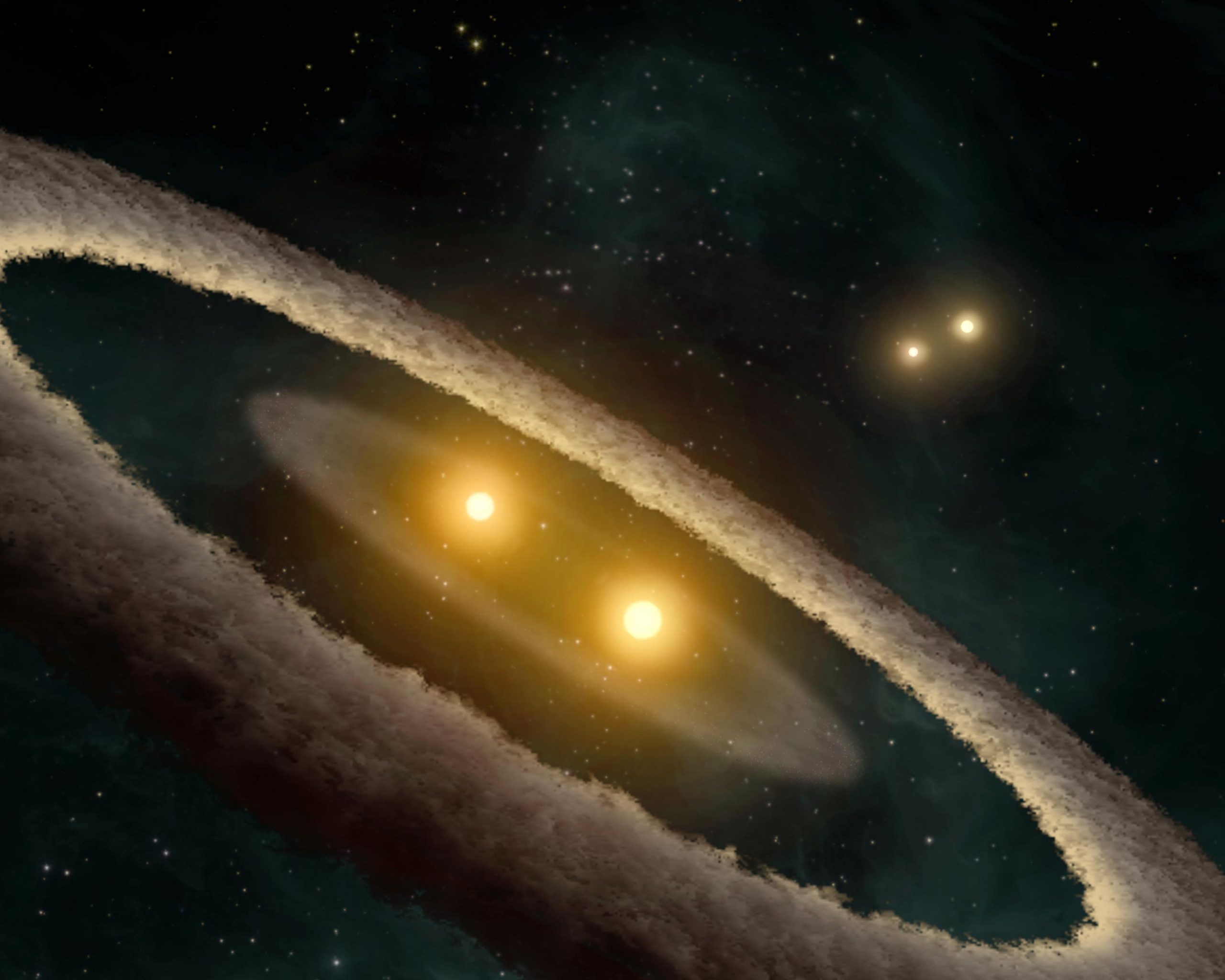
In 2019 researchers found a unique quadruple star system where the stars are at a right angle to the disk of gas and dust surrounding them. Planets will likely form from this protoplanetary disk. How unusual would the view from a planet’s surface be in that system?
The team of researchers isn’t finished yet. They say that they’ve detected an order of magnitude more false positives than vetted detections and that complete analysis is beyond the scope of this paper. “… given the large number of targets inspected and assuming many of the additional candidates turn out to be real, TESS has the potential to increase the number of known eclipsing quadruple systems by more than a factor of two,” they write.
Adapted from an article originally published on Universe Today.
Never miss a breakthrough: Join the SciTechDaily newsletter.
Follow us on Google and Google News.