
Close Menu
    Facebook X (Twitter) Instagram
    SciTechDaily
    • Biology
    • Chemistry
    • Earth
    • Health
    • Physics
    • Science
    • Space
    • Technology
    Facebook X (Twitter) Pinterest YouTube RSS
    SciTechDaily
    Home»Space»Astronomers Use Gyrochronology to Reveal the Ages of 22 Sun-Like Stars
    Space

    Astronomers Use Gyrochronology to Reveal the Ages of 22 Sun-Like Stars

    By Harvard-Smithsonian Center for AstrophysicsJuly 10, 2014No Comments4 Mins Read
    Facebook Twitter Pinterest Telegram LinkedIn WhatsApp Email Reddit
    Share
    Facebook Twitter LinkedIn Pinterest Telegram Email Reddit
    New Technique Measures the Age of a Star Using Its Spin
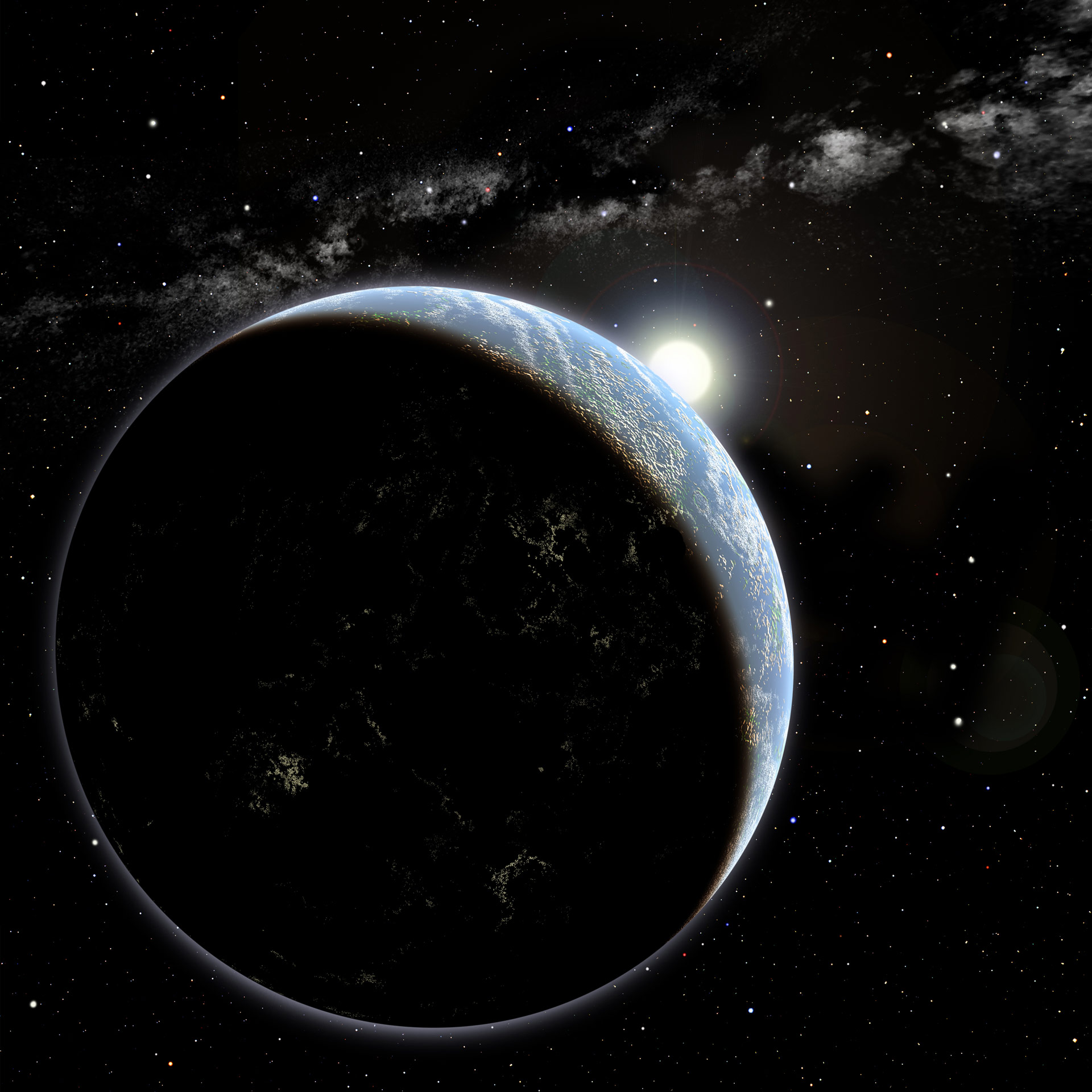
    Artist’s conception of a hypothetical exoplanet orbiting a yellow, Sun-like star. Astronomers have measured the ages of 22 Sun-like stars using their spins, in a method called gyrochronology. Before now, only two Sun-like stars had measured spins and ages. Credit: David A. Aguilar (CfA); CfA, created using StarWalkHD (VT 7.0.3) and MAST and the Virtual Observatory (VO)

    Using a new technique for measuring the age of a star using its spin, astronomers reveal the gyrochronological ages of 22 Sun-like stars.

    Defining what makes a star “Sun-like” is as difficult as defining what makes a planet “Earth-like.” A solar twin should have a temperature, mass, and spectral type similar to our Sun. We also would expect it to be about 4.5 billion years old. However, it is notoriously difficult to measure a star’s age so astronomers usually ignore age when deciding if a star counts as “Sun-like.”

    A new technique for measuring the age of a star using its spin – gyrochronology – is coming into its own. Today astronomers are presenting the gyrochronological ages of 22 Sun-like stars. Before this, only two Sun-like stars had measured spins and ages.

    “We have found stars with properties that are close enough to those of the Sun that we can call them ‘solar twins,'” says lead author Jose Dias do Nascimento of the Harvard-Smithsonian Center for Astrophysics (CfA). “With solar twins, we can study the past, present, and future of stars like our Sun. Consequently, we can predict how planetary systems like our solar system will be affected by the evolution of their central stars.”

    To measure a star’s spin, astronomers look for changes in its brightness caused by dark spots known as starspots crossing the star’s surface. By watching how long it takes for a spot to rotate into view, across the star, and out of view again, we learn how fast the star is spinning.
    Astronomers Present the Gyrochronological Ages of 22 Sun Like Stars
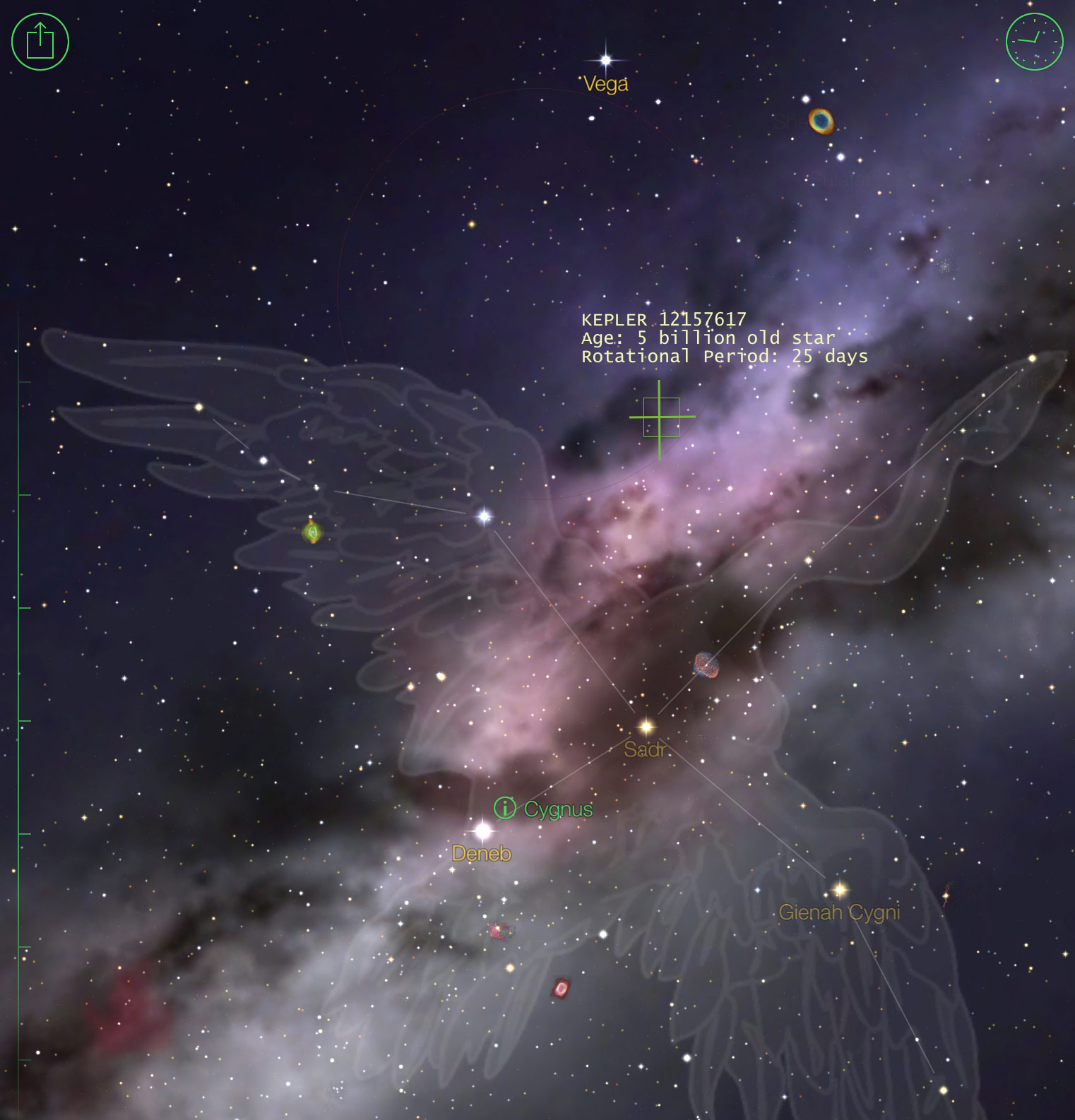
    Finder chart for one of the most Sun-like stars examined in this study. KIC 12157617 is located in the constellation Cygnus, about halfway between the bright stars Vega and Deneb (two members of the Summer Triangle). An 8-inch or larger telescope is advised for trying to spot this 12th-magnitude star. Credit: David A. Aguilar (CfA); CfA, created using StarWalkHD (VT 7.0.3) and MAST and the Virtual Observatory (VO)

    The change in a star’s brightness due to starspots is very small, typically a few percent or less. NASA’s Kepler spacecraft excels at such exacting brightness measurements. Using Kepler, Nascimento and his colleagues found that the Sun-like stars in their study spin once every 21 days on average, compared to the 25-day rotation period of our Sun at its equator.

    Younger stars spin faster than older ones because stars slow down as they age, much like humans. As a result, a star’s rotation can be used like a clock to derive its age. Since most of the stars the team studied spin slightly faster than our sun, they tend to be younger too.

    This work expands on previous research done by CfA astronomer (and co-author on the new study) Soren Meibom. Meibom and his collaborators measured the rotation rates for stars in a 1-billion-year-old cluster called NGC 6811. Since the stars had a known age, astronomers could use them to calibrate the gyrochronology “clock.” The new research led by do Nascimento examines free-floating “field” stars that are not members of a cluster.

    Since stars and planets form together at the same time, by learning a star’s age we learn the age of its planets. And since it takes time for life to develop and evolve, knowing the ages of planet-hosting stars could help narrow down the best targets to search for signs of alien life. Although none of the 22 stars in the new study are known to have planets, this work represents an important step in the hunt for Sun-like stars that could host Earth-like planets.

    The paper was accepted for publication in The Astrophysical Journal Letters.

    Headquartered in Cambridge, Mass., the Harvard-Smithsonian Center for Astrophysics (CfA) is a joint collaboration between the Smithsonian Astrophysical Observatory and the Harvard College Observatory. CfA scientists, organized into six research divisions, study the origin, evolution, and ultimate fate of the universe.

    Reference: “Rotation periods and ages of solar analogs and solar twins revealed by the Kepler Mission” by J.-D. do Nascimento Jr, R. A. Garcia, S. Mathur, F. Anthony, S. A. Barnes, S. Meibom, J.S. da Costa, M. Castro, D. Salabert and T. Ceillier, 15 July 2014, The Astrophysical Journal Letters.
    DOI: 10.1088/2041-8205/790/2/L23
    arXiv: 1407.2289


    Never miss a breakthrough: Join the SciTechDaily newsletter.
    Follow us on Google and Google News.

    Astronomy Astrophysics Harvard-Smithsonian Center for Astrophysics Popular Stars
    Share. Facebook Twitter Pinterest LinkedIn Email Reddit

    Related Articles

    Behold! Rare Quasar Triplet Forms Most Massive Object in Universe

    Harvard Astronomers Have Revealed the True Shape of the Milky Way’s Halo of Stars

    Earth Is Surrounded by 1,000-Light-Year Wide Bubble – Source of All Nearby, Young Stars

    Astronomers Explore Cosmic Ray Influences on Star Formation in Galaxies

    Astronomers Have Discovered a Gigantic Sphere-Shaped Cavity in Space

    The Give and Take of Stellar Mega-Flares: By Studying Thousands of Young Stars, New Information Has Emerged

    Chandra Studies Extraordinary Magnetar: Fastest Spinning and Possibly the Youngest Magnetar Known

    Synchrotron Emission Will Allow Astronomers to Find Stars That No One Has Seen Before

    Rogue Planets Captured by Stars

    Leave A Reply Cancel Reply

    • Facebook
    • Twitter
    • Pinterest
    • YouTube

    Don't Miss a Discovery

    Subscribe for the Latest in Science & Tech!

    Trending News

    Collapsing Plasma May Hold the Key to Cosmic Magnetism

    This Breakthrough Solar Panel Generates Power From Both Sunlight and Raindrops

    Scientists Uncover New Metabolic Effects Beyond Weight Loss of Mounjaro

    Scientists Discover Cancer Tumors Are “Addicted” to This Common Antioxidant

    1,800 Miles Down: Scientists Uncover Mysterious Movements at the Edge of Earth’s Core

    Scientists Discover Hidden “Good Fats” in Green Rice That Could Transform Nutrition

    Your Child’s Clothes Could Contain Toxic Lead, Study Finds

    Researchers Break a 150-Year-Old Math Law With a Surprising Donut Discovery

    Follow SciTechDaily
    • Facebook
    • Twitter
    • YouTube
    • Pinterest
    • Newsletter
    • RSS
    SciTech News
    • Biology News
    • Chemistry News
    • Earth News
    • Health News
    • Physics News
    • Science News
    • Space News
    • Technology News
    Recent Posts
    • Why Some People Reach 100: New Study Reveals Key Biological Differences
    • This Is How Ovarian Cancer Spreads Before Doctors Can Detect
    • Scientists Discover Hidden Virus Linked to Colorectal Cancer
    • Hidden Danger: Widely Used Pesticides Linked to 150% Higher Cancer Risk
    • The Mystery of the Notes: Why No One Knows How This 120-Year-Old Song Should Sound
    Copyright © 1998 - 2026 SciTechDaily. All Rights Reserved.
    • Science News
    • About
    • Contact
    • Editorial Board
    • Privacy Policy
    • Terms of Use

    Type above and press Enter to search. Press Esc to cancel.