
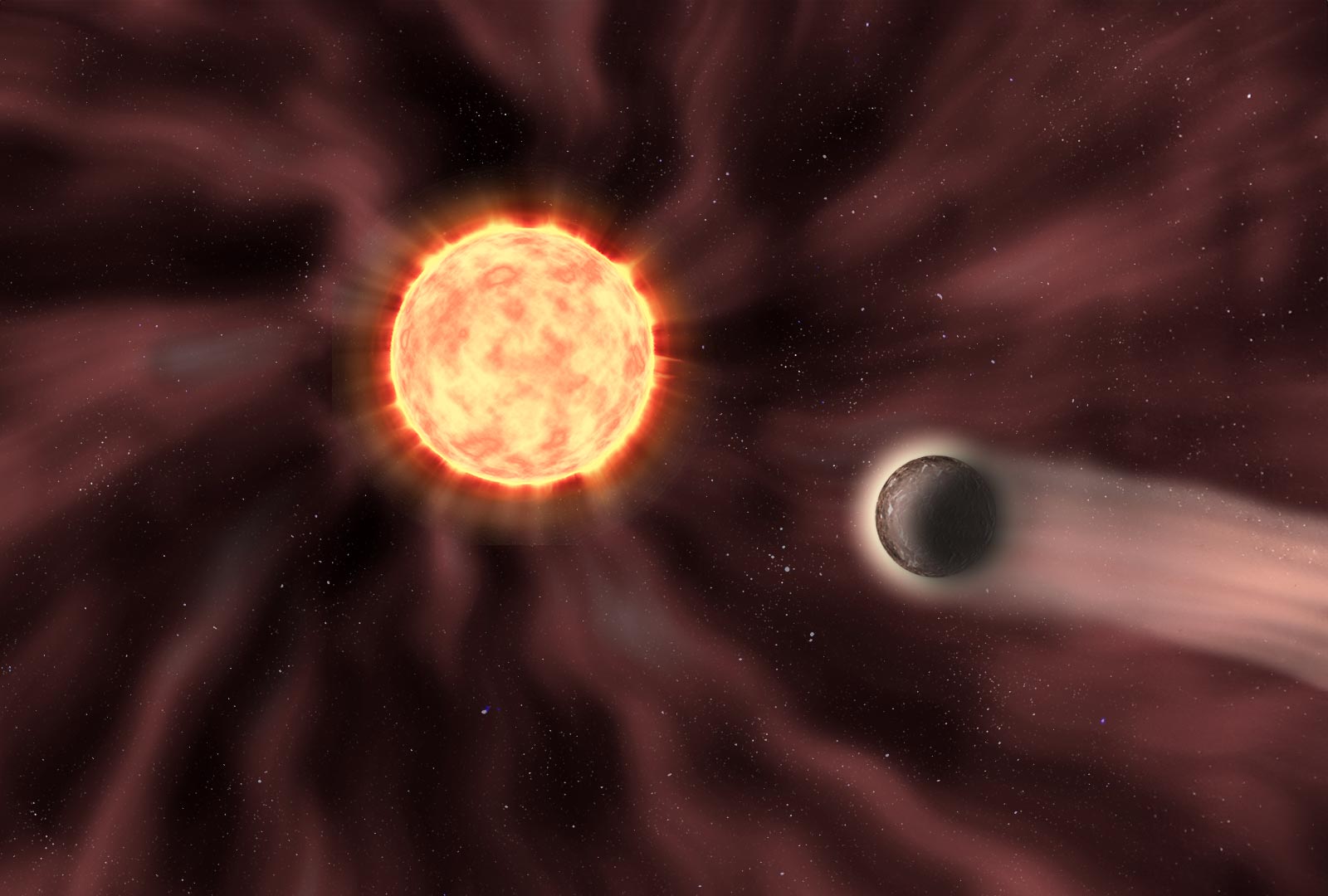
A groundbreaking study reveals that cool stars with strong magnetic fields produce powerful stellar winds, crucial information for assessing the habitability of exoplanetary systems.
Employing state-of-the-art numerical simulations, a study led by scientists at the Leibniz Institute for Astrophysics Potsdam (AIP) has obtained the first systematic characterization of the properties of stellar winds in a sample of cool stars. They found that stars with stronger magnetic fields produce more powerful winds. These winds create unfavorable conditions for the survival of planetary atmospheres, thus affecting the possible habitability of these systems.
Classification of Cool Stars
The Sun is among the most abundant stars in the universe known as “cool stars.” These stars are divided into four categories (F, G, K, and M-type) that differ in size, temperature, and brightness. The Sun is a fairly average star and it belongs to category G. Stars brighter and larger than the Sun are in category F, while K stars are slightly smaller and cooler than the Sun. The smallest and faintest stars are the M stars, also known as “red dwarfs” due to the color in which they emit most of their light.
Solar Wind and Its Implications
Satellite observations have revealed that apart from light, the Sun emits a persistent stream of particles known as the solar wind. These winds travel across interplanetary space and interact with the planets of the solar system, including the Earth. The beautiful display of aurorae near the north and south pole is in fact produced by this interaction. However, these winds could also be harmful, as they can erode away a stable planetary atmosphere, as was the case on Mars.
While much is known about the solar wind – thanks in part to missions such as Solar Orbiter – the same is not true for other cool stars. The problem is that we cannot see these stellar winds directly, limiting us to the study of their influence on the thin gas that fills the cavity between stars in the galaxy. However, this approach has several limitations and is only applicable to a few stars. This motivates the use of computer simulations and models to predict the various properties of stellar winds without requiring astronomers to observe them.
Pioneering Study on Stellar Wind Properties
In this context, the PhD student Judy Chebly, scientist Dr. Julián D. Alvarado-Gómez, and section head Professor Katja Poppenhäger from the Stellar Physics and Exoplanets section at the AIP, in collaboration with Cecilia Garraffo of the Center for Astrophysics at Harvard & Smithsonian, have performed the first systematic study of the stellar wind properties expected for F, G, K, and M stars.
For this purpose, they used numerical simulations employing one of the most sophisticated models currently available, driven by the observed large-scale magnetic field distribution of 21 well-observed stars. The simulations were carried out in the supercomputing facilities of the AIP and the Leibniz Rechenzentrum (LRZ).
The team examined how the stars’ properties, such as gravity, magnetic field strength, and rotation period, affect wind characteristics in terms of velocity or density. The results include a comprehensive characterization of the stellar wind properties across spectral types which, among other results, indicate the need to revisit previous assumptions on the stellar wind speeds when estimating the associated mass loss rates from observations.
In addition, the simulations allow the prediction of the expected size of the Alfvén surface – the boundary between the star’s corona and its stellar wind. This information is fundamental to determine whether or not a planetary system might be subject to strong magnetic star-planet interactions, which can occur when the planetary orbit enters or is completely embedded within the Alfvén surface of its host star.
Impact on Planetary Systems
Their findings show that stars with magnetic fields larger than the Sun’s have faster winds. In some cases, the stellar wind speeds can be up to five times faster than the average solar wind speed, which is typically 450 km/s. The investigation obtained an assessment of how strong the winds of these stars are at the so-called “Habitable Zones,” defined as the orbital distances at which rocky exoplanets could sustain surface liquid water, provided an Earth-like atmospheric pressure. They found milder conditions around F and G-type stars, comparable to what the Earth experiences around the G-type Sun, and increasingly harsher wind environments for K and M-type stars. Such intense stellar winds strongly affect any potential atmosphere the planet might have.
Broader Implications for Exoplanetary Research
This phenomenon is well documented in solar physics between rocky planets and the Sun, but not in the case of exoplanetary systems. This requires estimates of the stellar wind to assess processes similar to those we see between the solar winds and planetary atmospheres. Information on the stellar wind was previously unknown for F to M main sequence stars, making this study important in the context of habitability.
The work presented in this paper was done for 21 stars, but the results are general enough to be applied to other cool main sequence stars. This investigation paves the way for future research on stellar wind observations and their impact on the erosion of planetary atmospheres.
Reference: “Numerical quantification of the wind properties of cool main sequence stars” by Judy J Chebly, Julián D Alvarado-Gómez, Katja Poppenhäger and Cecilia Garraffo, 19 July 2023, Monthly Notices of the Royal Astronomical Society.
DOI: 10.1093/mnras/stad2100
Never miss a breakthrough: Join the SciTechDaily newsletter.
Follow us on Google and Google News.