
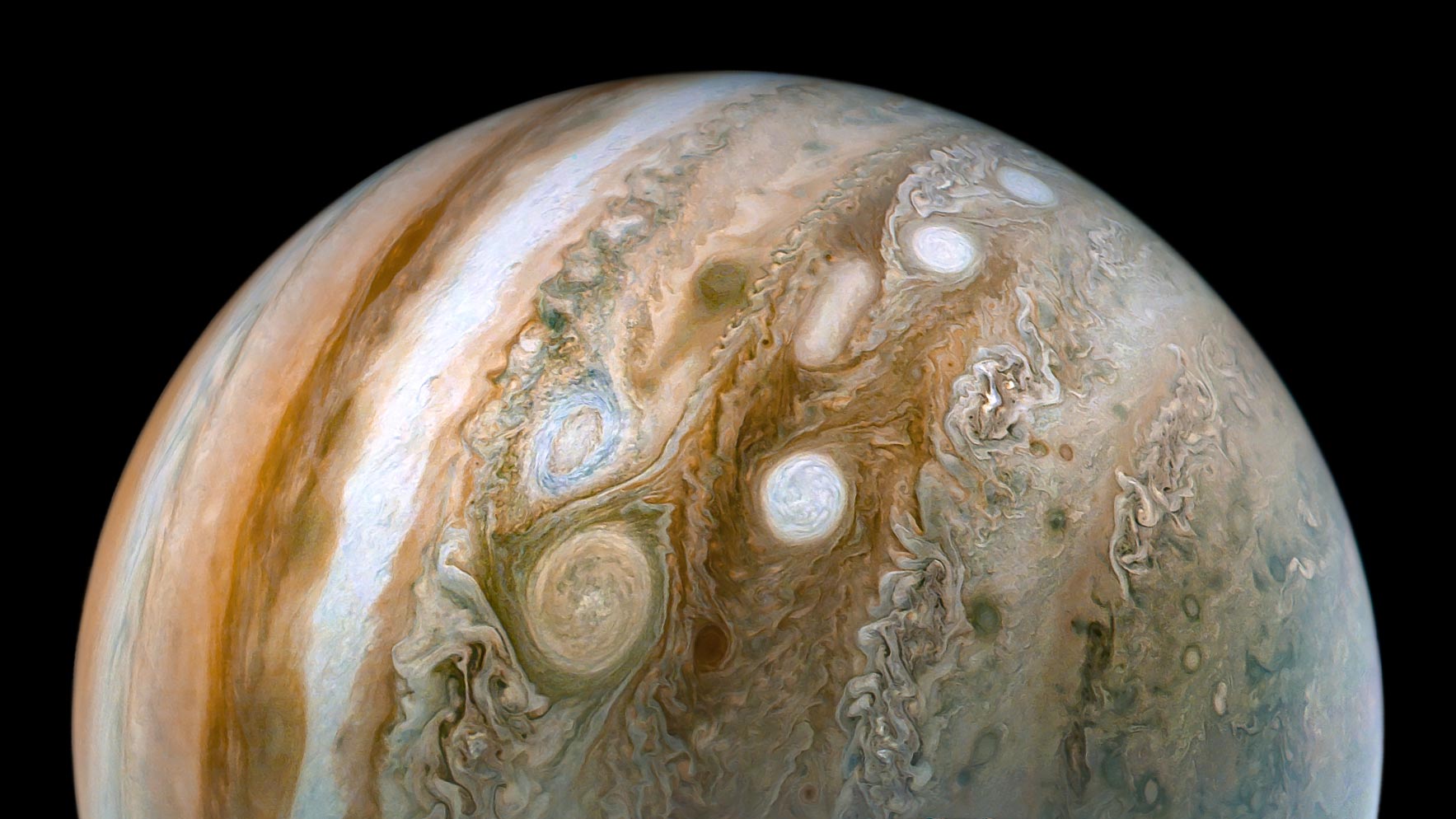
Leicester study of data captured in orbit around Jupiter has revealed new insights into what’s happening deep beneath the gas giant’s distinctive and colorful bands.
Data from the microwave radiometer carried by NASA’s Juno spacecraft shows that Jupiter’s banded pattern extends deep below the clouds, and that the appearance of Jupiter’s belts and zones inverts near the base of the water clouds. Microwave light allows planetary scientists to gaze deep beneath Jupiter’s colorful clouds, to understand the weather and climate in the warmer, darker, deeper layers.
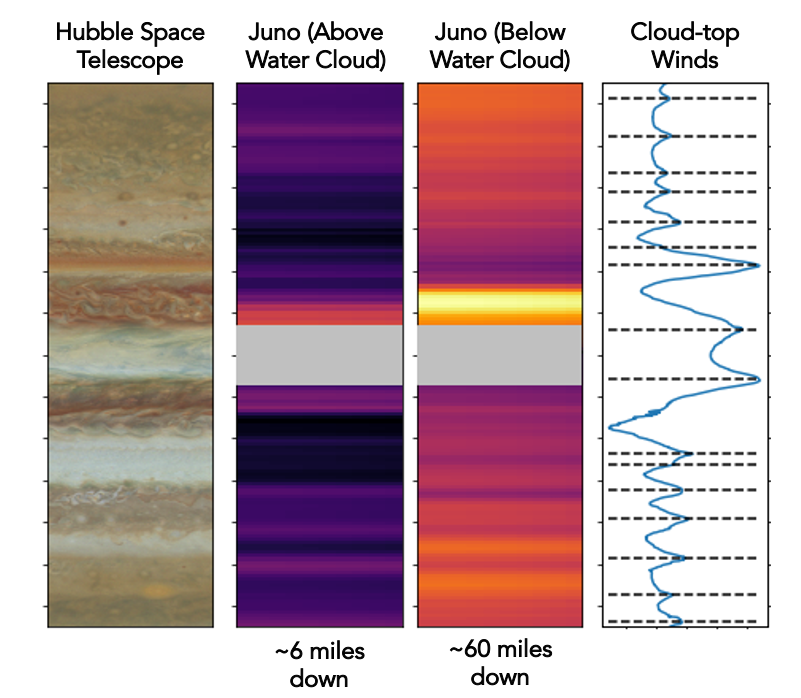
At altitudes shallower than five bars of pressure (or around five times the average atmospheric pressure on Earth), the planet’s belts shine brightly in microwave light, whereas the zones are dark. But everything changes at higher pressures, at altitudes deeper than 10 bars, giving scientists a glimpse of an unexpected reversal in the meteorology and circulation.

Dr. Leigh Fletcher, Associate Professor in Planetary Science at the University of Leicester and Participating Scientist for the Juno mission, is lead author of the study, published in the Journal of Geophysical Research-Planets. He said:
“One of Juno’s primary goals was to peer beneath the cloudy veil of Jupiter’s atmosphere, and to probe the deeper, hidden layers.
“Our study has shown that those colorful bands are just the ‘tip of the iceberg’, and that the mid-latitude bands not only extend deep, but seem to change their nature the further down you go.
“We’ve been calling the transition zone the jovicline, and its discovery has only been made possible by Juno’s microwave instrument.”
The Mystery of Jupiter’s Colorful Bands
Among Jupiter’s most notable attributes is its distinctive banded appearance. Planetary scientists call the light, whiteish bands zones, and the darker, reddish ones belts. Jupiter’s planetary-scale winds circulate in opposite directions, east and west, on the edges of these colorful stripes. A key question is whether this structure is confined to the planet’s cloud tops, or if the belts and zones persist with increasing depth.
An investigation of this phenomenon is one of the primary objectives of NASA’s Juno mission, and the spacecraft carries a specially designed microwave radiometer to measure emission from deep within the Solar System’s largest planet for the first time.
The Juno team utilizes data from this instrument to examine the nature of the belts and zones by peering deeper into the Jovian atmosphere than has ever previously been possible.
Juno’s microwave radiometer operates in six wavelength channels ranging from 1.4 cm to 50 cm (0.6 in to 20 in), and these enable Juno to probe the atmosphere at pressures starting at the top of the atmosphere near 0.6 bars to pressures exceeding 100 bars, around 250 km (155 mi) deep.
At the cloud tops, Jupiter’s belts appear bright with microwave emission, while the zones remain dark. Bright microwave emission either means warmer atmospheric temperatures, or an absence of ammonia gas, which is a strong absorber of microwave light.
The Surprising Belt–Zone Inversion
This configuration persists down to approximately five bars. And at pressures deeper than 10 bars, the pattern reverses, with the zones becoming microwave-bright and the belt becoming dark. Scientists, therefore, believe that something – either the physical temperatures or the abundance of ammonia – must therefore be changing with depth.
Dr Fletcher terms this transition region between five and 10 bars the jovicline, a comparison to the thermocline region of Earth’s oceans, where seawater transitions sharply from relative warmth to relative coldness. Researchers observe that the jovicline is nearly coincident with a stable atmospheric layer created by condensing water.
Dr Scott Bolton, of NASA’s Jet Propulsion Laboratory (JPL), is the Principal Investigator (PI) for the Juno mission. He said:
“These amazing results provide our first glimpse of how Jupiter’s famous zones and belts evolve with depth, revealing the power of investigating the giant planet’s atmosphere in three dimensions.”
Ammonia, Temperature, and Circulation Cells
There are two possible mechanisms that could be responsible for the change in brightness, each implying different physical conclusions.
One mechanism is related to the distribution of ammonia gas within the belts and zones. Ammonia is opaque to microwaves, meaning a region with relatively less ammonia will shine brighter in Juno’s observations. This mechanism could imply a stacked system of opposing circulation cells, similar to patterns in Earth’s tropics and mid-latitudes.
These circulation patterns would provide sinking in belts at shallow depths and upwelling in belts at deeper levels – or vigorous storms and precipitation, moving ammonia gas from place to place.
Heat-Driven Winds Beneath the Clouds
Another possibility is that the gradient in emission corresponds to a gradient in temperature, with higher temperatures resulting in greater microwave emission.
Temperatures and winds are connected, so if this scenario is correct, then Jupiter’s winds may increase with depth below the clouds until we reach the jovicline, before tapering off into the deeper atmosphere – something that was also suggested by NASA’s Galileo probe in 1995, which measured windspeeds as it descended under a parachute into the clouds of Jupiter.
The likely scenario is that both mechanisms are at work simultaneously, each contributing to part of the observed brightness variation. The race is now on to understand why Jupiter’s circulation behaves in this way, and whether this is true of the other Giant Planets in our Solar System.
‘Jupiter’s Temperate Belt/Zone Contrasts Revealed at Depth by Juno Microwave Observations’ is published in the Journal of Geophysical Research-Planets.
University of Leicester scientists have been members of the Juno team throughout its 5-year prime mission, orbiting the Gas Giant. Earlier this year, Leicester researchers revealed a solution to Jupiter’s ‘energy crisis’, working with colleagues from the Japanese Space Agency (JAXA), Boston University, NASA’s Goddard Space Flight Center, and the National Institute of Information and Communications Technology (NICT).
Their research, published in Nature, showed that Jupiter’s powerful aurorae are responsible for delivering planet-wide heating, despite only covering less than 10% of the planet’s area.
Leicester astronomers and planetary scientists are also set to lead Jupiter observations from the forthcoming James Webb Space Telescope, and play a leading role in both science and instrumentation on the European Space Agency (ESA)’s Jupiter Icy Moons Explorer (JUICE), due for launch in 2022.
Reference: “Jupiter’s Temperate Belt/Zone Contrasts Revealed at Depth by Juno Microwave Observations” by L. N. Fletcher, F. A. Oyafuso, M. Allison, A. Ingersoll, L. Li, Y. Kaspi, E. Galanti, M. H. Wong, G. S. Orton, K. Duer, Z. Zhang, C. Li, T. Guillot, S. M. Levin and S. Bolton, 28 October 2021, Journal of Geophysical Research Planets.
DOI: 10.1029/2021JE006858
Never miss a breakthrough: Join the SciTechDaily newsletter.
Follow us on Google and Google News.
1 Comment
not yet this is awesome forme when learning to see