
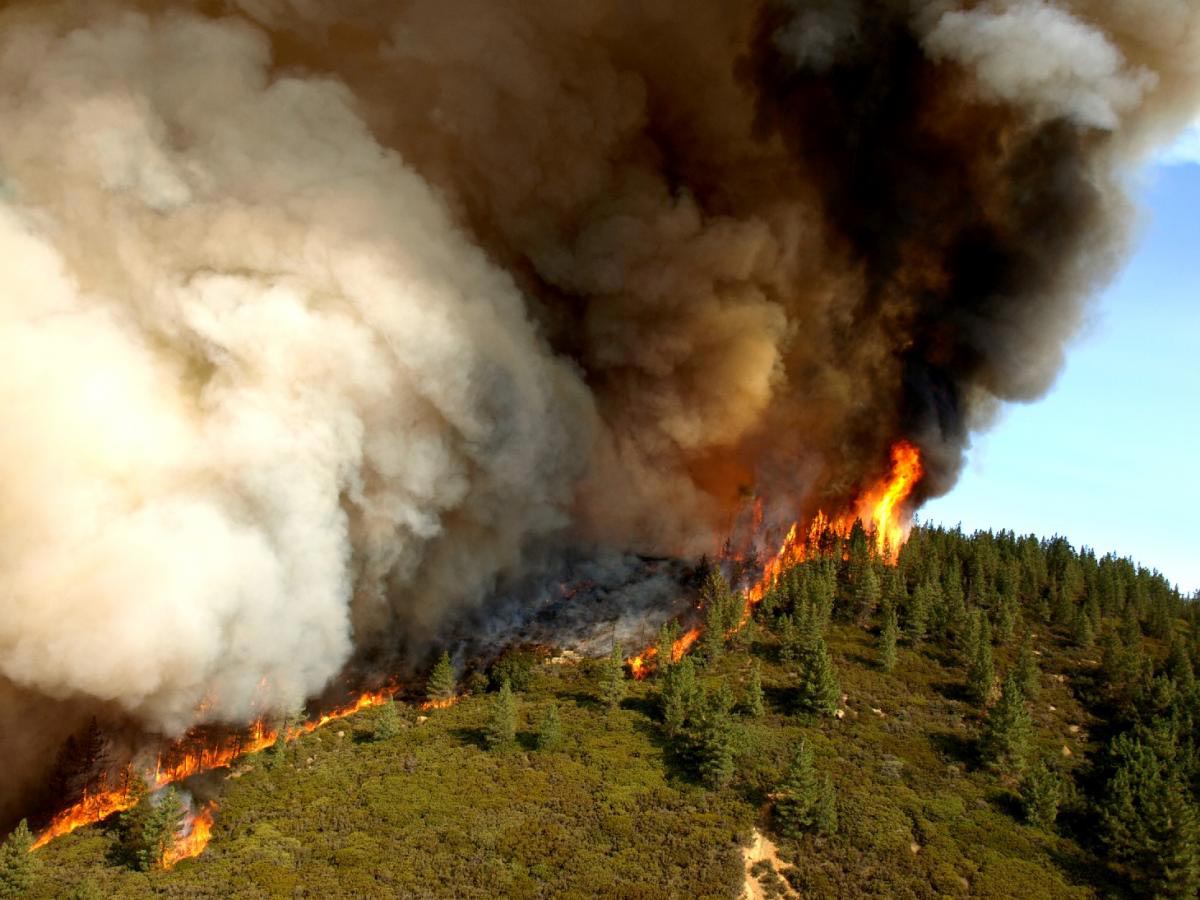
Statistical modeling highlights predictive importance of local climate and human activity.
Researchers have uncovered new insights into the dynamics that underlie the probabilities of wildfire across the state of California. Isaac Park of the University of California, Santa Barbara, and colleagues present their method and findings in the open-access journal PLOS ONE on November 3, 2021.
Recent wildfires in California and nearby states have demonstrated the need to better understand the dynamics that determine where and when wildfires occur. However, the factors and conditions that interact to contribute to the probability of wildfire—such as the interplay between local vegetation, precipitation, human land use, and more—are diverse and complex, and they vary between locations and over time.
To improve understanding of those relationships, Park and colleagues used a statistical approach known as generalized additive modeling to explore and map annual wildfire probabilities throughout California from 1970 to 2016. This work built on previous research that employed the same technique for longer time scales. In this case, the researchers tailored the method for annual probabilities by incorporating relevant information on local climate variation, human activity, and the amount of time since the previous fire event for each location and year—all at a geographic scale of 1 kilometer.
Key Drivers: Climate, Human Activity, and Fuel Dryness
This analysis uncovered several new insights into wildfire probabilities in California. For instance, the researchers found, both local climate and human activity—such as the dryness of fuel available to burn and housing density—play key roles in determining wildfire probabilities throughout the state. For example, portions of the Southern California mountains such as the Angeles and Los Padres National Forests were at high risk, having plenty of vegetation and therefore fuel availability as well as being close to and at risk from ignitions starting in high-density housing in the Los Angeles metropolitan area.
In addition, in certain environments, the amount of time since the last fire has an important influence; as do short-term climate variations involving extreme conditions, especially in fire-prone shrublands and forests in southern California.
The researchers also showed that their broad-scale, state-wide approach for predicting wildfire probabilities outperformed statistical models developed for certain localized regions. The researchers suggest that this work—and further refinements to their modeling method—could prove valuable for a variety of research and practical applications in such areas as wildfire emissions and hazard mapping for implementation of fire-resistant building codes.
The authors add: “This study presents a powerful tool for mapping the probability of wildfire across the state of California under a variety of historical climate regimes. By leveraging machine learning methods, it demonstrates the distinct ways in which local climate, human development, and prior fire history each contribute to the yearly risk of wildfire over space and time.”
Reference: “Relationships of climate, human activity, and fire history to spatiotemporal variation in annual fire probability across California” by Isaac W. Park, Michael L. Mann, Lorraine E. Flint, Alan L. Flint and Max Moritz, 3 November 2021, PLoS ONE.
DOI:10.1371/journal.pone.0254723
Funding: This work was supported by the California Department of Forestry and Fire Protection, Fire and Resource Assessment Program (CAL FIRE – FRAP) and California Climate Investments, under CAL FIRE contract number 8CA03698, to M.Moritz and M.Mann. The funders had no role in study design, data collection and analysis, decision to publish, or preparation of the manuscript.
Never miss a breakthrough: Join the SciTechDaily newsletter.
Follow us on Google and Google News.
1 Comment
“… as do short-term climate variations involving extreme conditions, …” In other words, “weather!”
“… local climate variation, …” = “microclimate.”