
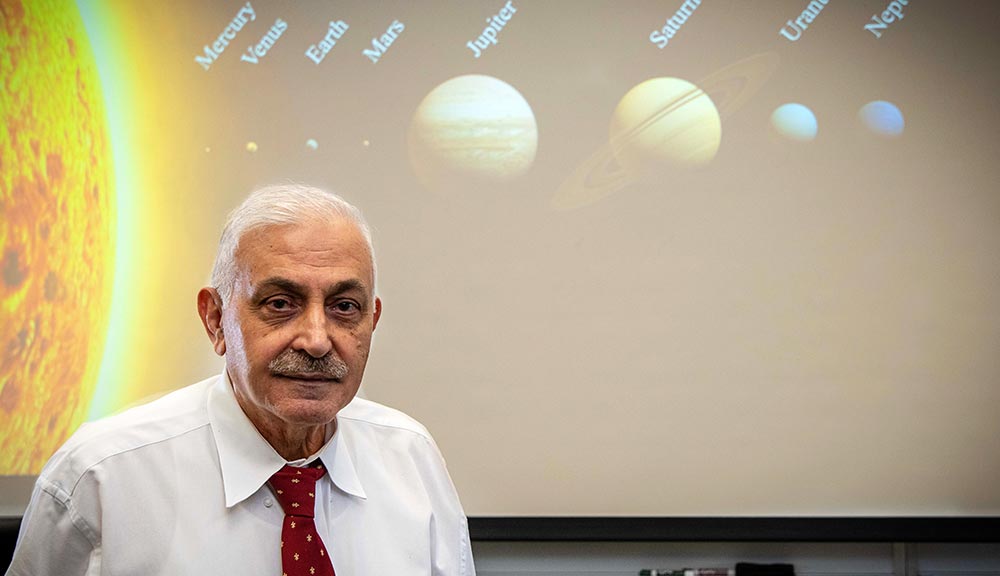
Using a limited set of mathematical equations, Worcester Polytechnic Institute mathematical sciences professor Mayer Humi said he has confirmed a 224-year-old math conjecture about the origins of our solar system, providing insights about the process that leads to the formation of solar systems across the universe.
“The science community is aware by now that there are thousands of solar systems in the galaxy. But what is not known is how these solar systems came into existence,” said Humi. “And what I’ve done is show that the first step to the creation of a solar system is the emergence of rings around a protostar. So from that standpoint, I’ve been able to verify a conjecture that is more than two centuries old.”
Humi’s peer-reviewed paper on the topic, titled “On the Evolution of a Primordial Interstellar Gas Cloud,” was recently published in the Journal of Mathematical Physics and was designated an “editor’s pick” as a featured piece.
Humi, a mathematical physicist working on the development and application of mathematical methods to astrophysics, atmospheric research, and satellite orbits, has been studying this question for more than 20 years. It is a mystery that has fascinated many generations of scientists, and an inquiry that became more pertinent as observations confirmed that solar systems and exoplanets are abundant in our galaxy. A conjecture, Humi noted, is a mathematical statement that has not been proven.
“We want to know how our solar system will evolve as time goes by,” said Humi. “There are two theories: one conjecture is that all the planets will be absorbed by the sun. The other conjecture is that planets are running away from the sun. The fundamental question is: How stable is the solar system? Are we going to be absorbed by the sun or are we going to run away from the sun?”
Humi says this research also has implications for issues such as climate change and the environment. “Imagine if we are going to come a few million miles closer to the sun. That would lead to major changes in climate and impact humanity. Oceans might evaporate.”
In 1796, the French mathematical physicist Pierre-Simon Laplace conjectured that the first step for the formation of a solar system from a primordial celestial cloud of gas requires the creation of rings of condensed matter within a cloud.
Even with its intuitively appealing contents, Humi said, this conjecture remained unverified for more than two centuries despite many efforts. Until now.
Humi was able to use a time-dependent model (based on Euler-Poisson equations) for the evolution of a primordial gas cloud and confirmed—for what Humi believes is the first time—that, under proper conditions, Laplace’s conjecture is correct.
Humi said there were some challenges with his research.
“The real stumbling block that I had to overcome in order to obtain this result was to be able to reduce the complexity of the original model,” he said. “That model has six nonlinear partial differential equations, which I reduced to three. I then provided analytical solutions to these equations, which demonstrated the creation matter rings as conjectured by Laplace.”
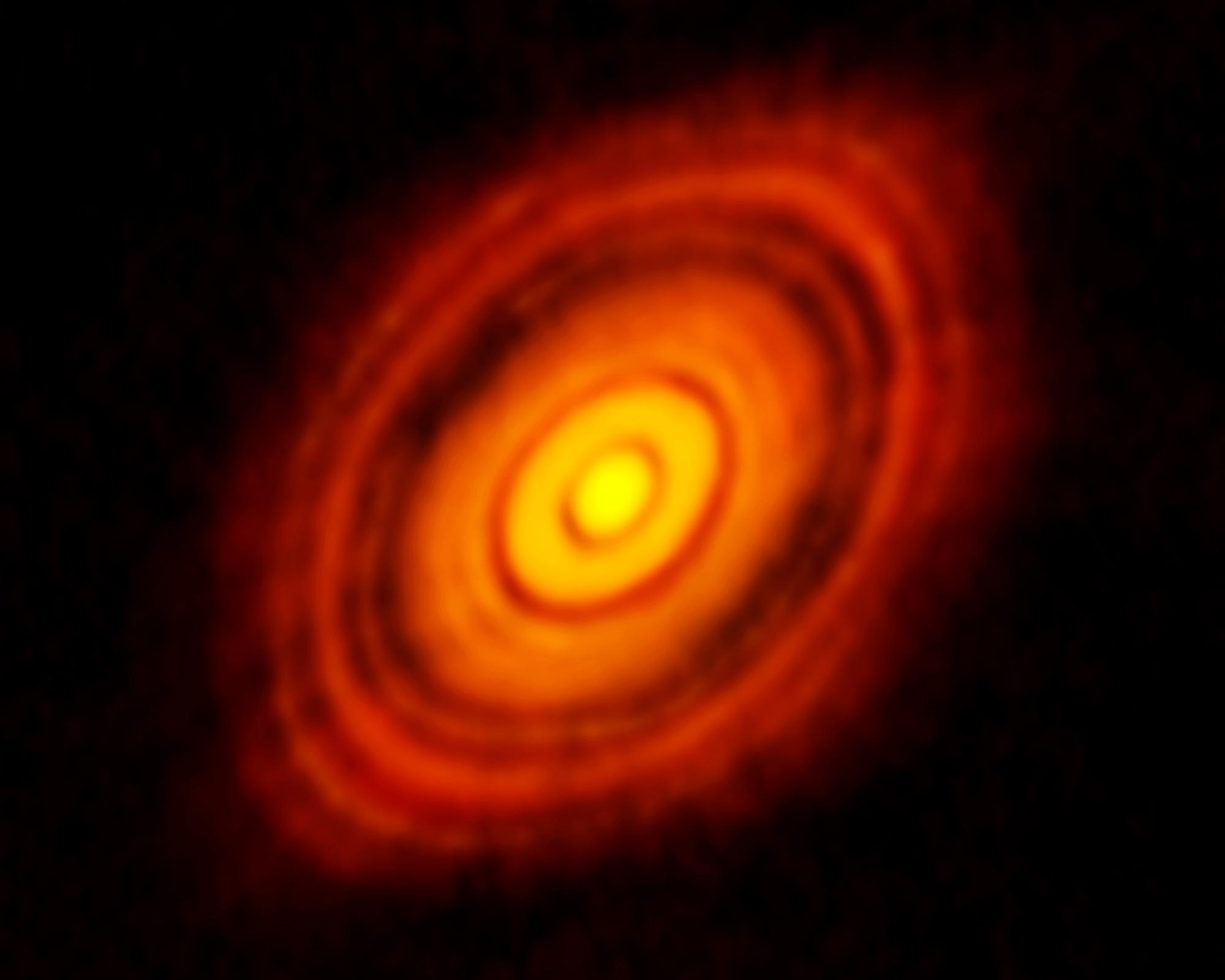
Humi noted that there has been a surge of interest in Laplace’s conjecture in recent years due to the actual discovery of ring structures around the star HL Tau in the constellation Taurus.
Humi said his research is distinctive because it makes us consider our own existence.
“It relates to the age-old question about humanity, our place in the universe, and our destiny,” he said.
Reference: “On the evolution of a primordial interstellar gas cloud” by Mayer Humi, 15 September 2020, Journal of Mathematical Physics.
DOI: 10.1063/1.5144917
Never miss a breakthrough: Join the SciTechDaily newsletter.
Follow us on Google and Google News.
13 Comments
The paper derives density waves as an analytical solution.
Now he needs to test that with simulation models.
The conjecture is unsurprisingly intuitive even without mathematical proof. Left to its own devices, a cloud of gas and dust is always going to be clumpy, and clumpiness is gravitationally clubby: it tends to increase density toward the center of clumps to the exclusion of peripheries.
If the cloud has a net angular momentum, those clumps are going are going to be smeared out into annular ‘clumps’. And because a net angular momentum has a preferred axis of rotation, it also has a preferred orbital plane wherein clumps will stably reside because of the centrifugal (pseudo)force. Any off-plane clumps will gravitate more towards the centre and lose what they had of their (lesser, off-axis) angular momentum and coalesce over time by their collisions with one another: it’s going to be a crowded three-dimensional intersection, with no traffic cop. Thus, the vast bulk of the original cloud is going to wind up in the center.
And to complete the picture, the densities around those annuli will never be perfectly uniformly smeared; each original clump will increasingly predominate within its annulus and…
Maybe it is intuitive, but the paper starts from the basic Euler–Poisson
equations that describe the steady state of non-rotating, spherically symmetric stars with mass density ρ = ρ(r) and flow velocity field u = 0 so it is not really helpful to form an intuition of disk formation.
From where it derives analytical solutions to perturbations in the form of density waves and has not explored them either analytically or numerically.
This may indeed explain one process that leads to planetary systems around protostars, however it does not eliminate many other processes, such as a wandering brown drawrf and its moons falling into orbit around a star, thence becoming a giant planet in that system.
These rings are formed by the planets meaning planetary formation began earlier. What we see as rings are the remnants of the original cloud, the planets themselves are in the space between rings. As the planets patrol their orbit, any material in the rings falls into the planets until the original cloud is absorbed by the planets or dispersed by the star.
I think the paper could be a part of disk – density waves – planets – gap formation models. But I agree with your skepticism.
So, from the results of that research/math-model, will Earth move toward the Sun or recede away over time?
The model only describes the formation of the system during the time there is a gas and dust filled disk. The later development is different, when friction and collision is mostly gone. There are many effects, such as correlated changes between orbit ellipse and planet axis parameter [ https://en.wikipedia.org/wiki/Milankovitch_cycles ].
For orbit size it is tidal interactions that dissipate energy. The Sun tidal force is 1/3 of Moons as seen in relation to ocean lunar tides. But in the Moon vs Earth case it is Earth rotational energy that is sapped, in the case of Earth vs Sun it is the orbit kinetic energy that is dissipated (see below on tidal interaction with Sun). The result of various forces keds up to a complicated dance at the end of Sun’s main sequence life:
“The Sun will experience more rapid mass loss, with about 33% of its total mass shed with the solar wind. The loss of mass will mean that the orbits of the planets will expand. The orbital distance of the Earth will increase to at most 150% of its current value.[71]
The most rapid part of the Sun’s expansion into a red giant will occur during the final stages, when the Sun will be about 12 billion years old. It is likely to expand to swallow both Mercury and Venus, reaching a maximum radius of 1.2 AU (180,000,000 km). The Earth will interact tidally with the Sun’s outer atmosphere, which would serve to decrease Earth’s orbital radius. Drag from the chromosphere of the Sun would also reduce the Earth’s orbit. These effects will act to counterbalance the effect of mass loss by the Sun, and the Earth will probably be engulfed by the Sun.[71]”
[ https://en.wikipedia.org/wiki/Future_of_Earth#Orbit_and_rotation ]
This is a hypothetical effort thus far, and I may have gotten it wrong. It is possible that current changes in Earth orbit is observable aside from the observed Milankovitch cycles, but I think it is iffy.
The model only describes the formation of the system during the time there is a gas and dust filled disk. The later development is different, when friction and collision is mostly gone. There are many effects, such as correlated changes between orbit ellipse and planet axis parameter [Milankovitch cycles@Wikipedia].
For orbit size it is tidal interactions that dissipate energy. The Sun tidal force is 1/3 of Moons as seen in relation to ocean lunar tides. But in the Moon vs Earth case it is Earth rotational energy that is sapped, in the case of Earth vs Sun it is the orbit kinetic energy that is dissipated (see below on tidal interaction with Sun). The result of various forces keds up to a complicated dance at the end of Sun’s main sequence life:
“The Sun will experience more rapid mass loss, with about 33% of its total mass shed with the solar wind. The loss of mass will mean that the orbits of the planets will expand. The orbital distance of the Earth will increase to at most 150% of its current value.[71]
The most rapid part of the Sun’s expansion into a red giant will occur during the final stages, when the Sun will be about 12 billion years old. It is likely to expand to swallow both Mercury and Venus, reaching a maximum radius of 1.2 AU (180,000,000 km). The Earth will interact tidally with the Sun’s outer atmosphere, which would serve to decrease Earth’s orbital radius. Drag from the chromosphere of the Sun would also reduce the Earth’s orbit. These effects will act to counterbalance the effect of mass loss by the Sun, and the Earth will probably be engulfed by the Sun.[71]”
[ https://en.wikipedia.org/wiki/Future_of_Earth#Orbit_and_rotation ]
This is a hypothetical effort thus far, and I may have gotten it wrong. It is possible that current changes in Earth orbit is observable aside from the observed Milankovitch cycles, but I think it is iffy.
Actually I think one error is that I claim the current tidal force would decrease orbital kinetic energy – orbiting closer would mean sapping the gravitational potential component of the orbit. Instead planets move faster in closer orbits to Sun.
cont. – for example, we know the Moon’s distance from Earth is growing.
change is everlasting be it star or planets galaxies,living $non living beings. Article shows changes in the universe.