
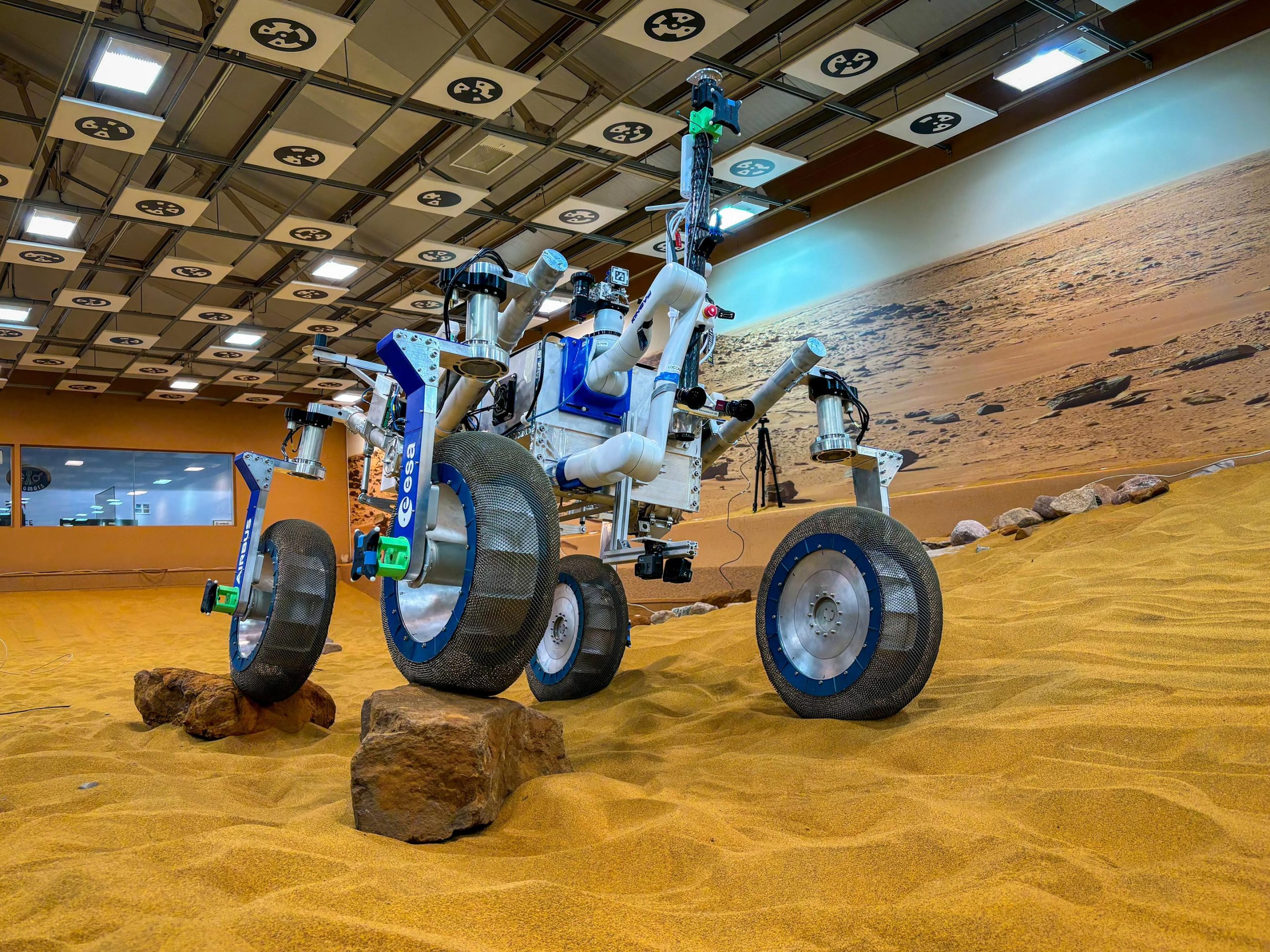
Exciting advances in space exploration are underway as NASA tests revolutionary shape memory alloy (SMA) spring tires designed to tackle the harsh terrain of Mars.
Developed at NASA Glenn in collaboration with Goodyear, these innovative tires can endure extreme deformation and return to their original shape, unlike traditional metals.
Exploring Mars: The Challenge of Mobility
For centuries, Mars has fascinated scientists and explorers alike. As the fourth planet from the Sun, it resembles a vast, red desert with a rugged and challenging terrain. Despite multiple robotic missions to Mars, NASA has only explored about 1% of its surface. In preparation for future human and robotic missions, NASA recently conducted extensive rover testing on simulated Martian terrain. This testing featured groundbreaking shape memory alloy (SMA) spring tire technology, developed at NASA’s Glenn Research Center in Cleveland in collaboration with Goodyear Tire & Rubber.
Rovers — mobile robots designed to explore planetary and lunar surfaces — require highly durable tires to navigate their environments effectively. Mars’ rocky and uneven landscape presents significant mobility challenges, making robust and flexible tires crucial for successful exploration. Shape memory alloy (SMA) spring tires offer a promising solution to these challenges.

What Are Shape Memory Alloys?
Shape memory alloys are special metals that can return to their original shape after being bent, stretched, heated, or cooled. While NASA has used this technology in various applications for decades, incorporating it into rover tires is a relatively new and exciting development
“We at Glenn are one of the world leaders in bringing the science and understanding of how you change the alloy compositions, how you change the processing of the material, and how you model these systems in a way that we can control and stabilize the behaviors so that they can actually be utilized in real applications,” said Dr. Santo Padula II, materials research engineer at NASA Glenn.
Padula and his team have tested several applications for SMAs, but his epiphany of the possibilities for tires came about because of a chance encounter.
A Chance Encounter Sparks Innovation
While leaving a meeting, Padula encountered Colin Creager, a mechanical engineer at NASA Glenn whom he hadn’t seen in years. Creager used the opportunity to tell him about the work he was doing in the NASA Glenn Simulated Lunar Operations (SLOPE) Laboratory, which can simulate the surfaces of the Moon and Mars to help scientists test rover performance. He brought Padula to the lab, where Padula immediately took note of the spring tires. At the time, they were made of steel.
Padula remarked, “The minute I saw the tire, I said, aren’t you having problems with those plasticizing?” Plasticizing refers to a metal undergoing deformation that isn’t reversible and can lead to damage or failure of the component.
“Colin told me, ‘That’s the only problem we can’t solve.’” Padula continued, “I said, I have your solution. I’m developing a new alloy that will solve that. And that’s how SMA tires started.”
Nickel-Titanium SMAs: The Game-Changer
From there, Padula, Creager, and their teams joined forces to improve NASA’s existing spring tires with a game-changing material: nickel-titanium SMAs. The metal can accommodate deformation despite extreme stress, permitting the tires to return to their original shape even with rigorous impact, which is not possible for spring tires made with conventional metal.
Since then, research has been abundant, and in the fall of 2024, teams from NASA Glenn traveled to Airbus Defence and Space in Stevenage, United Kingdom, to test NASA’s innovative SMA spring tires. Testing took place at the Airbus Mars Yard — an enclosed facility created to simulate the harsh conditions of Martian terrain.
“We went out there with the team, we brought our motion tracking system and did different tests uphill and back downhill,” Creager said. “We conducted a lot of cross slope tests over rocks and sand where the focus was on understanding stability because this was something we had never tested before.”
Testing Results and Performance Insights
During the tests, researchers monitored rovers as the wheels went over rocks, paying close attention to how much the crowns of the tires shifted, any damage, and downhill sliding. The team expected sliding and shifting, but it was very minimal, and testing met all expectations. Researchers also gathered insights about the tires’ stability, maneuverability, and rock traversal capabilities.
As NASA continues to advance systems for deep space exploration, the agency’s Extravehicular Activity and Human Surface Mobility program enlisted Padula to research additional ways to improve the properties of SMAs for future rover tires and other potential uses, including lunar environments.
“My goal is to extend the operating temperature capability of SMAs for applications like tires, and to look at applying these materials for habitat protection,” Padula said. “We need new materials for extreme environments that can provide energy absorption for micrometeorite strikes that happen on the Moon to enable things like habitat structures for large numbers of astronauts and scientists to do work on the Moon and Mars.”
Researchers say shape memory alloy spring tires are just the beginning.
Never miss a breakthrough: Join the SciTechDaily newsletter.
Follow us on Google and Google News.
1 Comment
Wow, NASA “discovers” a “revolutionary” material that’s over 60 years old. I remember seeing Nitinol demonstrated when I was a kid in school in the 1960’s. Why do I fell unimpressed?