
Close Menu
    Facebook X (Twitter) Instagram
    SciTechDaily
    • Biology
    • Chemistry
    • Earth
    • Health
    • Physics
    • Science
    • Space
    • Technology
    Facebook X (Twitter) Pinterest YouTube RSS
    SciTechDaily
    Home»Technology»NASA Mobile Launcher Reacted as Expected During Move to Launch Pad 39B
    Technology

    NASA Mobile Launcher Reacted as Expected During Move to Launch Pad 39B

    By Steven Siceloff, NASA's Kennedy Space CenterFebruary 7, 2012No Comments4 Mins Read
    Facebook Twitter Pinterest Telegram LinkedIn WhatsApp Email Reddit
    Share
    Facebook Twitter LinkedIn Pinterest Telegram Email Reddit
    Mobile Launcher Tests Confirm Designs
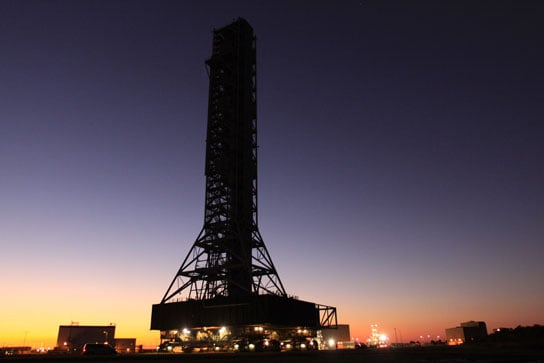
    The mobile launcher was returned to its park site beside the Vehicle Assembly Building in November 2011 following checkouts at Launch Pad 39B at NASA’s Kennedy Space Center in Florida. Credit: NASA/Kim Shiflett

    The results are in and multiple sensors showed that NASA’s 355-foot-tall (108-meter-tall) Mobile Launcher reacted as expected during its move to Launch Pad 39B in November 2011. Engineers were testing to see if the structure and crawler would be up to the challenge and stated that the actual results varied less than 5 percent from the predicted computer models used in designing the ML.

    The 355-foot-tall Mobile Launcher, or ML, behaved as expected during its move to Launch Pad 39B in November 2011, an analysis of multiple sensors showed. The top of the tower swayed less than an inch each way.

    “I would think you would have perceived it,” said NASA’s Chris Brown, the lead design engineer for the ML.

    The tests showed that the computer models used in designing the massive structure were correct. The actual results varied less than 5 percent of what was predicted.

    “This gives us much higher confidence in the models,” Brown said. “We know that our approach is valid.”

    The computer models for the launch support structures and the models for the Space Launch System rocket the ML will work with will be used together to fine-tune both designs.
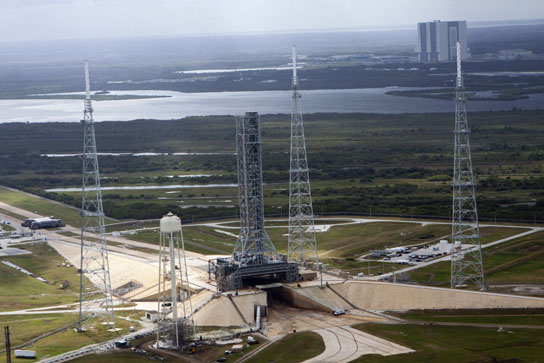
    mobile launcher as it stood at Launch Pad 39B
    The mobile launcher as it stood at Launch Pad 39B. Note the Vehicle Assembly Building in the background. Credit: NASA/Kim Shiflett

    Engineers had the tower wired with dozens of accelerometers and strain gauges along with wind sensors to record the launcher’s movement during its slow ride atop a crawler-transporter from a park site beside the Vehicle Assembly Building to the launch pad.

    The ML is expected to make the same trip numerous times during its career as the support structure for NASA’s Space Launch System, or SLS, a huge rocket envisioned to launch astronauts into deep space. The move and testing were planned to show designers whether the structure and crawler would be up to the challenge.

    Crawler drivers performed several speed changes during the six-mile journeys to and from the pad. While at the pad, which is being refurbished after decades of hosting space shuttles, workers connected ventilation, fire support and alarm systems and other water lines.

    The instruments used in the testing are very precise, and accurate enough to record even the most subtle of vibrations and movements.

    “We were measuring milli-g’s,” Brown said.

    The readings will also be used for determining how fast the crawler will be allowed to go as it carries the rocket to the launch pad. For instance, there is substantial vibration at 0.8 mph (1.3 kph), so engineers want drivers to stay away from that particular speed, but that does not necessarily mean the crawler will be ordered to slow it down.

    The ML, designed for the Ares I rocket of the canceled Constellation program, is due for major modifications in the coming few years as it is strengthened to support the much-heavier SLS. It took two years to build and was completed in August 2010.

    A structural design contract is expected to be awarded this year and a construction contractor in 2013. Umbilical arms reaching from the tower to the rocket are scheduled to be installed in 2015.

    The ML is the biggest structure of its kind since the Launch Umbilical Towers were constructed to support the Apollo/Saturn V. Those towers saw numerous modifications throughout their lives as trial-and-error showed where changes were needed, Brown said.

    “Our goal here is to have less of those kinds of problems,” Brown said.

    Computer models were also used when NASA designed the Apollo towers, but those models were much simpler than today’s versions simply by virtue of the computing power available now, Brown said.

    “We can run in five minutes what would have taken them days to run,” Brown said.

    Never miss a breakthrough: Join the SciTechDaily newsletter.
    Follow us on Google and Google News.

    Kennedy Space Center NASA Space Launch System
    Share. Facebook Twitter Pinterest LinkedIn Email Reddit

    Related Articles

    Artemis I Progress Continues in NASA’s Vehicle Assembly Building

    NASA’s Artemis I SLS Rocket Core Stage Transported to Its New Home

    Barging In: Mighty SLS Core Stage for Artemis I Mission Arrives at Kennedy Space Center

    Space Launch System Core Stage Heads to NASA’s Kennedy Space Center

    Future NASA Rocket Engines May Include Large-Scale 3D Printing

    A Peek Inside the Fuel Tank For World’s Largest Rocket

    NASA Space Launch System Completes Design Review, Ready to Meet the Challenges of the Journey to Mars

    NASA SLS Program ‘Right on Track’ for Journey to Mars

    NASA’s Space Launch System Passes Review, Moving to Preliminary Design Phase

    Leave A Reply Cancel Reply

    • Facebook
    • Twitter
    • Pinterest
    • YouTube

    Don't Miss a Discovery

    Subscribe for the Latest in Science & Tech!

    Trending News

    The Universe Is Expanding Too Fast and Scientists Can’t Explain Why

    “Like Liquid Metal”: Scientists Create Strange Shape-Shifting Material

    Early Warning Signals of Esophageal Cancer May Be Hiding in Plain Sight

    Common Blood Pressure Drug Shows Surprising Power Against Deadly Antibiotic-Resistant Superbug

    Scientists Uncover Dangerous Connection Between Serotonin and Heart Valve Disease

    Scientists Discover a “Protector” Protein That Could Help Reverse Hair Loss

    Bone-Strengthening Discovery Could Reverse Osteoporosis

    Scientists Uncover Hidden Trigger Behind Stem Cell Aging

    Follow SciTechDaily
    • Facebook
    • Twitter
    • YouTube
    • Pinterest
    • Newsletter
    • RSS
    SciTech News
    • Biology News
    • Chemistry News
    • Earth News
    • Health News
    • Physics News
    • Science News
    • Space News
    • Technology News
    Recent Posts
    • Scientists Overcome Major Quantum Bottleneck, Potentially Transforming Teleportation and Computing
    • Quantum Physics’ Strangest Problem May Hold the Key to Time Itself
    • Scientists Create “Liquid Gears” That Spin Without Touching
    • The Simple Habit That Could Help Prevent Cancer
    • Forgotten Medicinal Plant Shows Promise in Fighting Dangerous Superbugs
    Copyright © 1998 - 2026 SciTechDaily. All Rights Reserved.
    • Science News
    • About
    • Contact
    • Editorial Board
    • Privacy Policy
    • Terms of Use

    Type above and press Enter to search. Press Esc to cancel.