
NASA’s SOFIA flying Observatory set to study planets, comets, and asteroids orbiting other stars and supermassive black holes.
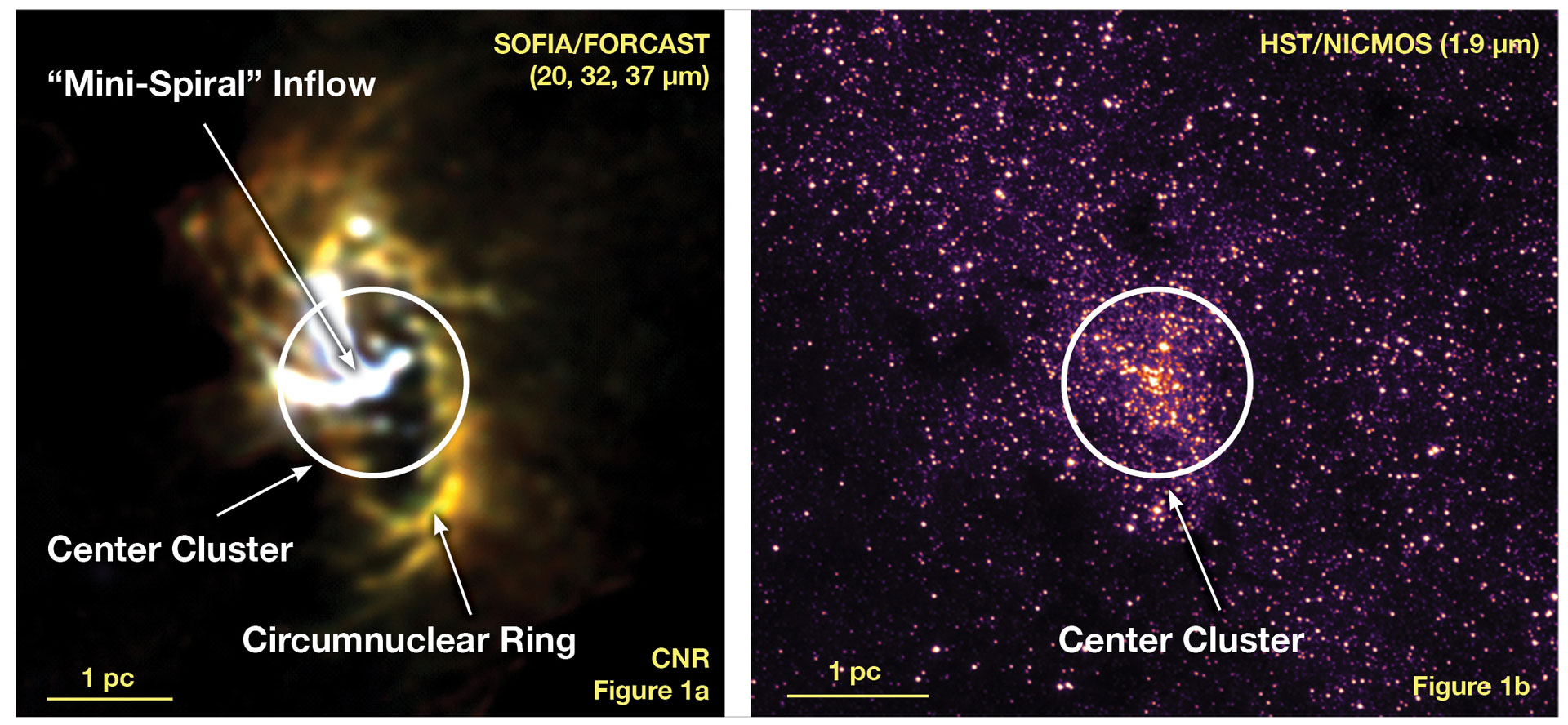
NASA’s Stratospheric Observatory for Infrared Astronomy, SOFIA, will soon be studying Neptune’s giant moon, Triton, and following up on Hubble’s recent sighting of water plumes on Jupiter’s moon Europa. According to recently completed plans for the 2017 observing campaign, about half of the research time for SOFIA will run the gamut from studies of planets to observations of comets and asteroids orbiting other stars and supermassive black holes in the centers of galaxies beyond our own. The other half will focus on star formation and the interstellar medium, the areas of dust and gas in the universe, including a vast turbulent region encircling the center of our Milky Way galaxy.
A total of 535 observing hours have been awarded for SOFIA’s Science Cycle 5, which runs from February 2017 through January 2018, and the selected programs span the entire field of astronomy from planetary science to extragalactic investigations. Triton, only one-third of a light year from Earth, will be one of the closest objects studied by NASA’s flying observatory while the farthest observation will study a supermassive black hole approximately 12 billion light years away.
SOFIA is a joint program between NASA and the German Aerospace Center and is a Boeing 747SP jetliner modified to carry a 100-inch diameter telescope that uses eight instruments to study the universe at infrared wavelengths that cannot be detected from ground-based observatories. Cycle 5 provides 455 research hours to U.S. programs and 80 hours to German programs.
“Four very highly rated programs were selected to investigate the galactic center region using the upGREAT high-resolution far-infrared spectrometer,” said Harold Yorke SOFIA Science Mission Director of the Universities Space Research Association.
“Three of those programs are aimed at understanding the Central Molecular Zone, a vast, turbulent region encircling the Milky Way’s nucleus that contains a large fraction of the galaxy’s dense molecular clouds and star-forming regions, Yorke explained. “The fourth program is focused on material surrounding, and perhaps feeding into, the supermassive black hole at the very heart of our galaxy.”
To study celestial objects that are best viewed from the Southern Hemisphere, planning is underway for an eight-week deployment to Christchurch, New Zealand, from late June to late August 2017, employing three instruments: the spectrometer known as the upgraded German Receiver for Astronomy at Terahertz Frequencies, or upGREAT, The Faint Object infraRed Camera for the SOFIA Telescope, or FORCAST, a combined mid-infrared camera and spectrometer, and the Far Infrared Field-Imaging Line Spectrometer, or FIFI-LS, a far-infrared imaging spectrometer.
Closer to home, the Echelon-Cross-Echelle Spectrograph, or EXES, a mid-infrared spectrometer, will take advantage of that instrument’s great sensitivity and high spectral resolution to make an ambitious search for previously unobserved molecules in the Orion star-forming region, looking for rare molecular species like acetylene, ethylene, and ethane. These observations will provide information about the production of organic compounds and water in a region where stars and planets are currently forming.
SOFIA’s High-resolution Airborne Wideband Camera-plus, known as HAWC+, a far-infrared polarimeter camera, now being commissioned, is slated for a joint project with the most powerful telescope on Earth, the Atacama Large Millimeter/submillimeter Array, ALMA, to understand how the galaxy’s magnetic fields resist the collapse of gas clouds that form stars thereby affecting the star formation process.
A challenging planetary science investigation will use SOFIA to observe Triton when it passes in front of a bright background star in October 2017. This would require a mini-deployment to the U.S. East Coast where the shadow of Triton will briefly be cast, allowing a look at that moon’s thin atmosphere.
“This project is quite comparable to SOFIA’s study of Pluto and its atmosphere during a stellar occultation observed from near New Zealand in 2015, and in fact was proposed by the same investigator team,” Yorke said. “This type of research demonstrates the virtues of a mobile observatory that can go wherever on Earth is required to view transient celestial phenomena.”
SOFIA’s ability to change instruments and adapt new technologies enables the rapid development and deployment of new sensors. To that end, NASA plans to solicit proposals for SOFIA’s next-generation instrumentation in 2017.
Never miss a breakthrough: Join the SciTechDaily newsletter.
Follow us on Google and Google News.