
Close Menu
    Facebook X (Twitter) Instagram
    SciTechDaily
    • Biology
    • Chemistry
    • Earth
    • Health
    • Physics
    • Science
    • Space
    • Technology
    Facebook X (Twitter) Pinterest YouTube RSS
    SciTechDaily
    Home»Earth»NASA’s Terra Satellite Captures Smoky Pall Over California After Unprecedented Lightning Strikes Ignite More Than 650 Wildfires
    Earth

    NASA’s Terra Satellite Captures Smoky Pall Over California After Unprecedented Lightning Strikes Ignite More Than 650 Wildfires

    By Lynn Jenner, NASA's Goddard Space Flight CenterAugust 25, 2020No Comments3 Mins Read
    Facebook Twitter Pinterest Telegram LinkedIn WhatsApp Email Reddit
    Share
    Facebook Twitter LinkedIn Pinterest Telegram Email Reddit
    NASA Terra Smoke Covered California
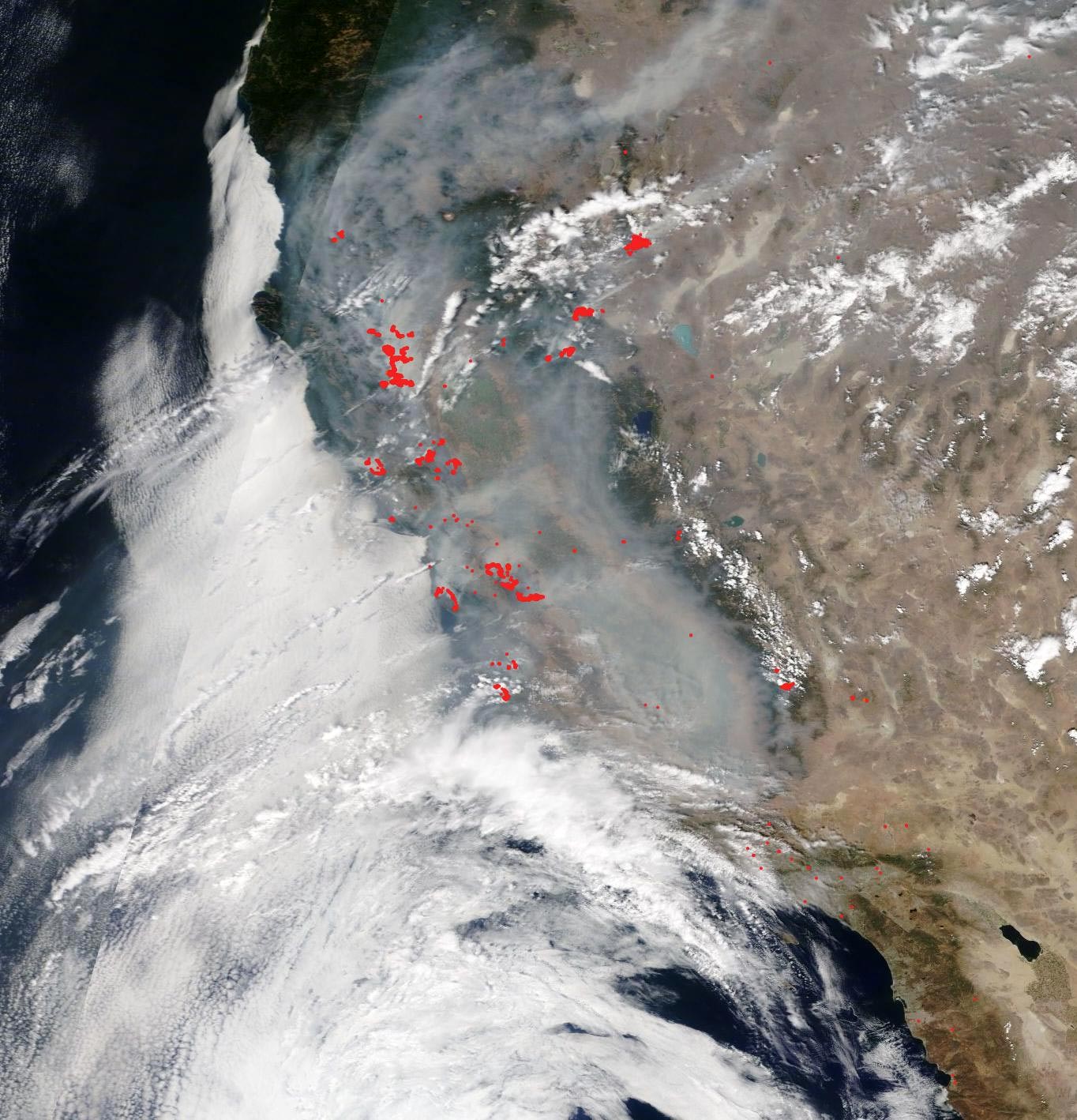
    NASA’s Terra satellite shows a smoke-covered California on August 24, 2020. Credit: NASA Worldview, Earth Observing System Data and Information System (EOSDIS)

    More than 650 wildfires are blazing in California after unprecedented lightning strikes, storms, and a heatwave that has set new records in the state and NASA’s Terra satellite captured the smoke-engulfed state on August 24, 2020.

    The two largest fires still burning the state are both named after the firefighting units that are battling them and the fact that both began with lightning strikes.  The LNU Lightning Complex and the SCU Lightning Complex are both located in northern California. The LNU (Lake Napa Unit) Lightning Complex has burned 347,630 acres and is 21% contained and the SCU (Santa Clara Unit) Lightning Complex has consumed 343,965 acres and is 10% contained according to the CAL Fire website. These two fires are now second and third on the list of California’s largest wildfires.

    Even discounting these fires there are still hundreds of other fires burning across the state as can be seen in this Terra satellite image taken on August 24, 2020. Red dots litter the landscape designating areas which are most likely fires–so many fires, in fact, that the dots blur together and individual fire are no longer visible.

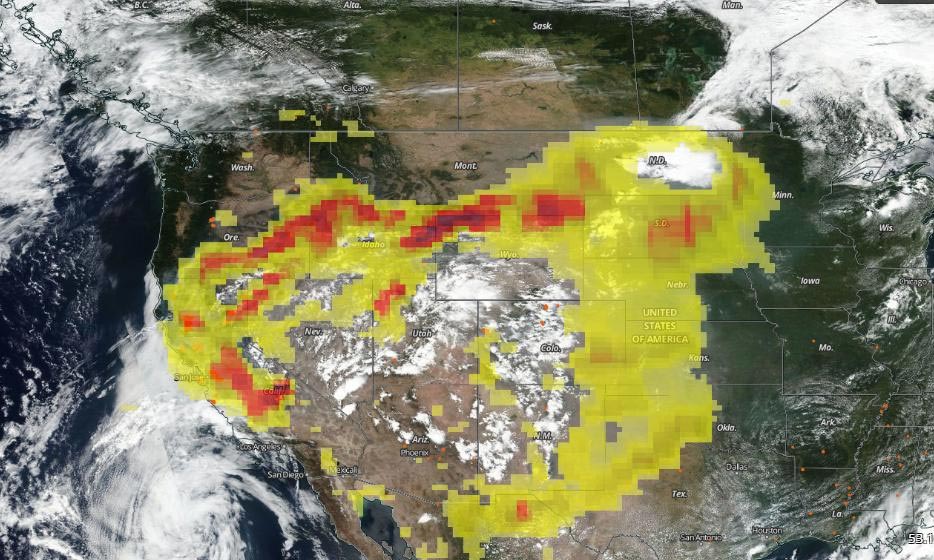
    More insidious than the fires is the smoke that rises from the landscape.  This aerosol image below shows not only California being affected by the heavy smoke as seen in the visible image above, but the smoke has traveled across much of the United States affecting areas from California all the way to Minnesota and Nebraska and air currents will undoubtedly carry the smoke across the entire U.S.
    Suomi NPP Aerosols California Fires
    NOAA-NASA’s Suomi NPP tracks aerosols over the U.S. from California fires. Credit: NASA Worldview, Earth Observing System Data and Information System (EOSDIS)

    The aerosol index provides information about the presence of particles in the air.  According to NASA Worldview: “The Aerosol Index is a unitless range from < 0.00 [clear] to >=5.00, where 5.0 [deepest red] indicates heavy concentrations of aerosols that could reduce visibility or impact human health. The Aerosol Index layer is useful for identifying and tracking the long-range transport of volcanic ash from volcanic eruptions, smoke from wildfires or biomass burning events and dust from desert dust storms, even tracking over clouds and areas of snow and ice.” In this image deep red areas can be seen in California but can also be seen as far east as Minnesota meaning the heavy aerosols do not necessarily diminish as they travel on the air currents.

    NASA’s satellite instruments are often the first to detect wildfires burning in remote regions, and the locations of new fires are sent directly to land managers worldwide within hours of the satellite overpass. Together, NASA instruments detect actively burning fires, track the transport of smoke from fires, provide information for fire management, and map the extent of changes to ecosystems, based on the extent and severity of burn scars. NASA has a fleet of Earth-observing instruments, many of which contribute to our understanding of fire in the Earth system. Satellites in orbit around the poles provide observations of the entire planet several times per day, whereas satellites in a geostationary orbit provide coarse-resolution imagery of fires, smoke and clouds every five to 15 minutes.

    Never miss a breakthrough: Join the SciTechDaily newsletter.
    Follow us on Google and Google News.

    NASA NASA Goddard Space Flight Center Wildfires
    Share. Facebook Twitter Pinterest LinkedIn Email Reddit

    Related Articles

    Massive Burn Scars Across California Revealed in Stunning NASA Terra Satellite Images

    1200+ Mile Trail of Smoke Stretches Across California in These NASA Terra Images of the Wildfires

    63 Mile Smoke Trail From Bighorn Fire Captured by NOAA/NASA Satellite

    Latest NASA Satellite Observations of Australia’s Bushfires Show Smoke Going Round the World

    World Path of Smoke and Aerosols From Australian Fires Animated by Fleet of NASA Satellites

    Satellite View of Australian Fires Shows Severe Burn Scars Across Kangaroo Island

    Stunning Satellite Images As Rain Brings Relief to Australia’s Fires

    Satellite Imagery Shows Ferocious Fires in Australia Intensify

    NASA Satellite Image: Amazon Fires Shroud South America in Smoke

    Leave A Reply Cancel Reply

    • Facebook
    • Twitter
    • Pinterest
    • YouTube

    Don't Miss a Discovery

    Subscribe for the Latest in Science & Tech!

    Trending News

    Your Blood Pressure Reading Could Be Wrong Because of One Simple Mistake

    Astronomers Stunned by Ancient Galaxy With No Spin

    Physicists May Be on the Verge of Discovering “New Physics” at CERN

    Scientists Solve 320-Million-Year Mystery of Reptile Skin Armor

    Scientists Say This Daily Walking Habit May Be the Secret to Keeping Weight Off After Dieting

    New Therapy Rewires the Brain To Restore Joy in Depression Patients

    Giant Squid Detected off Western Australia in Stunning Deep-Sea Discovery

    Popular Sugar-Free Sweetener Linked to Liver Disease, Study Warns

    Follow SciTechDaily
    • Facebook
    • Twitter
    • YouTube
    • Pinterest
    • Newsletter
    • RSS
    SciTech News
    • Biology News
    • Chemistry News
    • Earth News
    • Health News
    • Physics News
    • Science News
    • Space News
    • Technology News
    Recent Posts
    • New Stroke Study Challenges Decades-Old Medical Beliefs
    • These Simple Plant Foods Are Linked to Lower Blood Pressure
    • Common Blood Pressure Drug Supercharges Cancer Treatment in Surprising New Study
    • Key Magic Mushroom Ingredient Increases Laziness and Reduces Aggression
    • Researchers Solve 15-Year Mystery Behind Cancer-Causing Gut Toxin
    Copyright © 1998 - 2026 SciTechDaily. All Rights Reserved.
    • Science News
    • About
    • Contact
    • Editorial Board
    • Privacy Policy
    • Terms of Use

    Type above and press Enter to search. Press Esc to cancel.