
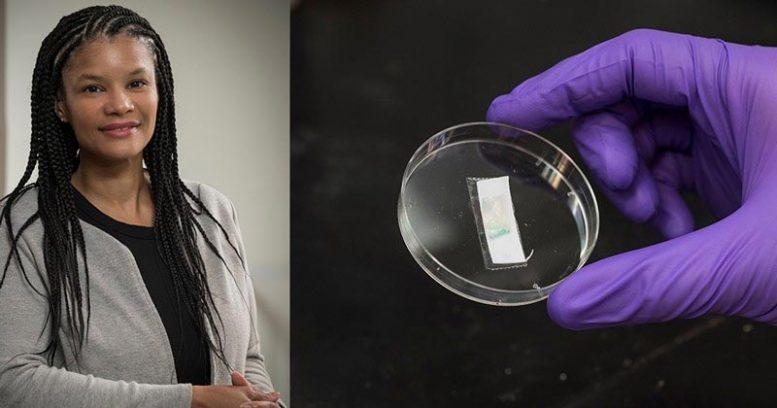
Drawing inspiration from natural marvels to make new materials, UD researchers mimic the architecture of the bristle worm’s jaw system.
A tiny bristle worm, wriggling around the ocean, can extend its jaw outside its mouth to ensnare its prey. The worm’s shape-shifting jaw, stiff at the base and flexible at the end, is made of one singular material containing the mineral zinc and the amino acid histidine, which together govern the joint’s mechanical behavior through what is known as a metal coordination chemistry.
Scientists like LaShanda Korley, Distinguished Associate Professor of Materials Science and Engineering and Chemical and Biomolecular Engineering at the University of Delaware, want to recreate these chemistries and build similar structures in synthetic materials. By doing so, they can develop new, improved materials for use in sensors, healthcare applications, and much more. Chemistries like these are ubiquitous in nature. The iron-protein interaction in human blood, for example, can be a determinant of disease.
In a paper published in the July 2019 edition of the European Polymer Journal, Korley, joined by materials science and engineering doctoral student Chase Thompson and post-doctoral associate Sourav Chatterjee, described how they built a network of materials, made of zinc and polymers, that mimicked the mechanical gradient of a bristle worm’s jaw.
This project, the culmination of more than five years of work, was funded by a grant from the National Science Foundation. The goal is to utilize natural material systems to understand how to control the interplay of structural features, especially mechanical properties, by combining dynamic and permanent structures, said Korley.
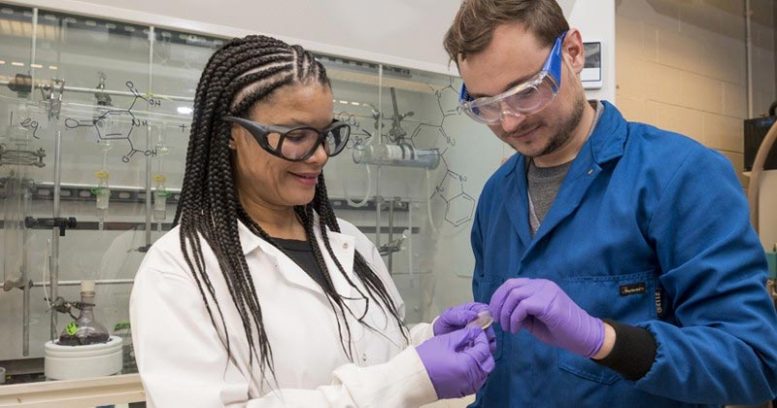
“The idea is: Can you put together two things that don’t really like each other and utilize this idea of dynamics as a way to control how energy is released in the system, which is related to the mechanical behavior?” she said.
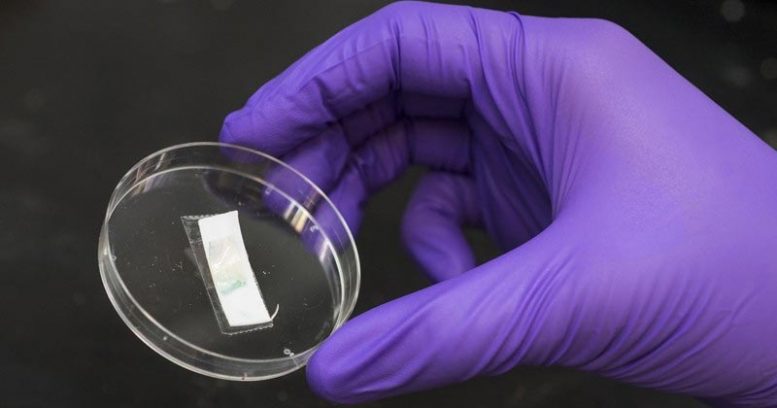
The team mimicked the architecture of the bristle worm’s jaw system by adding a zinc-coordinated supramolecular polymer into a covalently crosslinked polyethylene glycol network. With the right concentrations, they found that they could govern the material’s mechanical properties. “The permanent network that we use to house these dynamic interactions is a good platform for achieving these gradient structures,” said Thompson. Next, he plans to investigate ways to influence shape memory and other properties of these materials.
Korley utilizes inspiration from nature to design a variety of materials. She is the principal investigator of PIRE: Bio-Inspired Materials and Systems, a five-year, $5.5 million grant from the National Science Foundation.
Through this project, Korley and collaborators at Case Western Reserve University, the University of California, San Diego, the University of Chicago, Switzerland’s University of Fribourg, and the UK’s University of Strathclyde are studying and developing materials that can change toughness in response to their environment, are safer and more effective biological implants, transmit nerve-like electrical signals, and can respond to the environment to initiate biological processes, all for use in soft robotic applications.
For example, researchers are studying ways to make materials that are strong like spider silk and materials that change their shape in response to humidity, such as pine cones, which open in dry conditions and close in moist ones. They are also utilizing the unique materials properties they uncover to develop new 3D printed materials.
The study of soft materials and polymers, long a strength at UD, is growing, in part thanks to Korley’s expertise. Korley and Thomas H. Epps, III, the Thomas and Kipp Gutshall Senior Career Development Professor in Chemical and Biomolecular Engineering and Materials Science and Engineering, have also formed a new research center, the Center for Research in Soft Matter and Polymers (CRISP). Korley and Epps are collaborating with researchers at Chemours and recently published a review article on structure-property relationships in polymeric surface coatings in the journal ACS Applied Polymer Materials.
Korley’s research enterprise also involves outreach to undergraduate students, who can benefit greatly from research experience that complements their classroom work.
“Research gives you a platform to take that fundamental training from the classroom and be able to apply it to a problem,” she said. “In the lab, students learn to think through problems, display and communicate their work, and be leaders and team players. We have all of those aspects in our courses, but I think that there’s a holistic way that undergraduate research can train students to do that.”
Korley is equally passionate about outreach activities that introduce girls in high school to science and engineering. Students from her lab have been involved in tutoring at Serviam Girls Academy in New Castle, Delaware.
“The biggest thing for me is to make an impact, to be collaborative, to really engage with the broader community,” she said. “That’s important to me.”
Reference: “Gradient supramolecular interactions and tunable mechanics in polychaete jaw inspired semi-interpenetrating networks” by Chase B.Thompson, Sourav Chatterjee and LaShanda T.J.Korley, 8 April 2019, European Polymer Journal.
DOI: 10.1016/j.eurpolymj.2019.04.015
Never miss a breakthrough: Join the SciTechDaily newsletter.
Follow us on Google and Google News.