
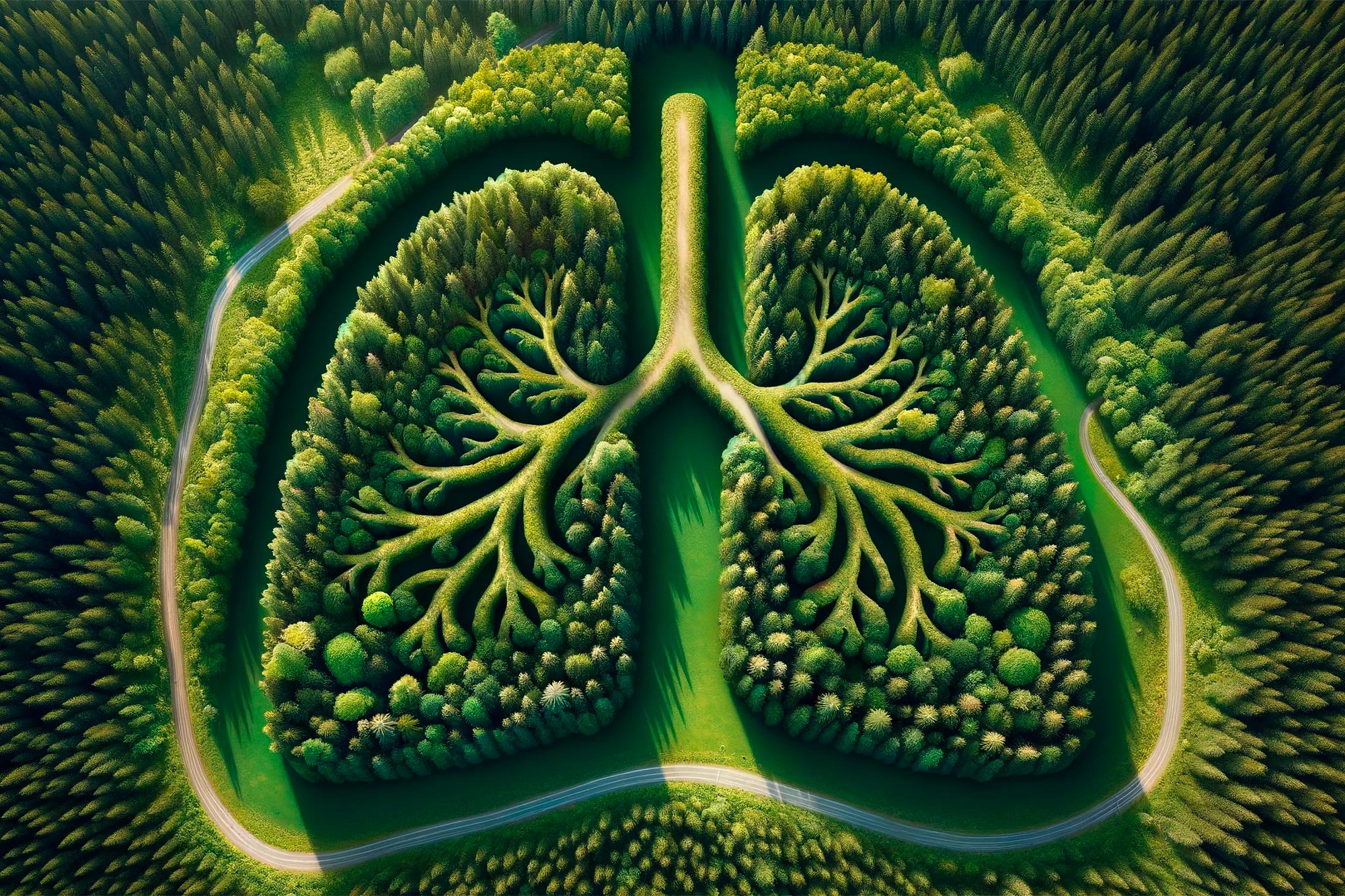
A new study reveals that plants might absorb more CO2 than expected, offering hope in combating climate change. However, reducing emissions remains crucial, as planting trees alone isn’t a sufficient solution.
New research published on November 17 in Science Advances paints an uncharacteristically upbeat picture for the planet. This is because more realistic ecological modeling suggests the world’s plants may be able to take up more atmospheric CO2 from human activities than previously predicted.
Despite this headline finding, the environmental scientists behind the research are quick to underline that this should in no way be taken to mean the world’s governments can take their foot off the brake in their obligations to reduce carbon emissions as fast as possible. Simply planting more trees and protecting existing vegetation is not a golden-bullet solution but the research does underline the multiple benefits to conserving such vegetation.
Understanding Plant CO2 Uptake
“Plants take up a substantial amount of carbon dioxide (CO2) every year, thereby slowing down the detrimental effects of climate change, but the extent to which they will continue this CO2 uptake into the future has been uncertain,” explains Dr. Jürgen Knauer, who headed the research team led by the Hawkesbury Institute for the Environment at Western Sydney University.
“What we found is that a well-established climate model that is used to feed into global climate predictions made by the likes of the IPCC predicts stronger and sustained carbon uptake until the end of the 21st century when it accounts for the impact of some critical physiological processes that govern how plants conduct photosynthesis.
“We accounted for aspects like how efficiently carbon dioxide can move through the interior of the leaf, how plants adjust to changes in temperatures, and how plants most economically distribute nutrients in their canopy. These are three really important mechanisms that affect a plant’s ability to ‘fix’ carbon, yet they are commonly ignored in most global models,” said Dr. Knauer.
Photosynthesis and Climate Change Mitigation
Photosynthesis is the scientific term for the process in which plants convert – or “fix” – CO2 into the sugars they use for growth and metabolism. This carbon fixing serves as a natural climate change mitigator by reducing the amount of carbon in the atmosphere; it is this increased uptake of CO2 by vegetation that is the primary driver of an increasing land carbon sink reported over the last few decades.
However, the beneficial effect of climate change on vegetation carbon uptake might not last forever and it has long been unclear how vegetation will respond to CO2, temperature, and changes in rainfall that are significantly different from what is observed today. Scientists have thought that intense climate change such as more intense droughts and severe heat could significantly weaken the sink capacity of terrestrial ecosystems, for example.
Modeling the Future of Vegetation Carbon Uptake
In the recently published study, however, Knauer and colleagues present results from their modeling study set to assess a high-emission climate scenario, to test how vegetation carbon uptake would respond to global climate change until the end of the 21st century.
The authors tested different versions of the model that varied in their complexity and realism of how plant physiological processes are accounted for. The simplest version ignored the three critical physiological mechanisms associated with photosynthesis while the most complex version accounted for all three mechanisms.
The results were clear: the more complex models that incorporated more of our current plant physiological understanding consistently projected stronger increases of vegetation carbon uptake globally. The processes accounted for re-enforced each other, so that effects were even stronger when accounted for in combination, which is what would happen in a real-world scenario.
Implications for Climate Change Strategies
Silvia Caldararu, Assistant Professor in Trinity’s School of Natural Sciences, was involved in the study. Contextualizing the findings and their relevance, she said:
“Because the majority of terrestrial biosphere models used to assess the global carbon sink are located at the lower end of this complexity range, accounting only partially for these mechanisms or ignoring them altogether, it is likely that we are currently underestimating climate change effects on vegetation as well as its resilience to changes in climate. We often think about climate models as being all about physics, but biology plays a huge role and it is something that we really need to account for.
“These kinds of predictions have implications for nature-based solutions to climate change such as reforestation and afforestation and how much carbon such initiatives can take up. Our findings suggest these approaches could have a larger impact in mitigating climate change and over a longer time period than we thought.
“However, simply planting trees will not solve all our problems. We absolutely need to cut down emissions from all sectors. Trees alone cannot offer humanity a get out of jail free card.”
Reference: “Higher global gross primary productivity under future climate with more advanced representations of photosynthesis” by Jürgen Knauer, Matthias Cuntz, Benjamin Smith, Josep G. Canadell, Belinda E. Medlyn, Alison C. Bennett, Silvia Caldararu and Vanessa Haverd, 17 November 2023, Science Advances.
DOI: 10.1126/sciadv.adh9444
Never miss a breakthrough: Join the SciTechDaily newsletter.
Follow us on Google and Google News.
2 Comments
All vegetation, unless buried away from the oxygen created, will eventually be recycled back to CO2 and water by aerobic respiration. Thus, any long term sequestration to affect climate is temporary. An ultimate waste of time and energy. Cutting down CO2 emissions toward zero by 2050 is also a bad plan because it will have very serious damage to transportation without oil for conventional fuels.
“Cutting down CO2 emissions toward zero by 2050 is also a bad plan because it will have very serious damage to transportation without oil for conventional fuels.” This statement does not make much sense. Hopefully, by 2050, 90% of transportation will be CO2 emission-free. Not sure what is meant by “serious damage”, apart from to the fossil oil and coal exploitation industry. If forests are permanently increased without exploitation, then the CO2 absorbed is permanently sequestered, as new growth matches any old trees being “recycled”. The presence of coal and oil underground proves that CO2 can be captured for eons.