
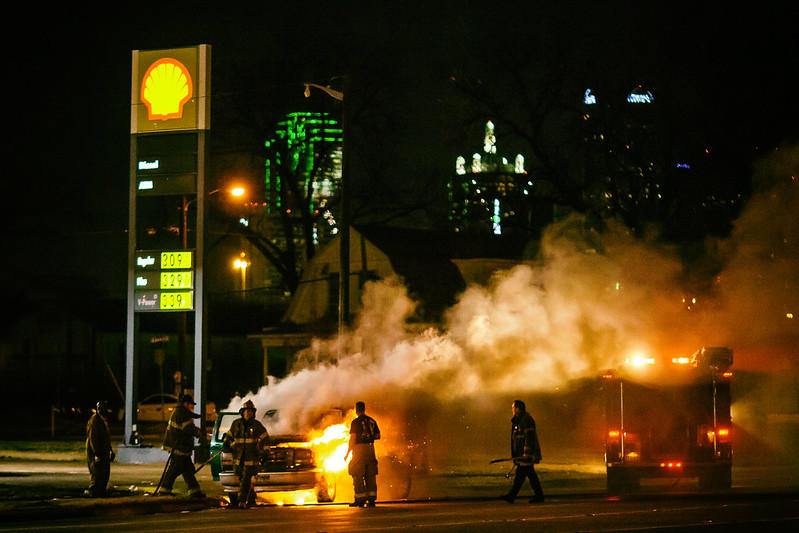
Chemical engineers at UC Riverside have developed a unique liquid fuel that requires an electric current to ignite. Unlike conventional fuels, this innovative fuel doesn’t react to flames and cannot start accidental fires during storage or transport, it is a “safe” liquid fuel.
“The fuel we’re normally using is not very safe. It evaporates and could ignite, and it’s difficult to stop that,” said Yujie Wang, UCR chemical engineering doctoral student and co-author of a new paper about the fuel. “It is much easier to control the flammability of our fuel and stop it from burning when we remove voltage.”
The Journal of the American Chemical Society paper describes how the team created the fuel, and additional technical details are also included in the patent they filed.
Controlling Fuel Combustion with Electricity
When fuel combusts, it is not the liquid itself that burns. Instead, it is the volatile fuel molecules hovering above the liquid that ignite on contact with oxygen and flame. Removing an oxygen source will extinguish the flame, but this is difficult to do outside of an engine.
“If you throw a match into a pool of gasoline on the ground, it’s the vapor of the gas that’s burning. You can smell that vapor and you instantly know it’s volatile,” said Prithwish Biswas, UCR chemical engineering doctoral student and first author of the paper. “If you can control the vapor, you can control whether the fuel burns.”
Ionic Liquid: The Core of the New Fuel
The base of the new fuel is an ionic liquid, which is a form of liquified salt. “It is similar to the salt we use to flavor food, which is sodium chloride,” Wang said. “The one we used for this project has a lower melting point than table salt, low vapor pressure, and is organic.”
Once in the lab, the team modified the ionic liquid’s formula, replacing the chlorine with perchlorate. Then, they used a cigarette lighter to see if the resulting liquid would burn. “The temperature from a normal lighter is high enough, and if it was going to burn, it would have,” Wang said.
Next the team tried an application of voltage followed by a lighter flame, which did ignite. “Once we shut off the current, the flame was gone, and we were able to repeat that process over and over again — applying voltage, seeing smoke, lighting the smoke so it burned, then turning it off,” Wang said. “We were excited to find a system we could start and stop very quickly.”
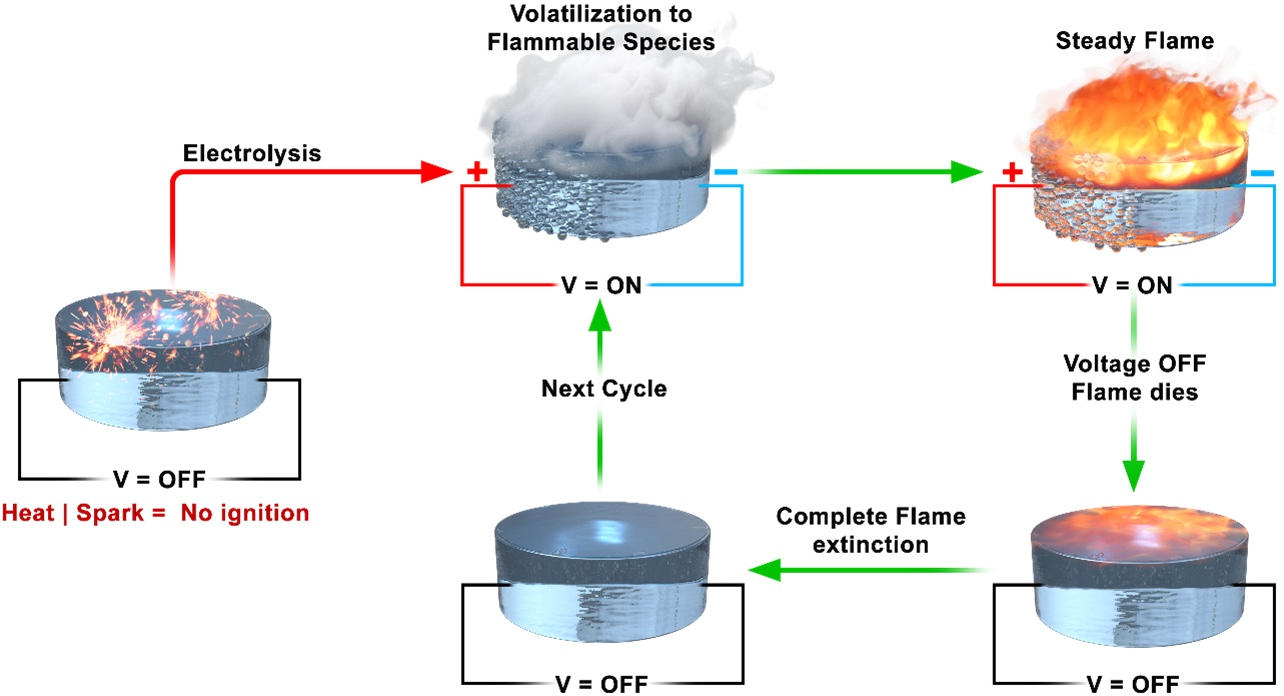
Adding more voltage to the liquid resulted in larger flames with more energy output. As such the approach could also act like a metering or throttling system in an engine.
“You can measure the combustion in this way, and cutting the voltage works like a dead man switch — a safety feature that automatically shuts down a machine if the operator becomes incapacitated,” said Michael Zachariah, distinguished professor of chemical engineering at UCR and corresponding paper author.
Potential Applications and Further Research
Theoretically, the ionic liquid fuel could be used in any type of vehicle. However, there are still questions that need to be answered before it could be commercialized. The fuel would need to be tested in various types of engines, and its efficiency would need to be determined.
An interesting property of the ionic liquid is that it can be mixed with conventional fuel and still behave the way it does on its own. “But there needs to be additional research to understand what percentage can be mixed and still have it be not flammable,” Zachariah said.
Though there are a number of areas for additional research on the liquid, the team is excited to have made a fuel that is safe from accidental, unintended fires.
“This would definitely be more expensive than the way they currently manufacture fuels. These compounds are not normally produced in bulk, but if they were, the cost would go down,” Zachariah said.
“How competitive would it be? I don’t know. But if safety is important, that’s a major aspect of this. You make something safe, then there is a benefit that goes beyond the bottom line,” Zachariah said.
Reference: “Electrochemical Modulation of the Flammability of Ionic Liquid Fuels” by Prithwish Biswas, Yujie Wang, Erik Hagen and Michael R. Zachariah, 24 July 2023, Journal of the American Chemical Society.
DOI: 10.1021/jacs.3c04820
Never miss a breakthrough: Join the SciTechDaily newsletter.
Follow us on Google and Google News.
1 Comment
The cost will be prohibitive. It will still be very useful in situations where safety is paramount, like fuel transportation by airplane, or in areas with open flames or high temperatures.
A bit of trivia, Yujie, as in the study co-author chemical engineer’s name Yujie Wang, when transliterated as 郁结 in Chinese can mean restrained or pent-up. Appropriate name for someone who chemically tamed a volatile fuel. Of course, the real transliteration for the name would probably be 羽洁.