
Limiting warming to 1.5°C could prevent twice the glacier loss seen in a +2.7°C scenario. Even if global temperatures were to stabilize at their current level, about 40 percent of the world’s glaciers are still expected to disappear.
A new study conducted in collaboration with ETH Zurich reveals that if global warming exceeds the targets set by the Paris Climate Agreement, non-polar glaciers will experience significant mass loss. However, if warming is limited to 1.5°C, it is possible to preserve at least 54% of these glaciers—more than twice the amount that would survive under a 2.7°C warming scenario.
The findings, published May 29, 2025, in the journal Science, reveal that even if global temperatures were to remain at the current level of 1.2°C, an estimated 39 percent of global glacier mass would still be lost compared to 2020 levels, contributing more than 10 centimeters to global sea-level rise.
In the study, an international team of 21 scientists from ten countries used eight glacier models to estimate ice loss from over 200,000 glaciers outside Greenland and Antarctica. They analyzed a wide range of global temperature scenarios, assuming that each temperature level would remain stable for thousands of years.
“The choices we make today will resonate for centuries, determining how much of our glaciers can be preserved,” says Harry Zekollari, co-lead author from Vrije Universiteit Brussel, who began this research as a postdoctoral fellow at the Chair of Glaciology in the Department of Civil, Environmental and Geomatic Engineering (D-BAUG) at ETH Zurich.
Looking beyond 2100 reveals new insights
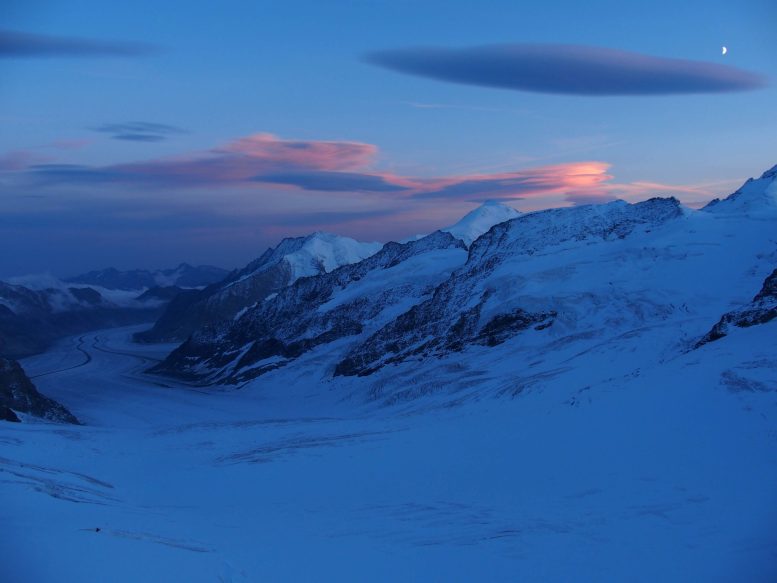
In all scenarios, glaciers lose mass quickly over the first few decades and then continue melting more slowly for centuries, even without further warming. This long-term response means glaciers will keep feeling the impact of today’s heat far into the future, gradually retreating to higher altitudes before eventually stabilizing at a new equilibrium.
“One of the key strengths of our study is that we were able, for the first time, to project global glacier evolution over multi-centennial timescales, and did so using eight models instead of one or two,” explains Harry Zekollari. “Most glacier studies stop at 2100, which is problematic when simulating the long-term impact of today’s climate policies, given the long-term response of glaciers over time.”
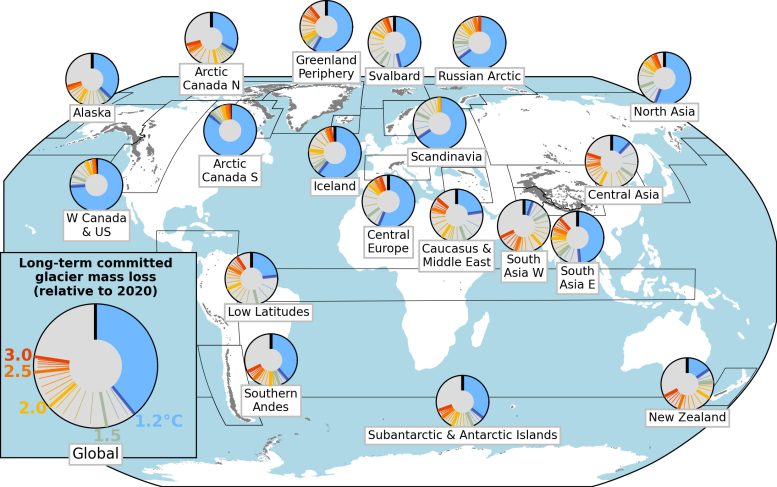
For example, studies that only look ahead to the year 2100 estimate that about 20 percent of today’s glacier mass will be lost, no matter how temperatures change in the future. However, the new study shows that nearly twice as much ice would disappear under current conditions when looking over several centuries. “We find that around 40 per cent of glacier mass is effectively ‘doomed’ to disappear,” says co-lead author Harry Zekollari.
Melting glaciers reveal the reality of global warming
“Glaciers are good indicators of climate change because their retreat allows us to see with our own eyes how climate is changing. However, since they adjust over longer timescales, their current size vastly understates the magnitude of climate change that has already happened. The situation for glaciers is actually far worse than visible in the mountains today,” says co-lead author Lilian Schuster from the University of Innsbruck.
Beyond contributing to sea-level rise, glacier loss has far-reaching consequences. It threatens freshwater availability, increases the risk of glacier-related hazards such as floods and landslides, and jeopardizes glacier-fed tourism economies. These cascading impacts will be felt across regions and generations.
“These effects underscore the critical importance of present-day climate policies,” says Harry Zekollari. “Our study makes it painfully clear that every fraction of a degree matters. If we manage to limit global warming to +1.5°C instead of +2.7°C, we could still save twice as much glacier ice.”
Current policies are projected to lead to an average global warming of around +2.7°C. As Zekollari emphasizes, the degree of warming between +1.5°C and +3.0°C plays a decisive role in glacier loss. Put simply: for every additional 0.1°C of warming, the world risks losing approximately 2 percent more of its glacier ice.
Contributing to the UN-Year of Glaciers’ Preservation
“This study is a major contribution to the United Nations International Year of Glaciers’ Preservation, emphasizing the urgent need for global climate action to protect the world’s glaciers,” says Daniel Farinotti, Professor of Glaciology at ETH Zurich and the Swiss Federal Institute for Forest, Snow and Landscape Research WSL.
His research group at the Laboratory of Hydraulics, Hydrology and Glaciology (VAW) played a central role in producing the new findings. The entire study led by Zekollari and Schuster was conducted as part of the Glacier Model Intercomparison Project (GlacierMIP) and coordinated by the Climate and Cryosphere (CliC) Project of the World Climate Research Programme (WCRP).
Reference: “Glacier preservation doubled by limiting warming to 1.5°C versus 2.7°C” by Harry Zekollari, Lilian Schuster, Fabien Maussion, Regine Hock, Ben Marzeion, David R. Rounce, Loris Compagno, Koji Fujita, Matthias Huss, Megan James, Philip D. A. Kraaijenbrink, William H. Lipscomb, Samar Minallah, Moritz Oberrauch, Lander Van Tricht, Nicolas Champollion, Tamsin Edwards, Daniel Farinotti, Walter Immerzeel, Gunter Leguy and Akiko Sakai, 29 May 2025, Science.
DOI: 10.1126/science.adu4675
Never miss a breakthrough: Join the SciTechDaily newsletter.
Follow us on Google and Google News.
11 Comments
Doesn’t earth go though these cycles naturally gets colder and colder until an ice age and then starts a warming trend until there very little or no ice and then starts to cool again. How do we think we are going to stop this process if it is a natural process. I agree we may be speeding this process up a bit but we can’t stop it.
“…, contributing more than 10 centimeters to global sea-level rise.”
Perhaps. The unstated assumption is that all the melted ice will end up in the oceans. It is possible that because of the increase in temperature, evaporation will increase, leading to increased precipitation. If the increased rainfall results in recharging the groundwater in arid regions, and growing more vegetation, then the water will be sequestered on land. There is geological evidence that the Sahara was quite lush in the past. Might that happen again, there, or in other arid regions? NASA has documented ‘Greening’ throughout the world, mostly attributed to CO2 acting like a fertilizer.
Another example of climate scientists demonstrating that Chamberlain’s ‘Method of Multiple Working Hypotheses’ was not required undergraduate reading.
the release of CO2from the permafrost will make it even warmer.notice how rising water levels change climate patterns on the planet
“notice [sic] how rising water levels change climate patterns on the planet [sic]”
Why don’t you tell us about it? Why are you concerned about Arctic CO2 if the rising oceans are driving the climate? How are the rising oceans affecting the climate? The article says that you have the relationship backwards! How much are the various Köppen–Geiger climate groups increasing in temperature and changing size and shape? Are any of them cooling? If so, by how much? What is causing the ocean surface to rise?
How is it that someone who can’t write a sentence with proper capitalization, spacing, and punctuation thinks they know so much about the climate?
How is it that a self-confessed scientist has to make a snide remark belittling a commentator they no doubt don’t know?
I think that the answer to your question can be found in my last sentence. If someone who can’t even write a complete sentence makes absurd claims, without support or even a demonstration that they understand the issues, a polite response will have little impact on them or other readers. Ridicule is going to be more effective in demonstrating that they need to stay in their lane, preferably in the shallow end of the pool, rather than make authoritative-sounding misstatements that demonstrate they are just repeating things that they read but obviously don’t understand.
Incidentally, while you feel that my questions were “snide,” I think that they are legitimate questions that gave ‘trex’ an opportunity to redeem himself and correct any misconceptions resulting from simply being inarticulate.
I get tired of people who feel compelled to comment on things that they don’t understand, and behave as though they are some kind of expert. A remark (truly snide) commonly attributed to Mark Twain, is that, “It ain’t what you don’t know that gets you into trouble. It’s what you know for sure that just ain’t so.” Unfortunately, the internet has given a platform to such people and when they make false statements, other people are prone to believing it.
Note that unlike ‘trex,’ I did not make any similar claims. Instead, I asked questions.
Now, a question for you: Was your intent to defend ‘trex,’ or did you just want an excuse to attack me?
“We find that around 40 per cent of glacier mass is effectively ‘doomed’ to disappear,”
“Melt” is what ice does: https://scitechdaily.com/scientists-stunned-to-discover-plants-beneath-mile-deep-greenland-ice-and-why-this-is-so-troubling/
The above linked article demonstrates that is can come back, however.
So, the 1.2 degree number is actually an average over several years (usually 5). Some reports I’ve looked at claim the value is actually 1.28 degrees (closer too 1.3 than 1.2 in my book). There have been some reports that 2024 alone was at the 1.5 degree mark and forecasts show an 86% chance of one of the next 5 years being above the 1.5 degree mark and a 70% chance that the average for 2025-2029 will be above the 1.5 degree mark.
The average coastal se level rise in the US is about 1/8 inch per year but was reported as 1/4 inch for 2024.
Projections for all of this is extremely complex and we don’t even know all of the factors involved; new one are constantly being discovered. The one thing that we DO know is tat ocean levels and the average world temperature are both rising. At this point we don’t know where it will end. It’s not helping that the Trump administration refuses to accept the FACT that it is happening. Their denials and cutbacks on research and climate initiatives is only going to make the situation worse. They don’t care if the environment is destroyed as long as they can get rich doing it.
What you describe is about the level of interest held by the world’s “Great Leaders” and indeed a great many people. Given that two nuclear-armed powers share water from the Himalayan glaciers and that their “Great Leaders” are quite happy, even given a minor irritation, to unleash warfare on their respective populations, already violently divided according to the idiocy of their respective religions, and that there is a study indicating that a nuclear war between the two could well induce a world-wide global winter of unpleasant proportions……………..one might live in hope that we could deal the issue of Anthropogenic Global Heating according to the precautionary principle irrespective of the countless approximations to our modelling.
However, that too is seen as a fatuous notion by certain learned scientists.
“…, and forecasts show an 86% chance of one of the next 5 years being above the 1.5 degree mark ,,,”
Do you know how the 86% probability was derived or what the margin of error is?
“The average coastal se[a] level rise in the US is about 1/8 inch per year but was reported as 1/4 inch for 2024.”
It sounds like you are referring to the press release put out by Josh Willis of NASA JPL, where he claims that the 2024 global sea level rise was 0.23″ (0.59 cm). He was making the claim that 2024 was an exceptional year, based on the fact that the seasonal change was greater than the forecast increase of the AVERAGE annual change over the period since 1993. Besides the fact that the published graph was comparing 2024 seasonal change to the average increase — apples to pineapples — the graph showed pretty clearly that the 2023 seasonal change was about twice what the 2024 seasonal change was. In other words, 2024 was LESS exceptional than 2023.
The whole fiasco was an illustration of sophistry in what was probably an attempt to scare the public in hopes of saving his oceanography/climate science job at the JET PROPULSION laboratory.
Hoover, I had intended to provide you with a link and forgot to append it before clicking on .
https://wattsupwiththat.com/2025/06/02/mckibbens-math-misstep-exposing-alarmisms-historic-innumeracy-in-rolling-stone/
You said, “They don’t care if the environment is destroyed as long as they can get rich doing it.” Are you a mind reader?