
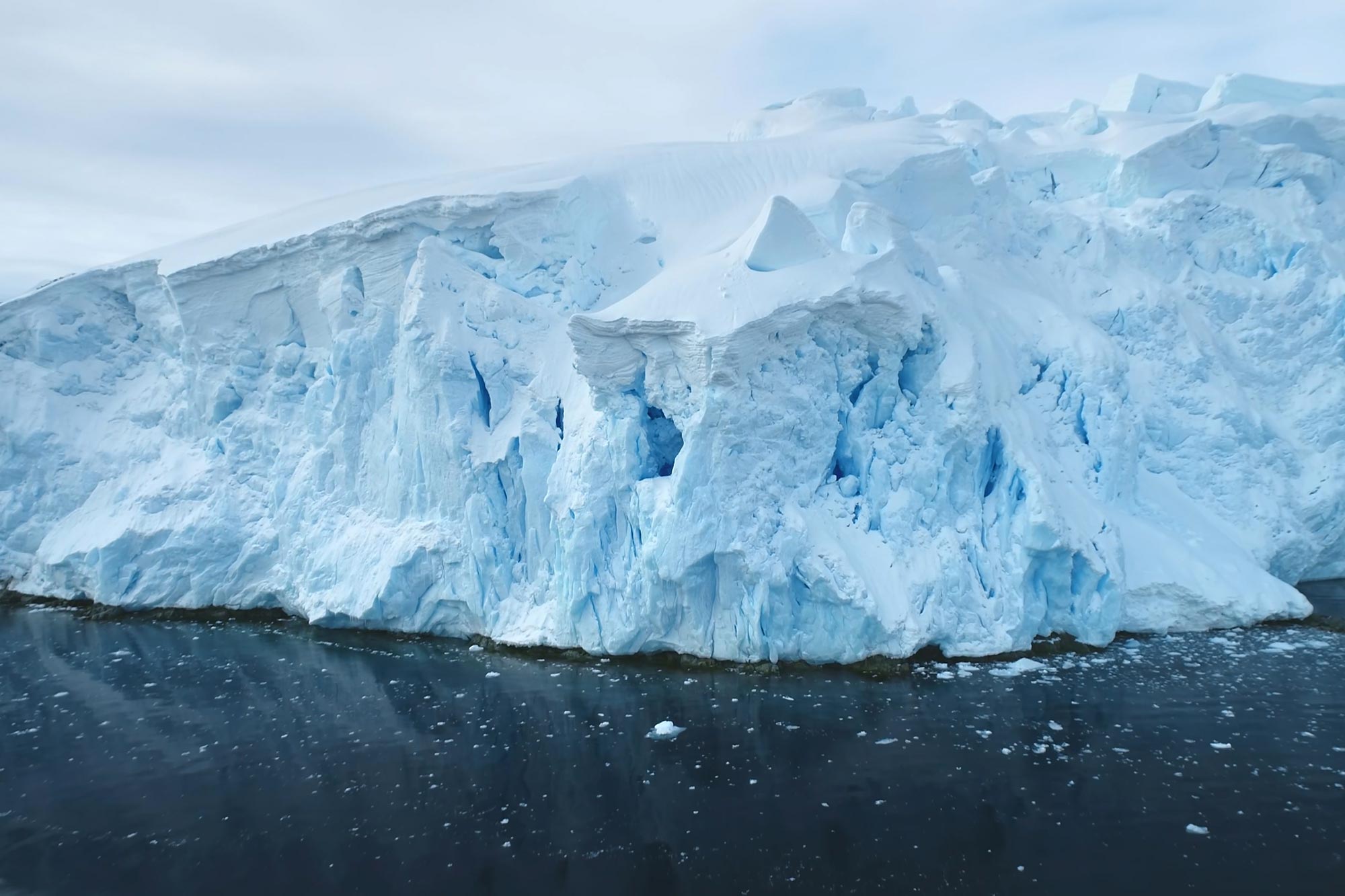
A new study led by scientists at the University of Manitoba’s Centre for Earth Observation Science offers the most comprehensive account to date of how the Thwaites Eastern Ice Shelf in West Antarctica has steadily broken apart over the last twenty years.
Thwaites Glacier in West Antarctica, often referred to as the “Doomsday Glacier,” is among the most rapidly evolving ice–ocean systems on the planet, and its fate remains one of the largest uncertainties in global sea-level projections.
One of its floating extensions, the Thwaites Eastern Ice Shelf (TEIS), is partially constrained and stabilized by a pinning point at its northern edge. Over the past twenty years, this ice shelf has undergone increasing fracturing centered around a major shear zone located upstream of that pinning point.
Research origins and international collaboration
A new paper published in Journal of Geophysical Research: Earth Surface (AGU, 2025) presents the most detailed record yet of how the Thwaites Eastern Ice Shelf has progressively weakened and broken apart over the past two decades.
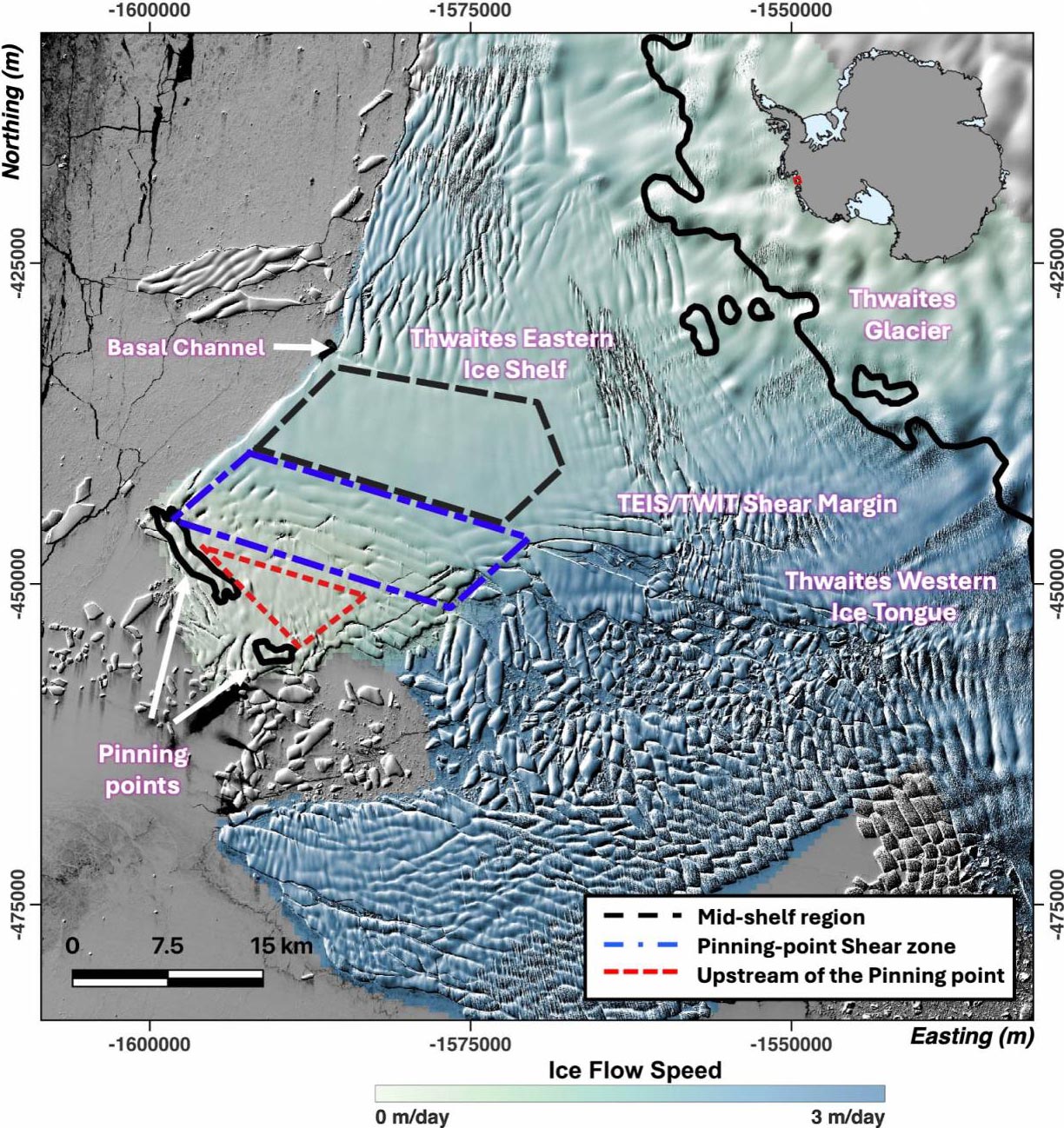
The research was conducted at the Centre for Earth Observation Science (CEOS) at the University of Manitoba and led by Debangshu Banerjee, a recent CEOS graduate student, alongside Dr. Karen Alley (Assistant Professor, CEOS) and Dr. David Lilien (Assistant Professor at Indiana University Bloomington and former CEOS Research Associate).
The project forms part of the TARSAN (Thwaites-Amundsen Regional Survey and Network) program, a component of the International Thwaites Glacier Collaboration (ITGC)—a major joint U.S.–U.K. research effort investigating the processes driving change in West Antarctica’s Thwaites Glacier. Distinguished glaciologists Dr. Ted Scambos, Dr. Martin Truffer, Dr. Adrian Luckman, and Dr. Erin Pettitt also contributed to the study.
How the ice shelf is breaking apart
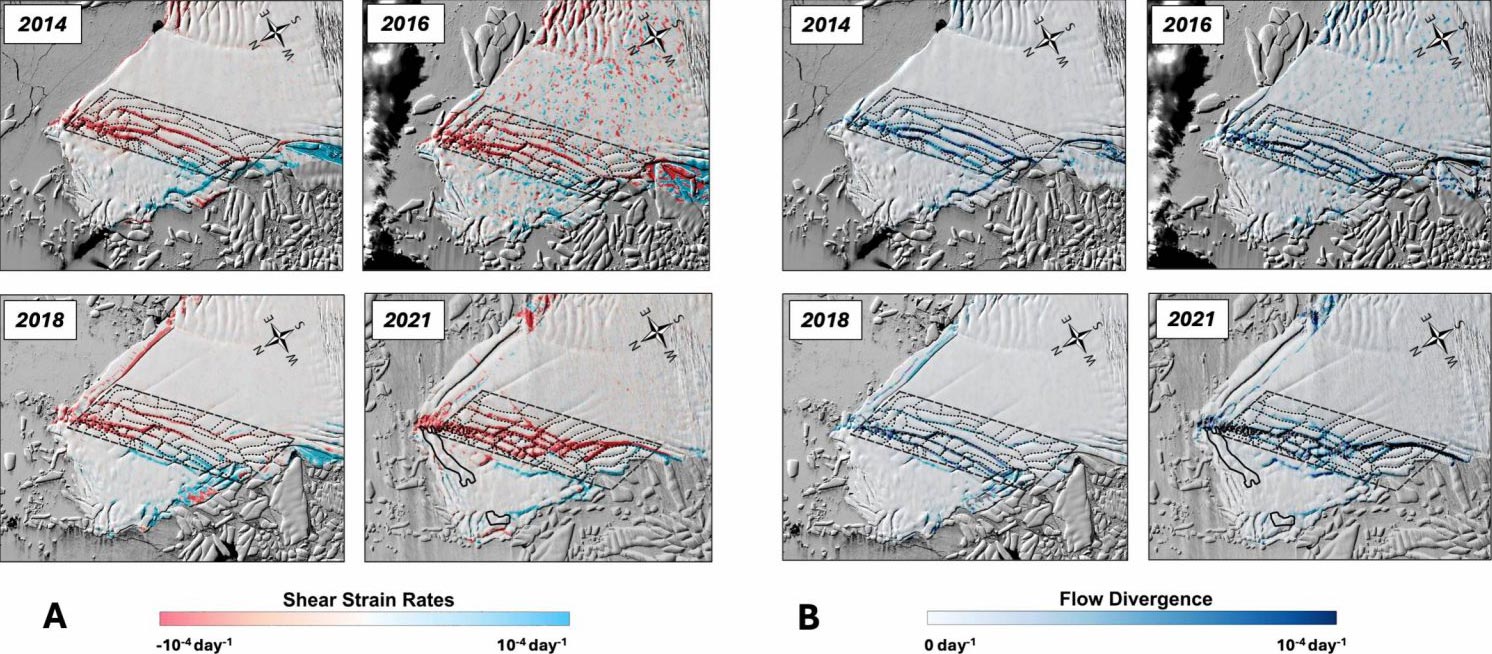
Using 20 years of data (2002–2022) from satellite imagery, ice-flow velocity measurements, and on-site GPS instruments, the researchers tracked how fractures formed and evolved within the Thwaites Eastern Ice Shelf (TEIS) shear zone and how those changes influenced ice movement.
Their analysis showed that the steady growth of these fractures caused the ice shelf to gradually detach from its pinning point, which in turn sped up ice flow upstream and reduced the shelf’s structural stability.
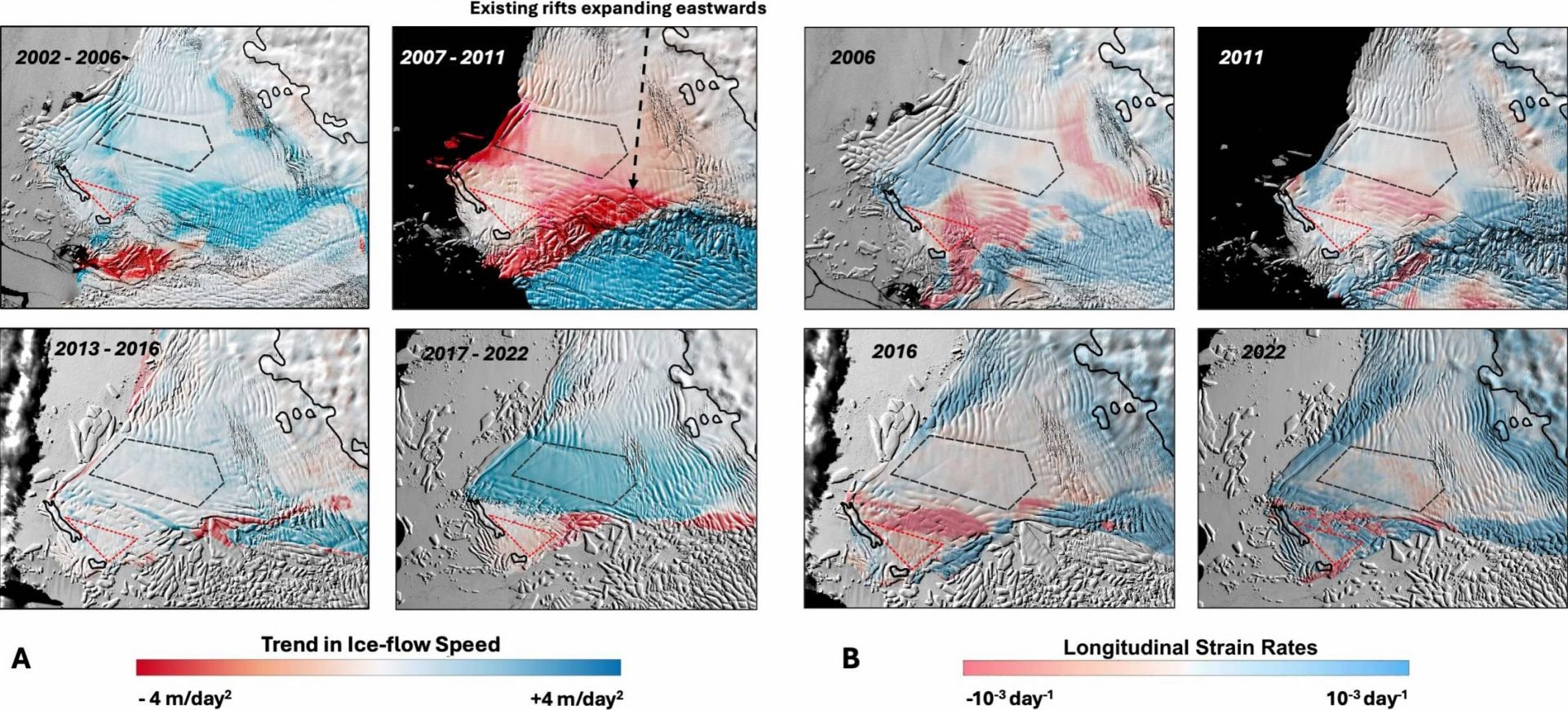
The study outlines four stages in this weakening process and highlights two major findings. First, the fractures expanded in two phases: an initial stage marked by long, flow-parallel cracks, followed by shorter fractures that formed perpendicular to the ice flow.
Second, the researchers found evidence of a reinforcing feedback loop between fracture damage and ice acceleration—a self-amplifying process that contributed to the shelf’s rapid breakdown in recent years.
The research highlights how the pinning point, once a major stabilizing force for the TEIS, has gradually transitioned into a destabilizing agent through four distinct stages.
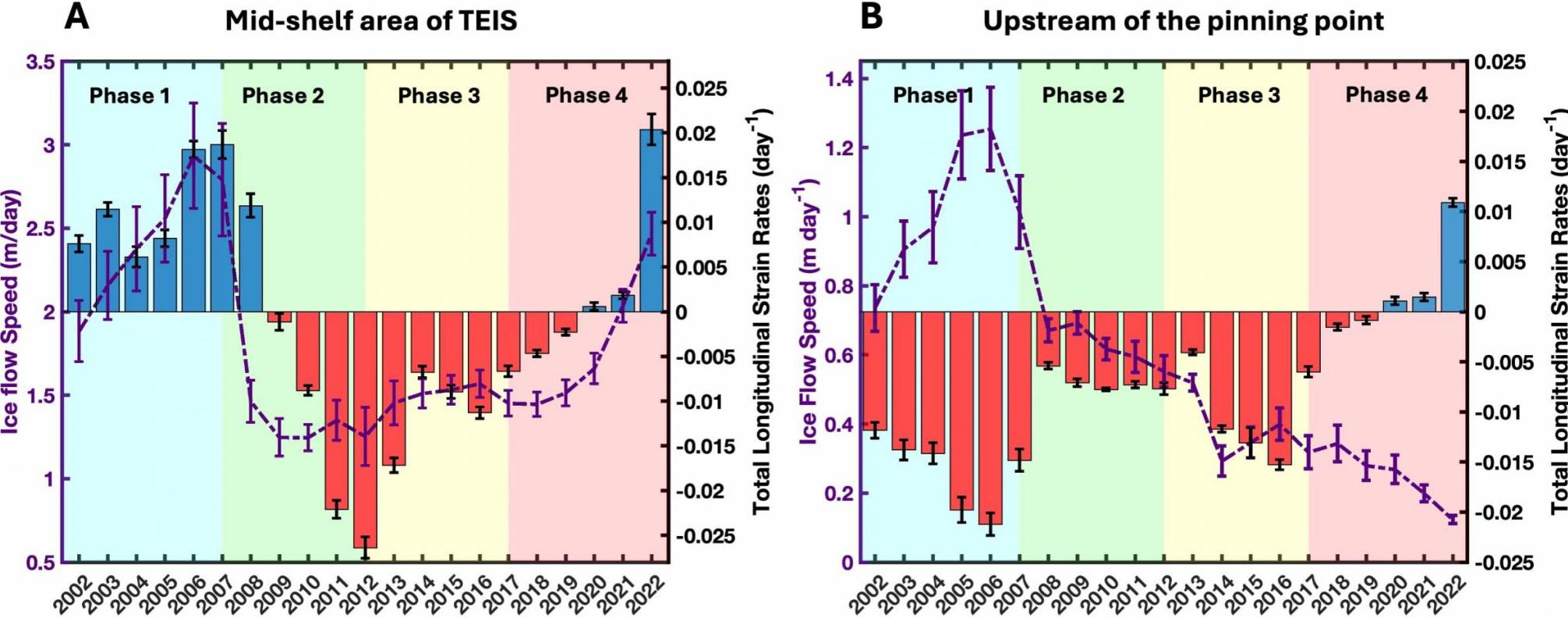
This pattern of ice-shelf disintegration may serve as a warning for other Antarctic ice shelves that are currently showing similar signs of weakening. The continued loss of these floating ice shelves could have significant implications for the Antarctic Ice Sheet’s future contribution to global sea-level rise.
Reference: “Evolution of Shear-Zone Fractures Presages the Disintegration of Thwaites Eastern Ice Shelf” by Debangshu Banerjee, David A. Lilien, Martin Truffer, Adrian Luckman, Christian T. Wild, Erin C. Pettit, Ted A. Scambos, Atsuhiro Muto and Karen E. Alley, 27 August 2025, Journal of Geophysical Research: Earth Surface.
DOI: 10.1029/2025JF008352
Never miss a breakthrough: Join the SciTechDaily newsletter.
Follow us on Google and Google News.
16 Comments
“The continued loss of these floating ice shelves could have significant implications for the Antarctic Ice Sheet’s future contribution to global sea-level rise.”
This claim needs explanation because Archimedes’ Principle says that floating ice displaces the same volume of water as the melt water from the floating ice.
I opened my freezer today and found the missing glacial ice sheets so it was time to defrost. Maybe it’s time for the planet in its natural cycles to defrost. Regardless, civilization will just have to learn to deal with it like life forms did in the past glacial melts!
Sea level rise of two feet will crash every financial market on Earth. Can you live with that?
True enough; but if land-based ice flows seaward more quickly as a result of the floating ice-shelf breaking up, and floats more quickly, sort of like Archimedes keeping the mixer-tap running to maintain a comfortable temperature in his bath……..The conclusion to that is if one believes that the inertia of a floating ice-shelf might slow the rate of flow of the land-bound glacier behind it ………?
Are you saying that the same ice that can be blown around and stacked up by the wind is actually the proverbial ‘irresistible force’ disguised as mere thin ice, or that it acts differently when it is attached to an upstream glacier? Where is your evidence beyond some wet-behind-the-ears PhD glaciologist casually claiming that shelf ice buttresses much thicker, grounded, glacial ice on a slope?
I refer to the inertia of a coherent ice-shelf, not the disparate bits that they form when they break up and float out to sea as ice floes/icebergs. And note the question mark in the bit where I address the potential inertia of an ice SHELF attached to land- based glaciers which feed the ice-shelf. I don’t know how that inertia operates but thought that a bloke like yourself might have some useful information. And again, concerning thicknesses of ice-shelves; the Ross Ice-shelf ain’t that thin compared with some of the assorted glaciers that feed into it. And it is certainly thicker than most of the floating bits of ice in the Ross Sea. Sorry old mate; life isn’t quite as simple as you would like.
Ice shelves hold back glaciers from flowing into the sea. NOBODY claims that the ice shelves themselves affect sea level. But when they’re gone glaciers lose ice faster at the coast, and that speeds up sea level rise. Also, ice shelves are not completely floating. They have grounding points where they rest on the seabed, where it rises up to the shore.
Your comment is a strawman logical fallacy.
You are right.
The reason why they are worried about ice shelves is that, while their melting won’t itself raise sea levels, they act essentially as corks keeping the glaciers behind them bottled up and otherwise protect the leading edge of the glaciers from the sea. Glaciers that are no longer protected from ocean water may melt and detach from the bedrock below. This exposes the glacier further upstream and can lift the glacier’s edge during storms, further exposing it. Furthermore deeper currents that easy away at the base tend to be warmer. Depending upon the underlying topography, the glacier may suddenly accelerate. This is in part what we’ve worried about with Thwaites.
However, at least one recent study suggests that the glaciers of East Antarctica may be less stable than we thought due to their sensitivity to seasonal conditions, and that has the potential to dwarf anything we might see from West Antarctica.
Please see:
Boeira Dias, F., England, M. H., Morrison, A. K., and Galton-Fenzi, B. K.: Seasonal variability of ocean heat transport and ice-shelf basal melt around Antarctica, The Cryosphere, 19, 5231–5258, https://doi.org/10.5194/tc-19-5231-2025, 2025.
sea ice formation expels most of the salt into the surrounding ocean making that water dense enough to sink to the bottom of the ocean. That’s the piston that drives deep ocean currents. That little ephemeral surface layer of ice is absolutely critical and it has been rapidly disappearing since 2015. But there’s even more bad news about the loss of sea ice around Antarctica. that Cascade of cold salty water down the Continental shelf slope prevented the warm bottom water currents from rising. That’s no longer true and the warm bottom water has risen to the stratification level and is penetrating underneath the ice shelves holding back the glaciers of Antarctica. You can consider the ice shelves analogous to an ice dam on a river. When the ice breaks gravity pushes everything toward the sea.
Well look at all the homes along PCH in LA. Even tho most burned, the fact remains that the coastline hasn’t changed one bit in 100 years. This all a big lie
Your anecdotal claim that “the coastline hasn’t changed one bit in 100 years” is completely meaningless. Show the data that supports your claim. The global average sea level rise since 1900 is only about 8 or 9 inches now . Do you think you could perceive that with your eyes?
In fact the NSIDC says sea level rise around the LA area was only 1.03 inches between 1923 and 2020. (National Snow Ice Data Center)
However sea level rise on the U.S. Southeast Atlantic coast, and especially the Gulf of Mexico coast, have had nearly 10 times that much in some places, well above the global avg.
Sea level is not exactly the same everywhere.
Sea level rise is not exactly the same everywhere.
Less is expected on the U.S. Pacific Coast than on the Atlantic or Gulf coasts.
So who’s telling lies?
This is who. Not a wild conspiracy theory, a well documented Fact.
The massive PR machine in America of climate change disinformation that deniers believe is funded by the fossil fuels industry and other anti environmental regulation allies of them.
The disinformation is spread by these proxies, that they fund.
These 32 conservative organizations have all been funded by and involved in the Tobacco industry’s campaign to deny the science showing the dangers of tobacco.
They are all now funded by fossil fuels, to do the same in the campaign to deny the science of climate change.
1. Acton Institute
2. American Legislative Exchange Council (ALEC)
3. Alexis de Tocqueville Institute
4. American Enterprise Institute (AEI)
5. Americans for Prosperity
6. Atlas Economic Research Foundation
7. Burson-Marsteller (PR firm)
8. Citizens Against Government Waste (CAGW)
9. Cato Institute
10. Competitive Enterprise Institute (CEI
11. Consumer Alert
12. DCI Group (PR firm)
13. European Science and Environment Forum
14. Fraser Institute
15. Frontiers of Freedom
16. George C. Marshall Institute
17. Harvard Center for Risk Analysis
18. Heartland Institute
19. Heritage Foundation
20. Independent Institute
21. International Center for a Scientific Ecology
22. International Policy Network
23. John Locke Foundation
24. Junk Science
25. National Center for Public Policy Research
26. National Journalism Center
27. National Legal Center for the Public Interest (NLCPI)
28. Pacific Research Institute
29. Reason Foundation
30. Small Business Survival Committee
31. The Advancement of Sound Science Coalition (TASSC)
32. Washington Legal Foundation
——————
#5, #9 and #10 were created by the billionaire oil and lumber tycoon Koch brothers, who fund all kinds of anti-environmental PR.
#24 Junk Science, which is aptly named, is run by Steve Milloy, who Fox News likes to feature as an “expert” on climate change. Milloy is NOT a scientist. He’s a paid lobbyist for fossil fuel interests and a professional PR man. Did Fox ever divulge that? I doubt it. And Milloy gets funding from, guess who? – the Koch brothers.
It’s not a doomsday glacier. It’s also not science. Science can’t make predictions of the future (this is a logically proven fact – google the philosophical problem of induction). This article is thus not honest science, it’s religious doomerism.
One can only make assumptions as to a possible future based on the information available. If one assumes that Jehovah wrote the Bible based on his absolute knowledge of Everything, that would change not only how we think but is underpinned by the untestable assumption that said Jehovah not only existed but also that he couldn’t write in English until James 1st, and 6th of Scotland became King of England as well as Scotland.
NASA Climate
6/11/2021
“UPDATE: Since 2002, Greenland and Antarctica have been losing ice mass at a combined average rate of 428 billion metric tons (BMT) per year.
approximately
150 billion tons Antarctica
280 billion tons Greenland
Antarctica is much colder
——————–
The sea level rise from Thwaites Glacier alone would be 2 feet, if it all melted.
“However, because Thwaites acts as a “cork” for other glaciers in West Antarctica, its collapse could lead to a total potential sea level rise of up to 10 feet (\(3\) meters) if it triggers the collapse of the wider Antarctic ice sheet.”
Google AI assisted search:
—————————–
This is Not Natural
“As the Earth moved out of ice ages over the past million years, the global temperature rose a total of 4 to 7 degrees Celsius over about 5,000 years.
In the past century alone, the temperature has climbed 0.7 degrees Celsius, roughly TEN TIMES FASTER than the average rate of ice-age-recovery warming.”
NASA Earth Observatory
—————————
That is from 2010. The warming since 1880 is now about double the 0.7C warming NASA was referring to.
——————-
Here’s why
“The maximum rate of change in CO2 concentrations from the ice core records is around 100 ppm in 10,000 years, or around 1 ppm per century.
The current rate of change in CO2 concentrations is 1 ppm every 21 weeks.”
NASA Climate Change
Please; you should not offend the ignorant, and even more the deliberately self-induced ignorant, with facts.
Just a quick question. Between 60 to 70%. Of ice is floating on sea water if I’m correct. weight of the ice melts. Sea levels stays the same as water can’t be heavier than the exact amount of ice