
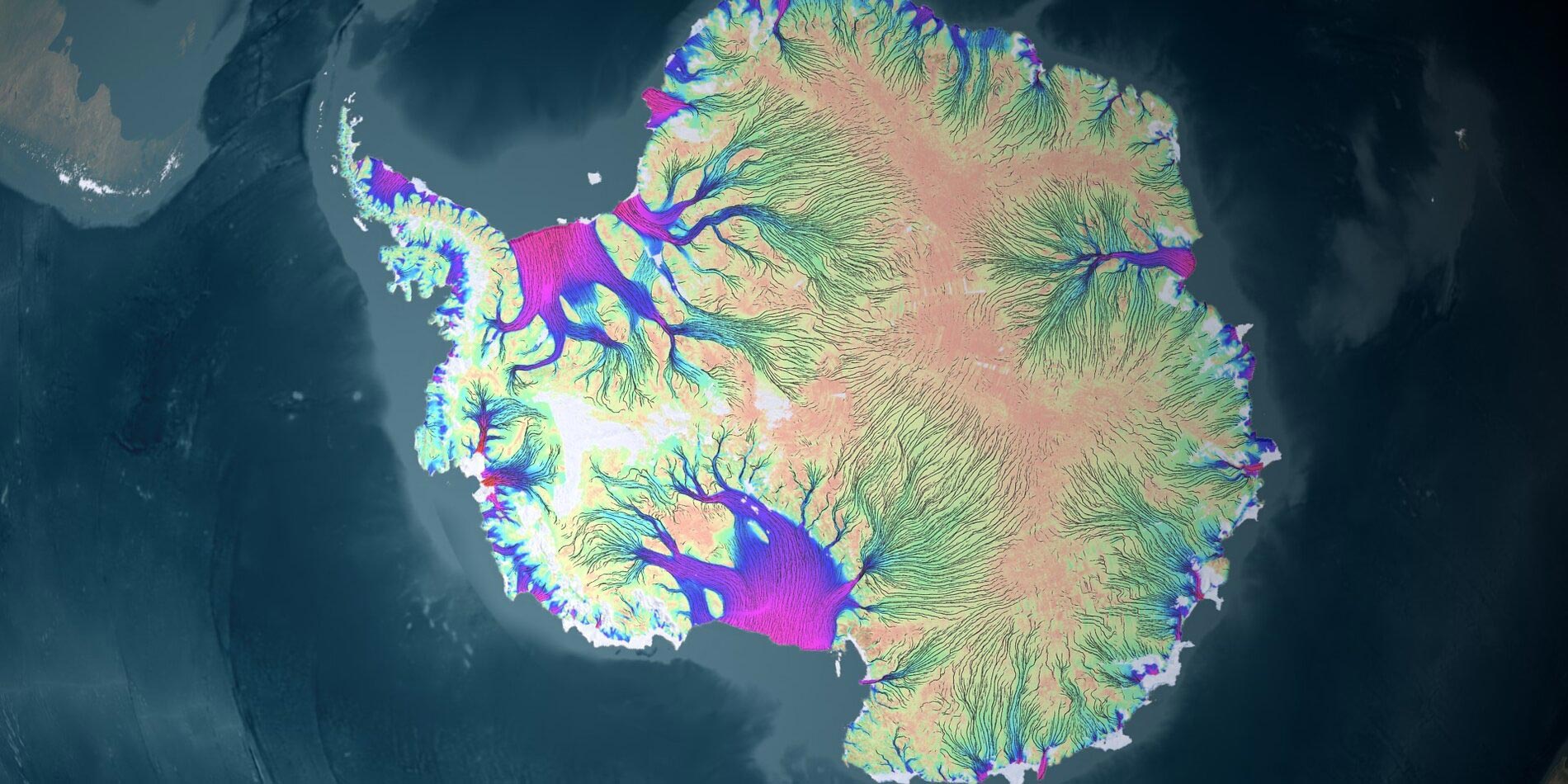
Stanford researchers have integrated machine learning with high-resolution satellite and aerial observations to analyze the physics driving large-scale ice movements in Antarctica. Their findings reveal that existing models lack critical complexity necessary for accurately predicting the Antarctic ice sheet’s dynamics and mass loss, both now and in the future.
As the planet warms, Antarctica’s ice sheet is melting, contributing to rising sea levels worldwide. With enough frozen water to raise global sea levels by 190 feet, accurately predicting how Antarctic ice will move and melt, both now and in the future, is crucial for protecting coastal areas. However, most climate models struggle to simulate Antarctic ice movement accurately due to limited data and the complex interactions between the ocean, atmosphere, and frozen surface.
In a paper published on March 13 in Science, researchers at Stanford University used machine learning to analyze high-resolution remote-sensing data of ice movements in Antarctica for the first time. Their work reveals key physical processes governing the large-scale movement of the Antarctic ice sheet and could improve predictions of how the continent will change in the future.
“A vast amount of observational data has become widely available in the satellite age,” said Ching-Yao Lai, an assistant professor of geophysics in the Stanford Doerr School of Sustainability and senior author on the paper. “We combined that extensive observational dataset with physics-informed deep learning to gain new insights about the behavior of ice in its natural environment.”
Ice sheet dynamics
The Antarctic ice sheet, Earth’s largest ice mass and nearly twice the size of Australia, acts like a sponge for the planet, keeping sea levels stable by storing freshwater as ice. To understand the movement of the Antarctic ice sheet, which is shrinking more rapidly every year, existing models have typically relied on assumptions about ice’s mechanical behavior derived from laboratory experiments. But Antarctica’s ice is much more complicated than what can be simulated in the lab, Lai said. Ice formed from seawater has different properties than ice formed from compacted snow, and ice sheets may contain large cracks, air pockets, or other inconsistencies that affect movement.

“These differences influence the overall mechanical behavior, the so-called constitutive model, of the ice sheet in ways that are not captured in existing models or in a lab setting,” Lai said.
Lai and her colleagues didn’t try to capture each of these individual variables. Instead, they built a machine learning model to analyze large-scale movements and thickness of the ice recorded with satellite imagery and airplane radar between 2007 and 2018. The researchers asked the model to fit the remote-sensing data and abide by several existing laws of physics that govern the movement of ice, using it to derive new constitutive models to describe the ice’s viscosity – its resistance to movement or flow.
Compression vs. strain
The researchers focused on five of Antarctica’s ice shelves – floating platforms of ice that extend over the ocean from land-based glaciers and hold back the bulk of Antarctica’s glacial ice. They found that the parts of the ice shelves closest to the continent are being compressed, and the constitutive models in these areas are fairly consistent with laboratory experiments. However, as ice gets farther from the continent, it starts to be pulled out to sea. The strain causes the ice in this area to have different physical properties in different directions – like how a log splits more easily along the grain than across it – a concept called anisotropy.
“Our study uncovers that most of the ice shelf is anisotropic,” said first study author Yongji Wang, who conducted the work as a postdoctoral researcher in Lai’s lab. “The compression zone – the part near the grounded ice – only accounts for less than 5% of the ice shelf. The other 95% is the extension zone and doesn’t follow the same law.”

Accurately understanding the ice sheet movements in Antarctica is only going to become more important as global temperatures increase – rising seas are already increasing flooding in low-lying areas and islands, accelerating coastal erosion, and worsening damage from hurricanes and other severe storms. Until now, most models have assumed that Antarctic ice has the same physical properties in all directions. Researchers knew this was an oversimplification – models of the real world never perfectly replicate natural conditions – but the work done by Lai, Wang, and their colleagues shows conclusively that current constitutive models are not accurately capturing the ice sheet movement seen by satellites.
“People thought about this before, but it had never been validated,” said Wang, who is now a postdoctoral researcher at New York University. “Now, based on this new method and the rigorous mathematical thinking behind it, we know that models predicting the future evolution of Antarctica should be anisotropic.”
AI for Earth science
The study authors don’t yet know exactly what is causing the extension zone to be anisotropic, but they intend to continue to refine their analysis with additional data from the Antarctic continent as it becomes available. Researchers can also use these findings to better understand the stresses that may cause rifts or calving – when massive chunks of ice suddenly break away from the shelf – or as a starting point for incorporating more complexity into ice sheet models. This work is the first step toward building a model that more accurately simulates the conditions we may face in the future.
Lai and her colleagues also believe that the techniques used here – combining observational data and established physical laws with deep learning – could be used to reveal the physics of other natural processes with extensive observational data. They hope their methods will assist with additional scientific discoveries and lead to new collaborations with the Earth science community.
“We are trying to show that you can actually use AI to learn something new,” Lai said. “It still needs to be bound by some physical laws, but this combined approach allowed us to uncover ice physics beyond what was previously known and could really drive new understanding of Earth and planetary processes in a natural setting.”
Reference: “Deep learning the flow law of Antarctic ice shelves” by Yongji Wang, Ching-Yao Lai, David J. Prior and Charlie Cowen-Breen, 13 March 2025, Science.
DOI: 10.1126/science.adp3300
This work was funded by a Stanford Doerr Discovery Grant, the Office of the Dean for Research at Princeton University, the National Science Foundation, NASA, the Schmidt Data X Fund, and the Royal Society of New Zealand.
Never miss a breakthrough: Join the SciTechDaily newsletter.
Follow us on Google and Google News.
6 Comments
“As the planet warms, [probably,] [West] Antarctica’s ice sheet is melting, contributing to rising sea levels worldwide.”
“The researchers asked the model to fit the remote-sensing data and abide by several existing laws of physics that govern the movement of ice, …”
Did that include the detailed slope and macro-topography so that the model could estimate basal friction and where the deep ice might be shearing over obstructions instead of sliding on the basement rock?
“The researchers focused on five of Antarctica’s ice shelves … that extend over the ocean from land-based glaciers and hold back the bulk of Antarctica’s glacial ice. They found that the parts of the ice shelves closest to the continent are being compressed, and the constitutive models in these areas are fairly consistent with laboratory experiments.”
That is probably because what they are observing and simulating is the grounded portion of the extension of the glacial tongue that is no longer supported by the land. Where there is something resisting the flow of ice, one can expect rumples and stacked ice. However, where there is tension, one can expect crevasses to form, and often serve as a detachment line for very large icebergs.
The anisotropism observed is probably because of air and/or water filled crevasses beyond the grounding line, at least down to about 50 meters. Additionally, as observed in Greenland by USA CRREL glaciologists, (circa 1960) ice tends to shear upwards as the ice thickness decreases because of ablation at the terminus. Thus, the ice layers may lack the original sub-horizontal orientation and include air, water, and glacial till.
This is all about the proverbial irresistible force encountering an immovable object. The floating ice goes its own way.
You are clearly a very learned person ! Very well explained !
“Now, based on this new method and the rigorous mathematical thinking behind it, we know that models predicting the future evolution of Antarctica should be anisotropic.”
Not only anisotropic, which means varying vectorially or with the angular direction, but one can expect abrupt changes such as where the bedrock slope changes, where the slope changes when the glacier enters the ocean and starts to experience buoyancy from the water, and where the glacial tongue starts to float (no longer grounded) and is no longer impeded by basal friction, yet still maintains the momentum it had upstream from the grounding line.
You are clearly a very learned person . Very well explained !