
Scientists have taken looking for love to a whole new level, revealing that different types of love light up different parts of the brain.
A recent study has mapped the brain’s response to different forms of love, showing that areas like the basal ganglia and the striatum light up depending on whether the love is parental, romantic, or for pets. Findings suggest that each type of love activates unique brain circuits, with parental love causing the most significant activity, and even the love for pets reflecting pet ownership.
Exploring the Universal Language of Love
We use the word “love” in a bewildering range of contexts — from sexual adoration to parental love or the love of nature. Now, more comprehensive imaging of the brain may shed light on why we use the same word for such a diverse collection of human experiences.
“You see your newborn child for the first time. The baby is soft, healthy, and hearty — your life’s greatest wonder. You feel love for the little one.”
The above statement was one of many simple scenarios presented to fifty-five parents, self-described as being in a loving relationship. Researchers from Aalto University utilized functional magnetic resonance imaging (fMRI) to measure brain activity while subjects mulled brief stories related to six different types of love.
Insights Into Various Forms of Love
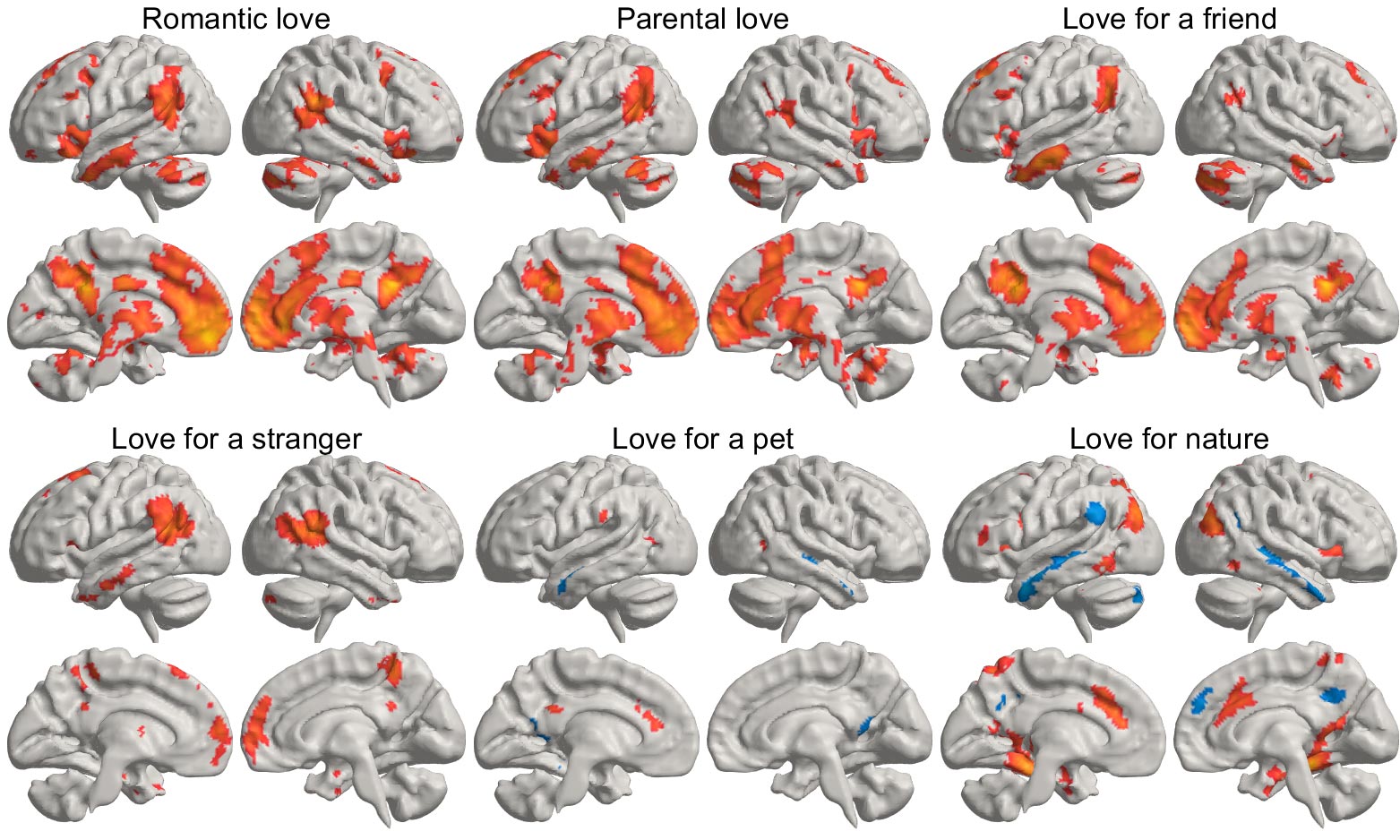
“We now provide a more comprehensive picture of the brain activity associated with different types of love than previous research,” says Pärttyli Rinne, the philosopher and researcher who coordinated the study. “The activation pattern of love is generated in social situations in the basal ganglia, the midline of the forehead, the precuneus, and the temporoparietal junction at the sides of the back of the head.”
Love for one’s children generated the most intense brain activity, closely followed by romantic love.
“In parental love, there was activation deep in the brain’s reward system in the striatum area while imagining love, and this was not seen for any other kind of love,” says Rinne. Love for romantic partners, friends, strangers, pets, and nature were also part of the study, which was published this week in the Cerebral Cortex journal, Oxford University Press.
According to the research, brain activity is influenced not only by the closeness of the object of love, but also by whether it is a human being, another species, or nature.
Unsurprisingly, compassionate love for strangers was less rewarding and caused less brain activation than love in close relationships. Meanwhile, love of nature activated the reward system and visual areas of the brain, but not the social brain areas.
Pet Love: A Unique Brain Signature
The biggest surprise for the researchers was that the brain areas associated with love between people ended up being very similar, with differences lying primarily in the intensity of activation. All types of interpersonal love activated areas of the brain associated with social cognition, in contrast to love for pets or nature — with one exception.
Subjects’ brain responses to a statement like the following, on average, revealed whether or not they shared their life with a furry friend:
“You are home lolling on the couch and your pet cat pads over to you. The cat curls up next to you and purrs sleepily. You love your pet.”
“When looking at love for pets and the brain activity associated with it, brain areas associated with sociality statistically reveal whether or not the person is a pet owner. When it comes to the pet owners, these areas are more activated than with non-pet owners,” says Rinne.
Control Studies and Further Research
Love activations were controlled for in the study with neutral stories in which very little happened. For example, looking out the bus window or absent-mindedly brushing your teeth. After hearing a professional actor’s rendition of each “love story,” participants were asked to imagine each emotion for ten seconds.
This is not the first effort at finding love for Rinne and his team, which includes researchers Juha Lahnakoski, Heini Saarimäki, Mikke Tavast, Mikko Sams, and Linda Henriksson. They have undertaken several studies seeking to deepen our scientific knowledge of human emotions. The group released research mapping subjects’ bodily experiences of love a year ago, with the earlier study also linking the strongest physical experiences of love with close interpersonal relationships.
Not only can understanding the neural mechanisms of love help guide philosophical discussions about the nature of love, consciousness, and human connection, but also, the researchers hope that their work will enhance mental health interventions in conditions like attachment disorders, depression, or relationship issues.
Reference: “Six types of loves differentially recruit reward and social cognition brain areas” by Pärttyli Rinne, Juha M Lahnakoski, Heini Saarimäki, Mikke Tavast, Mikko Sams and Linda Henriksson, 26 August 2024, Cerebral Cortex.
DOI: 10.1093/cercor/bhae331
Never miss a breakthrough: Join the SciTechDaily newsletter.
Follow us on Google and Google News.
4 Comments
Brovo!thank you .8 wished you could also measure the same subjects reading these results for self consciousness or love awareness versus loneliness with love deprivation
Wonderful analysis & research ; exploring the most human positive emotion ( love & affection ) deeply & broadly : linking the corresponding areas of the brain , such a complex neurosystem developed over millions of years . It is a pleasure to go thro’ the study, tku very much & all the best to the team
Maybe its described in the link to the paper, but how do we know the associated areas of the brain arent just collections of memories being accessed? How would we know certain brain activity is due to the act or emotion of love versus accessing the memory of the person/thing?
i no