
Close Menu
    Facebook X (Twitter) Instagram
    SciTechDaily
    • Biology
    • Chemistry
    • Earth
    • Health
    • Physics
    • Science
    • Space
    • Technology
    Facebook X (Twitter) Pinterest YouTube RSS
    SciTechDaily
    Home»Technology»New Class of Topological Insulators is 1,000 Times More Energy-Efficient
    Technology

    New Class of Topological Insulators is 1,000 Times More Energy-Efficient

    By Matthew Chin, University of California - Los AngelesMay 15, 2014No Comments3 Mins Read
    Facebook Twitter Pinterest Telegram LinkedIn WhatsApp Email Reddit
    Share
    Facebook Twitter LinkedIn Pinterest Telegram Email Reddit
    UCLA Develops Magnetic Topological Insulators That Are 1,000 Times More Energy Efficient
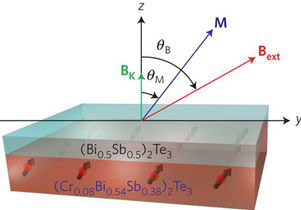
    Structure of the two-layer topological insulator developed by UCLA Engineering researchers. Credit: UCLA Newsroom

    Researchers at the UCLA Henry Samueli School of Engineering and Applied Science have developed a new class of topological insulators that use 1,000 times less energy to switch polarity than comparable memory structures.

    Topological insulators are an emerging class of materials that act as both insulators and conductors, and could potentially be used in smartphones, computers, and other electronic devices.

    A research team at the UCLA Henry Samueli School of Engineering and Applied Science has developed a new class of topological insulators in which one of two layers is magnetized. The advance could lead to the development of much more energy-efficient big-data processing systems and ultra-low power electronics.

    Led by Kang Wang, the Raytheon Professor of Electrical Engineering at UCLA and the study’s principal investigator, the team demonstrated for the first time that the new topological insulators can be electrically “switched” to make them significantly more energy-efficient than current devices. The research was published April 28 in the journal Nature Materials.

    “We are very excited about this important result with the new topological insulators, which should lead to the advancement of future low-power, green electronics,” Wang said.

    The interiors of topological insulators prevent the flow of electrical currents, but their surfaces allow a current to move with very little resistance. Perhaps most importantly, their surfaces enable the transport of spin-polarized electrons while preventing the “scattering” of electrons that causes energy to be dissipated and wasted.

    The topological insulator created at UCLA comprises two layers, one of which contains chromium, a magnetic element. An electrical current that drives spin-polarized electrons can switch the up-down polarity of the magnetic chromium atoms. This switching is what enables the device to write memory or perform calculations.

    Most significantly, the new two-layer structure uses 1,000 times less energy to switch polarity than comparable memory structures.

    “This is the first time that topological insulators have been incorporated in a magnetic structure that can be efficiently switched, and is perhaps the first demonstration of potential applicable devices based on topological insulators,” said Yabin Fan, the paper’s lead author and a UCLA graduate student in electrical engineering.

    The study’s other authors include UCLA Engineering graduate students Pramey Upadhyaya and Xufeng Kou.

    The research was supported by the Defense Advanced Research Projects Agency’s Mesodynamic Architectures program. Additional support came from two UCLA Engineering research centers, the Western Institute of Nanoelectronics and the Center for Functional Accelerated nanoMaterial Engineering.

    Reference: “Magnetization switching through giant spin–orbit torque in a magnetically doped topological insulator heterostructure” by Yabin Fan, Pramey Upadhyaya, Xufeng Kou, Murong Lang, So Takei, Zhenxing Wang, Jianshi Tang, Liang He, Li-Te Chang, Mohammad Montazeri, Guoqiang Yu, Wanjun Jiang, Tianxiao Nie, Robert N. Schwartz, Yaroslav Tserkovnyak and Kang L. Wang, 28 April 2014, Nature Materials.
    DOI: 10.1038/nmat3973


    Never miss a breakthrough: Join the SciTechDaily newsletter.
    Follow us on Google and Google News.

    Engineering Materials Science Topological Insulators UCLA
    Share. Facebook Twitter Pinterest LinkedIn Email Reddit

    Related Articles

    Beat the Heat: UCLA’s New Cooling Device Drops Temperatures by 16 Degrees Continuously

    New Flexible Cooling Device Could Provide Efficient Cooling for Mobile Electronics

    Nanodiamonds Improve Effectiveness of Breast Cancer Treatment

    A Cost-Effective Fabrication Method for Micro-Scale Graphene-Based Supercapacitors

    New 3D Form of Graphene May Lead to Flexible Electronics

    Self-Assembling Polymer Increases Hard Drive Capacity Fivefold

    Chemical Lift-Off Lithography Patterns Biomolecules at High Resolution

    Superhydrophobic Coating Allows Boiling Water without the Creation of Bubbles

    Highly Transparent Polymer Solar Cell Produces Energy by Absorbing Near-Infrared Light

    Leave A Reply Cancel Reply

    • Facebook
    • Twitter
    • Pinterest
    • YouTube

    Don't Miss a Discovery

    Subscribe for the Latest in Science & Tech!

    Trending News

    Sitting Up Straight Could Actually Help You Make Better Decisions

    Never-Before-Seen Vortices Are Swirling Across the Sun

    This Common Amino Acid May Help the Body Fight Cancer and Viruses

    Low-Protein “Longevity Diet” Linked to Fat Loss, Muscle Preservation, and Healthy Aging

    How Prehistoric Poop Changed Earth’s Ecosystems Forever

    This Fossil Upends a Decades-Old Debate About Snake Evolution

    A Blood Test Years Before Cancer May Reveal a Hidden Warning Sign

    Starlink Satellites Reveal a Hidden Atmosphere 300 Miles Above Earth

    Follow SciTechDaily
    • Facebook
    • Twitter
    • YouTube
    • Pinterest
    • Newsletter
    • RSS
    SciTech News
    • Biology News
    • Chemistry News
    • Earth News
    • Health News
    • Physics News
    • Science News
    • Space News
    • Technology News
    Recent Posts
    • A Simple Feeding Change Makes Zoo Lions Behave More Like They Do in the Wild
    • Scientists Discover a Hidden World of Fungi 1,640 Feet Beneath Michigan
    • Where Were All the Tiny Dinosaurs? Scientists May Finally Have an Answer
    • Astronomers Caught a Star Exploding Almost the Instant It Began
    • Empty Space May Not Be Empty After All: Magnetar Reveals a Bizarre Quantum Effect
    Copyright © 1998 - 2026 SciTechDaily. All Rights Reserved.
    • Science News
    • About
    • Contact
    • Editorial Board
    • Privacy Policy
    • Terms of Use

    Type above and press Enter to search. Press Esc to cancel.