

Stress granules play a crucial role in the stress response, arising from the aggregation of non-translating mRNAs and proteins. Although significant knowledge exists about stress granules, the mechanisms behind their mRNA localization remain partially understood. Alterations to mRNA can change the characteristics of the nucleobases, influencing key processes like translation, splicing, and the positioning of specific transcripts.
The researchers show that the RNA modification N4-acetylcytidine (ac4C) on mRNA associates with transcripts enriched in stress granules and that stress granule localized transcripts with ac4C are specifically translationally regulated.
They also show that ac4C on mRNA can mediate the localization of proteins to stress granules. Their results suggest that acetylation of mRNA regulates the localization of both stress-sensitive transcripts and RNA-binding proteins to stress granules and adds to our understanding of the molecular mechanisms responsible for stress granule formation.
Stress Granule Formation and RNA Modifications
Stress granules are membrane-less assemblies of mRNA-protein complexes that arise from mRNAs stuck in translation initiation. RNA-protein complexes are important for their formation and the mechanisms promoting stress granule formation involve both conventional RNA-protein interactions and interactions that encompass intrinsically disordered regions of proteins.
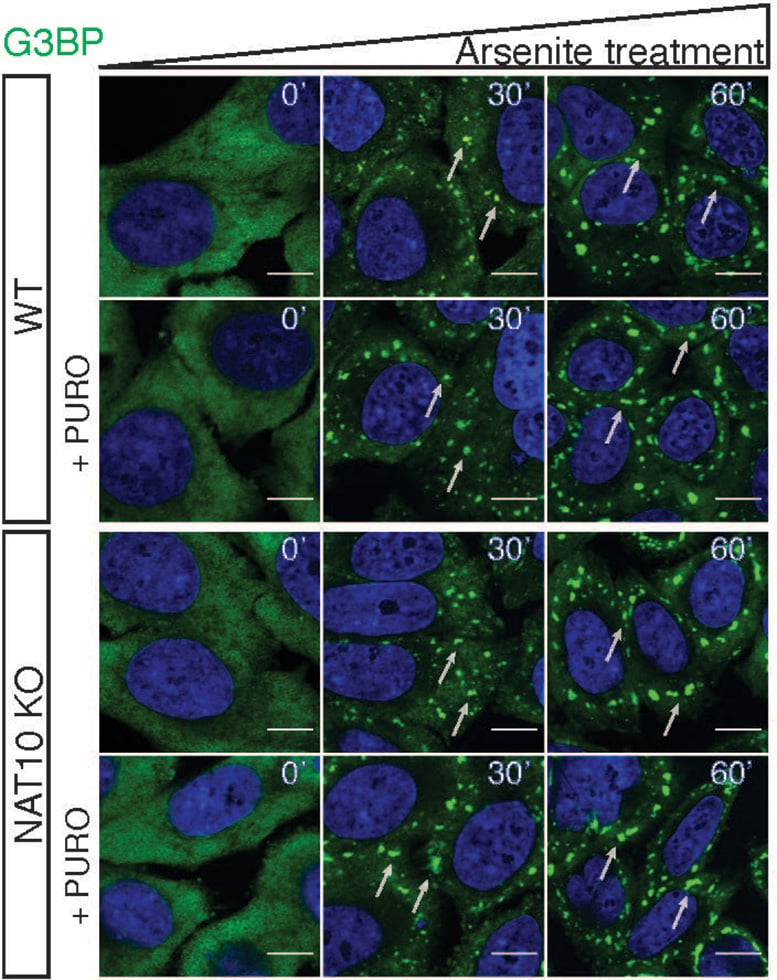
Stress granules have been extensively studied, and it is well-established that they form when translation initiation is limited a variety of roles for stress granules within the cell have been proposed. While stress granule assembly and disassembly can be regulated by various post-translational modifications the impact of RNA modifications on their formation, dispersal, and function remains largely unclear.
Impact of ac4C on Stress Granules and Cellular Stress Response
The RNA modification N4-acetylcytidine (ac4C) has recently been shown to be deposited on mRNA and regulate translation efficiency. ac4C is conserved through all kingdoms of life and is induced upon several different stresses. ac4C is less abundant than other RNA modifications on mRNA and due to difficulties in precise and quantitative mapping its function and occurrence on mRNA have remained controversial.
The researchers show in their publication that ac4C is enriched in stress granules and that acetylated transcripts are predominantly localized to stress granules in response to oxidative stress, proposing a model where acetylation of RNA can affect mRNA localization to stress granules, in part by affecting the translational release of mRNA from the ribosome, providing new insight into both the function and consequences of mRNA acetylation and mechanism of RNA localization to stress granules.
The findings will promote the understanding of how the cells react to stress and which role RNA modifications play in the process. Both stress and RNA acetylation have implications in disease and their findings could help shed light on relevant molecular pathways that could be targeted in disease.
Reference: “N4-acetylcytidine (ac4C) promotes mRNA localization to stress granules” by Pavel Kudrin, Ankita Singh, David Meierhofer, Anna Kuśnierczyk and Ulf Andersson Vang Ørom, 27 February 2024, EMBO Reports.
DOI: 10.1038/s44319-024-00098-6
The project was led by Ulf A.V. Ørom’s lab at Aarhus University in Denmark, and the study involved collaboration with researchers from the University of Tartu, Norwegian Technical University, and the Max Planck Institute for Molecular Genetics in Berlin.
Never miss a breakthrough: Join the SciTechDaily newsletter.
Follow us on Google and Google News.