
Close Menu
    Facebook X (Twitter) Instagram
    SciTechDaily
    • Biology
    • Chemistry
    • Earth
    • Health
    • Physics
    • Science
    • Space
    • Technology
    Facebook X (Twitter) Pinterest YouTube RSS
    SciTechDaily
    Home»Space»New ESO Image of Star Cluster NGC 3293
    Space

    New ESO Image of Star Cluster NGC 3293

    By European Southern ObservatoryJuly 24, 2014No Comments4 Mins Read
    Facebook Twitter Pinterest Telegram LinkedIn WhatsApp Email Reddit
    Share
    Facebook Twitter LinkedIn Pinterest Telegram Email Reddit
    New ESO Image of Star Cluster NGC 3293
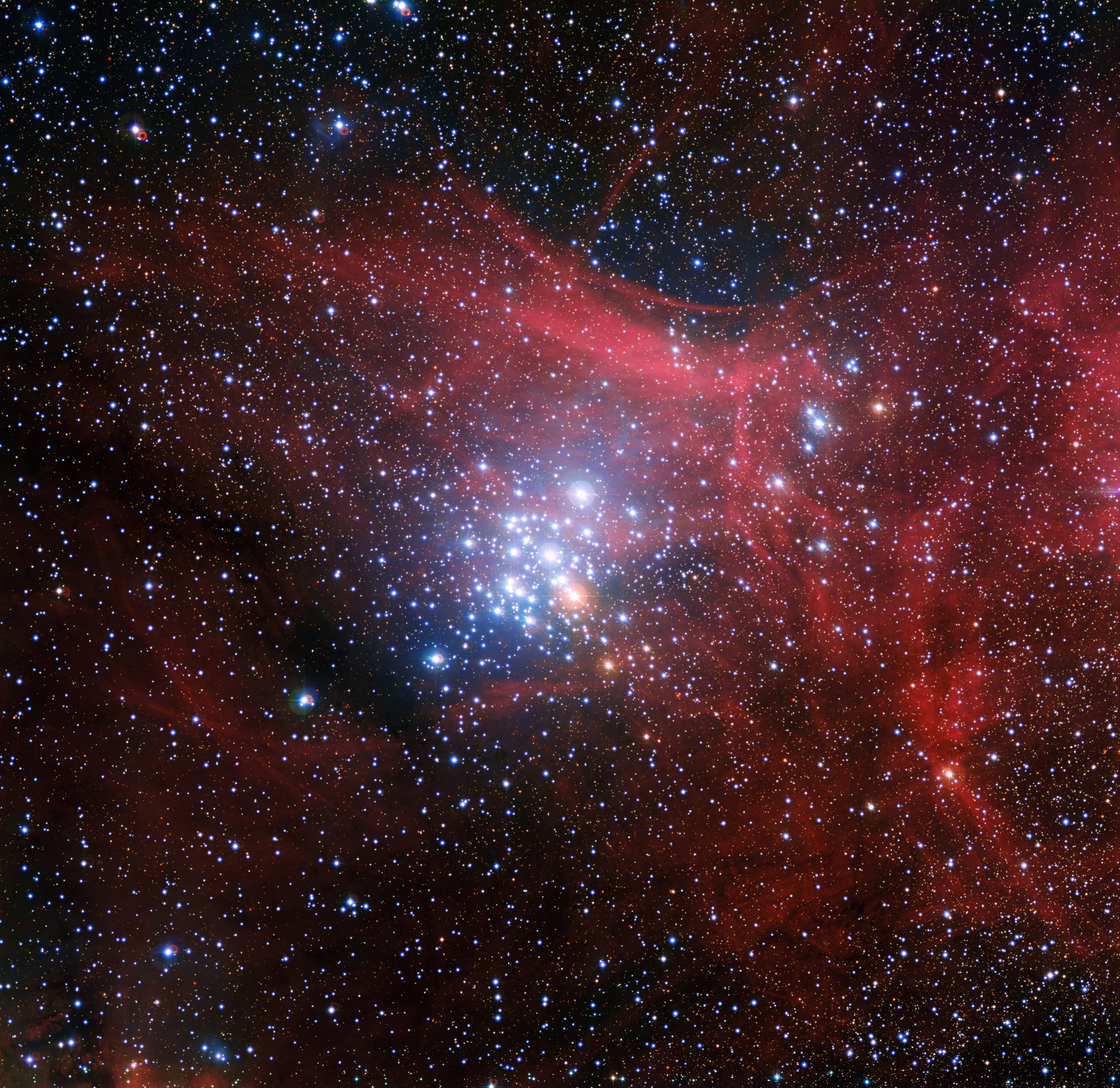
    In this image from the Wide Field Imager on the MPG/ESO 2.2-meter telescope at ESO’s La Silla Observatory in Chile young stars huddle together against a backdrop of clouds of glowing gas and lanes of dust. The star cluster, known as NGC 3293, would have been just a cloud of gas and dust itself about ten million years ago, but as stars began to form it became the bright group we see here. Clusters like this are celestial laboratories that allow astronomers to learn more about how stars evolve. Credit: ESO/G. Beccari

    This newly released image from ESO’s La Silla Observatory in Chile shows star cluster NGC 3293, which is located 8,000 light-years from Earth in the constellation of Carina.

    In this striking new image from ESO’s La Silla Observatory in Chile, young stars huddle together against a backdrop of clouds of glowing gas and lanes of dust. The star cluster, known as NGC 3293, would have been just a cloud of gas and dust itself about ten million years ago, but as stars began to form it became the bright group of stars we see here. Clusters like this are celestial laboratories that allow astronomers to learn more about how stars evolve.

    This beautiful star cluster, NGC 3293, is found 8,000 light-years from Earth in the constellation of Carina (The Keel). This cluster was first spotted by the French astronomer Nicolas-Louis de Lacaille in 1751, during his stay in what is now South Africa, using a tiny telescope with an aperture of just 12 millimeters. It is one of the brightest clusters in the southern sky and can be easily seen with the naked eye on a dark clear night.

    Star clusters like NGC 3293 contain stars that all formed at the same time, at the same distance from Earth and out of the same cloud of gas and dust, giving them the same chemical composition. As a result clusters like this are ideal objects for testing stellar evolution theory.

    Most of the stars seen here are very young, and the cluster itself is less than 10 million years old. Just babies on cosmic scales if you consider that the Sun is 4.6 billion years old and still only middle-aged. An abundance of these bright, blue, youthful stars is common in open clusters like NGC 3293, and, for example, in the better known Kappa Crucis cluster, otherwise known as the Jewel Box or NGC 4755.

    These open clusters each formed from a giant cloud of molecular gas and their stars are held together by their mutual gravitational attraction. But these forces are not enough to hold a cluster together against close encounters with other clusters and clouds of gas as the cluster’s own gas and dust dissipate. So, open clusters will only last a few hundred million years, unlike their big cousins, the globular clusters, which can survive for billions of years, and hold on to far more stars.

    Despite some evidence suggesting that there is still some ongoing star formation in NGC 3293, it is thought that most, if not all, of the nearly fifty stars in this cluster were born in one single event. But even though these stars are all the same age, they do not all have the dazzling appearance of a star in its infancy; some of them look positively elderly, giving astronomers the chance to explore how and why stars evolve at different speeds.

    Take the bright orange star at the bottom right of the cluster. This huge star, a red giant, would have been born as one of the biggest and most luminous of its litter, but bright stars burn out fast. As the star used up the fuel at its core its internal dynamics changed and it began to swell and cool, becoming the red giant we now observe. Red giants are reaching the end of their life cycle, but this red giant’s sister stars are still in what is known as the pre-main-sequence — the period before the long, stable, middle period in a star’s life. We see these stars in the prime of their life as hot, bright, and white against the red and dusty background.

    This image was taken with the Wide Field Imager (WFI) installed on the MPG/ESO 2.2-meter telescope at ESO’s La Silla Observatory in northern Chile.

    Never miss a breakthrough: Join the SciTechDaily newsletter.
    Follow us on Google and Google News.

    Astronomy European Southern Observatory
    Share. Facebook Twitter Pinterest LinkedIn Email Reddit

    Related Articles

    Supermassive Black Holes on a Collision Course: Closest Pair of Supermassive Black Holes to Earth Ever Discovered

    Black Hole Discovered Lurking in Star Cluster Outside Our Galaxy

    Discovery in a Galaxy Over 12 Billion Light-Years Away – Reveals How Element Found in Our Bones Is Forged in the Universe

    Strange 160 Mile-Long “Dog-Bone” Asteroid Kleopatra Captured in Detailed Images

    Astronomers Find Small Rocky Planet – Just Half the Mass of Venus

    First Clear Detection of a Moon-Forming Disc Around a Planet Outside Our Solar System

    Mystery Solved: Astronomers Unravel the Puzzle of Betelgeuse’s “Great Dimming”

    Stunning Galactic Fireworks: New ESO Images Reveal Spectacular Features of Nearby Galaxies

    Astronomers Were Puzzled by “Great Dimming” of Betelgeuse – Now the Mystery Is Solved

    Leave A Reply Cancel Reply

    • Facebook
    • Twitter
    • Pinterest
    • YouTube

    Don't Miss a Discovery

    Subscribe for the Latest in Science & Tech!

    Trending News

    Could Low Vitamin D Be Making Your Pain Worse?

    Scientists Discover Once-Weekly Workout That Melts Belly Fat Surprisingly Effectively

    Scientists Just Tested a Thruster Powerful Enough for Human Missions to Mars

    Doctors Say Your Ice Pack Might Be Making Injuries Worse

    Scientists Discover 43-Foot Sea Reptile Twice the Size of a Great White Shark

    Bees and Birds Are Drinking Alcohol From Flowers

    Scientists Discover How Obesity May Trigger Alzheimer’s Disease

    Scientists Confirm Alcohol Causes Widespread Health Damage

    Follow SciTechDaily
    • Facebook
    • Twitter
    • YouTube
    • Pinterest
    • Newsletter
    • RSS
    SciTech News
    • Biology News
    • Chemistry News
    • Earth News
    • Health News
    • Physics News
    • Science News
    • Space News
    • Technology News
    Recent Posts
    • Ancient Goose Fossil Challenges Long-Held Theories About New Zealand Birds
    • A Tiny Bright-Blue Octopus Found in the Galápagos Is Completely New to Science
    • Scientists Stop Pancreatic Cancer Before It Starts in Landmark Preclinical Study
    • Scientists Discover Surprising Anti-Aging Power Hidden in Aged Garlic
    • Just Minutes of Intense Exercise Could Slash Disease Risk by 50%
    Copyright © 1998 - 2026 SciTechDaily. All Rights Reserved.
    • Science News
    • About
    • Contact
    • Editorial Board
    • Privacy Policy
    • Terms of Use

    Type above and press Enter to search. Press Esc to cancel.