
Close Menu
    Facebook X (Twitter) Instagram
    SciTechDaily
    • Biology
    • Chemistry
    • Earth
    • Health
    • Physics
    • Science
    • Space
    • Technology
    Facebook X (Twitter) Pinterest YouTube RSS
    SciTechDaily
    Home»Space»New Herschel Image of the Orion A Star-Formation Cloud
    Space

    New Herschel Image of the Orion A Star-Formation Cloud

    By European Space AgencyAugust 26, 2013No Comments2 Mins Read
    Facebook Twitter Pinterest Telegram LinkedIn WhatsApp Email Reddit
    Share
    Facebook Twitter LinkedIn Pinterest Telegram Email Reddit
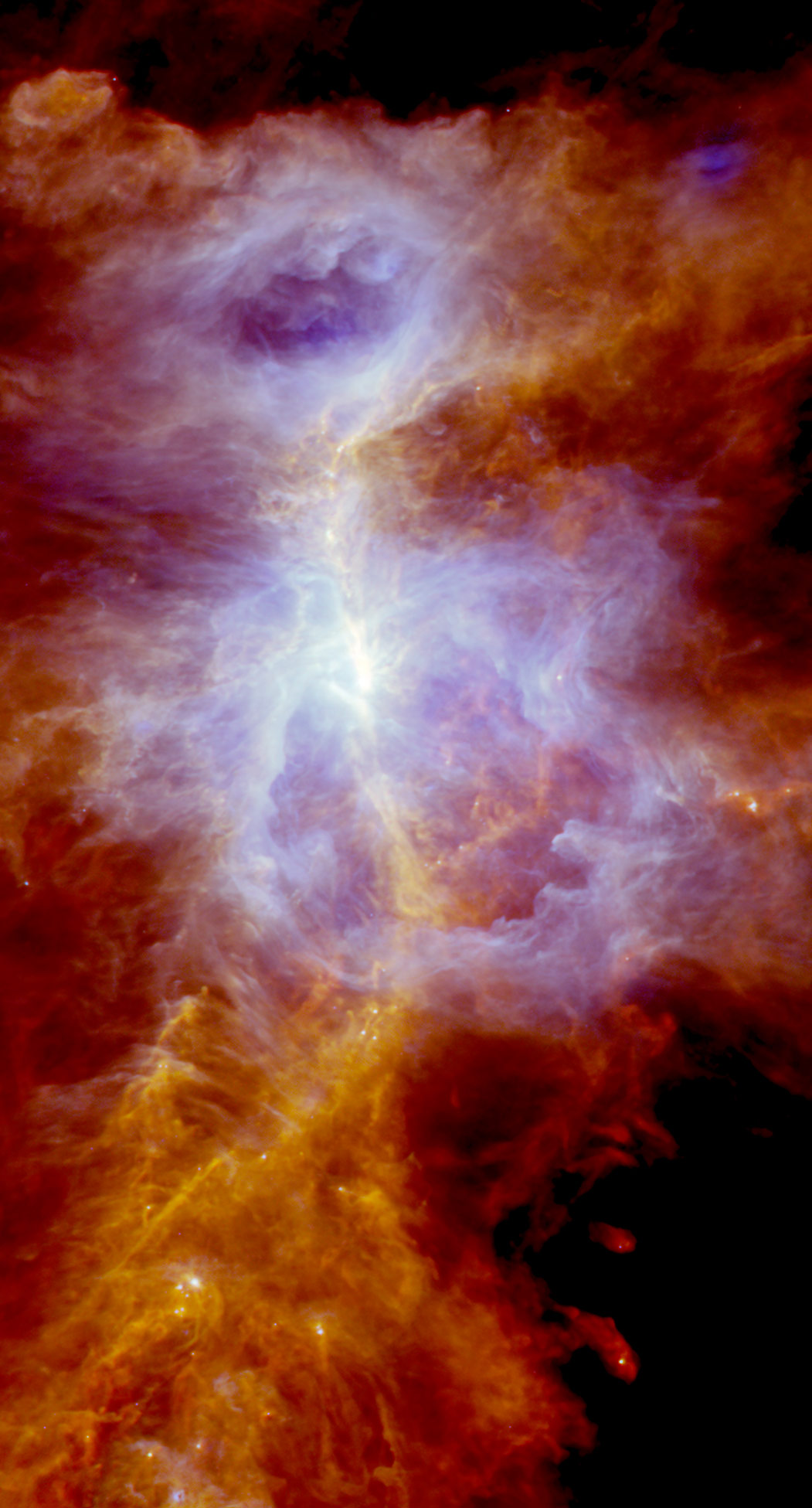
    Herschel Views the Orion A Star Formation Cloud
    The image is a composite of the wavelengths of 70 microns (blue), 160 microns (green), and 250 microns (red) and spans about 1.3 x 2.4 degrees. North is up and east is to the left. Credit: ESA/Herschel/ Ph. André, V. Könyves, N. Schneider (CEA Saclay, France) for the Gould Belt survey Key Program

    This new composite image from ESA’s Herschel Space Observatory shows the Orion A star-formation cloud.

    This new view of the Orion A star-formation cloud from ESA’s Herschel Space Observatory shows the turbulent region of space that hugs the famous Orion Nebula.

    The nebula lies about 1,500 light years from Earth within the ‘sword of Orion’ – below the three main stars that form the belt of the Orion constellation.

    In this view, the nebula corresponds to the brightest region in the center of the image, where it is lit up by the Trapezium group of stars at its heart.

    The scene is awash with turbulent star formation, the fierce ultraviolet radiation of massive new born stars blasting away their surrounding cloudy cocoons, carving ethereal shapes into the gas and dust.

    Wispy tendrils rise like flames away from some of the most intense regions of star formation, while pillars of denser material withstand the searing blaze for longer.

    Great arms of gas and dust extend from the Orion Nebula to form a ring, while a spine of cooler material weaves up through the scene to a halo of cloudy star-formation material above.

    Embedded within the red and yellow filaments are a handful of point-like sources: these are protostars, the seeds of new stars that will soon ignite and begin to flood their surrounds with intense radiation.

    The black regions to the top of the image and to the bottom right may seem like voids, but actually contain hints of much fainter emission that has not been emphasized in this image.

    The red ‘islands’ of emission in the bottom right are also a subtle trick of image processing for they are connected to the main cloud by much fainter emission. The bright ‘eyes’ in the two most distinct clouds indicates that the tip of each pillar has already collapsed and is forming stars.


    Never miss a breakthrough: Join the SciTechDaily newsletter.
    Follow us on Google and Google News.

    European Space Agency Herschel Space Observatory Nebula
    Share. Facebook Twitter Pinterest LinkedIn Email Reddit

    Related Articles

    Astronomers Discover Water-Building Molecule in Planetary Nebulas

    Herschel Views Red Supergiant Star Betelgeuse

    Crab Nebula Contains Enough Dust to Make Around 40,000 Earths

    Herschel Image of the Vela C Region

    Searching for Molecular Oxygen in the Orion Nebula

    Searching for Link Between Star Formation and Black Hole Activity

    Panoramic View of 30 Doradus – The Brightest Star-Forming Region in Our Galactic Neighborhood

    New Images of Orion Nebula Show Young Stars Hidden in Gas and Dust Clouds

    ESA’s Hershel Space Telescope Captures Incredible Views of Eagle Nebula

    Leave A Reply Cancel Reply

    • Facebook
    • Twitter
    • Pinterest
    • YouTube

    Don't Miss a Discovery

    Subscribe for the Latest in Science & Tech!

    Trending News

    Scientists Discover How Coffee Impacts Memory, Mood, and Gut Health

    Why Did the Neanderthals Disappear? Scientists Reveal Humans Had a Hidden Advantage

    Physicists Propose Strange Experiment Where Time Goes Quantum

    Magnesium Magic: New Drug Melts Fat Even on a High-Fat, High-Sugar Diet

    Weight-Loss Drugs Like Ozempic May Come With an Unexpected Cost

    Mezcal “Worm” in a Bottle Mystery: DNA Testing Reveals a Surprise

    New Research Reveals That Your Morning Coffee Activates an Ancient Longevity Switch

    This Is What Makes You Irresistible to Mosquitoes

    Follow SciTechDaily
    • Facebook
    • Twitter
    • YouTube
    • Pinterest
    • Newsletter
    • RSS
    SciTech News
    • Biology News
    • Chemistry News
    • Earth News
    • Health News
    • Physics News
    • Science News
    • Space News
    • Technology News
    Recent Posts
    • Harvard Scientists Reveal Secret Structure Behind How You Smell
    • Scientists Just Discovered the Hidden Trick That Keeps Your Cells Alive
    • This Simple Movement Could Be Secretly Cleaning Your Brain
    • Male Birth Control Breakthrough: Scientists Find Way To Turn Sperm Production Off and Back On
    • A Common Vitamin Could Hold the Key to Treating Fatty Liver Disease
    Copyright © 1998 - 2026 SciTechDaily. All Rights Reserved.
    • Science News
    • About
    • Contact
    • Editorial Board
    • Privacy Policy
    • Terms of Use

    Type above and press Enter to search. Press Esc to cancel.