

Close Menu
    Facebook X (Twitter) Instagram
    SciTechDaily
    • Biology
    • Chemistry
    • Earth
    • Health
    • Physics
    • Science
    • Space
    • Technology
    Facebook X (Twitter) Pinterest YouTube RSS
    SciTechDaily
    Home»Technology»New High-Tech Windows Cut Building Energy Use by 20%
    Technology

    New High-Tech Windows Cut Building Energy Use by 20%

    By Shanghai Jiao Tong University Journal CenterFebruary 24, 2025No Comments4 Mins Read
    Facebook Twitter Pinterest Telegram LinkedIn WhatsApp Email Reddit
    Share
    Facebook Twitter LinkedIn Pinterest Telegram Email Reddit
    Cellular Window Shades
    Researchers have developed a breakthrough flexible dual-band electrochromic smart window that intelligently controls light and heat, reducing building energy consumption by up to 20% while integrating energy storage for enhanced sustainability.

    A new dual-band electrochromic window enhances energy efficiency by controlling light and heat, reducing energy use by 20%. It is durable, scalable, and outperforms conventional windows, offering a promising solution for sustainable buildings.

    As global energy consumption continues to rise, buildings account for about 40% of total energy use, with nearly half dedicated to heating and cooling. Windows, as the primary interface for energy exchange between indoor and outdoor environments, contribute to 20–40% of energy loss. To address this, the development of energy-efficient smart windows that minimize energy consumption while preserving natural light and aesthetics has become a crucial focus in sustainable building design.

    A research team from Nanjing University of Aeronautics and Astronautics, led by Prof. Shengliang Zhang, has introduced a groundbreaking flexible dual-band electrochromic window. This innovation integrates energy storage and significantly improves energy efficiency by allowing precise control over both visible light and near-infrared (NIR) radiation. Compared to conventional windows, this advanced technology can reduce building energy consumption by up to 20%, offering a promising solution for sustainable architecture.

    Core Technology and Performance

    The core of this innovative window lies in its W18O49 nanowire structure, which enables precise control over optical modulation in both the visible and NIR spectrums. This dual-band electrochromic device (DBED) provides outstanding optical modulation ranges (73.1% for visible light, 85.3% for NIR) and exceptional longevity, with minimal capacity loss after 10,000 cycles (3.3%). Additionally, it boasts an energy recovery efficiency of 51.4%, where energy consumed during the coloring process is recycled, reducing overall net energy consumption.
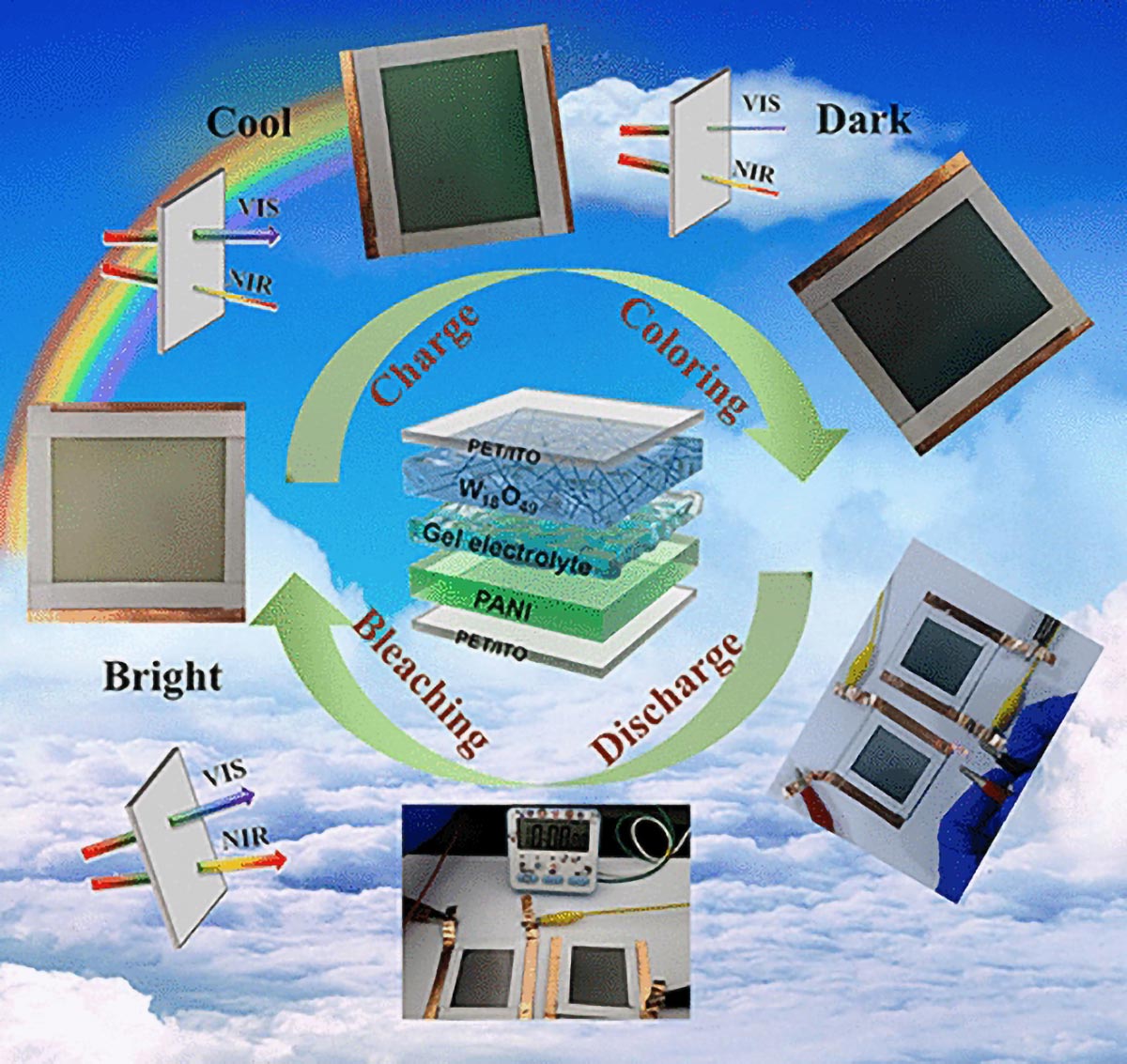
    Flexible Dual Band Electrochromic Device With a High Optical Modulation and a Long Cycle Life
    A flexible dual-band electrochromic device with high optical modulation and durability has been developed. It independently controls visible and near-infrared light, offering superior energy-saving performance compared to commercial low-emissivity glass in various climates. Additionally, it features efficient energy storage, recycling 51.4% of the energy used during coloration for local reuse. Credit: Zekun Huang, Yutao Peng, Jing Zhao, Shengliang Zhang, Penglu Qi, Xianlin Qu, Fuqiang Yan, Bing Ding, Yimin Xuan & Xiaogang Zhang

    When integrated into buildings, the device not only optimizes thermal regulation but also demonstrates excellent performance in various climate zones. According to EnergyPlus simulations, DBED outperforms conventional low-emissivity glass in most global climates, providing substantial energy savings. Its ability to selectively modulate light and heat across multiple wavelengths ensures a significant reduction in the energy required for heating and cooling.

    Scalability and Future Potential

    The flexibility and scalability of the device, coupled with its high optical modulation and energy recovery capabilities, present a significant step forward in the development of sustainable building materials. Researchers have also demonstrated that the device can be scaled to large sizes without compromising performance, offering promising potential for widespread adoption in energy-efficient buildings.

    Despite its success, challenges remain in terms of mass production and cost-efficiency. Future research will focus on enhancing material stability and integrating the technology more seamlessly into existing architectural systems. Additionally, optimizing the design for mass-market applications could pave the way for the next generation of energy-saving smart windows.

    In summary, this novel electrochromic device presents a groundbreaking solution for smart windows, combining energy efficiency, flexibility, and energy storage to redefine the future of sustainable building technologies. As further research unlocks its full potential, it could set new standards in intelligent architecture, offering a pathway to more sustainable, energy-efficient buildings worldwide.

    Reference: “An Efficient and Flexible Bifunctional Dual-Band Electrochromic Device Integrating with Energy Storage” by Zekun Huang, Yutao Peng, Jing Zhao, Shengliang Zhang, Penglu Qi, Xianlin Qu, Fuqiang Yan, Bing Ding, Yimin Xuan and Xiaogang Zhang, 27 December 2024, Nano-Micro Letters.
    DOI: 10.1007/s40820-024-01604-0

    Never miss a breakthrough: Join the SciTechDaily newsletter.
    Follow us on Google and Google News.

    Energy Engineering
    Share. Facebook Twitter Pinterest LinkedIn Email Reddit

    Related Articles

    Using Science and Technology To Address the World’s Most Pressing Issues

    No More Blackouts? New Framework Guarantees the Stability of Microgrids

    New Aluminum Batteries Increase the Range of UUVs Tenfold

    MIT Engineers Look Toward All-Solid Lithium Batteries

    Engineers Design Calcium-Based Multi-Element for Liquid Batteries

    Sustainable Power Sources Based on High Efficiency Thermopower Wave Devices

    New Material Can Store Solar Energy During the Day and Release it Later as Heat

    Thermal-Imaging Quickly Tracks Energy Leaks in Homes and Buildings

    Power Conserving Chip May Increase Smartphone Battery Life

    Leave A Reply Cancel Reply

    • Facebook
    • Twitter
    • Pinterest
    • YouTube

    Don't Miss a Discovery

    Subscribe for the Latest in Science & Tech!

    Trending News

    Millions Take These IBS Drugs, But a New Study Finds Serious Risks

    Scientists Unlock Hidden Secrets of 2,300-Year-Old Mummies Using Cutting-Edge CT Scanner

    Bread Might Be Making You Gain Weight Even Without Eating More Calories

    Scientists Discover Massive Magma Reservoir Beneath Tuscany

    Europe’s Most Active Volcano Just Got Stranger – Here’s Why Scientists Are Rethinking It

    Alzheimer’s Symptoms May Start Outside the Brain, Study Finds

    Millions Take This Popular Supplement – Scientists Discover a Concerning Link to Heart Failure

    The Universe Is Expanding Too Fast and Scientists Can’t Explain Why

    Follow SciTechDaily
    • Facebook
    • Twitter
    • YouTube
    • Pinterest
    • Newsletter
    • RSS
    SciTech News
    • Biology News
    • Chemistry News
    • Earth News
    • Health News
    • Physics News
    • Science News
    • Space News
    • Technology News
    Recent Posts
    • Simple Blood Test May Predict Alzheimer’s Years Before Brain Scans Show Signs
    • Scientists Say Adding This Unusual Seafood to Your Diet Could Reverse Signs of Aging
    • U.S. Waste Holds $5.7 Billion Worth of Crop Nutrients
    • Scientists Say a Hidden Structure May Exist Inside Earth’s Core
    • Doctors Surprised by the Power of a Simple Drug Against Colon Cancer
    Copyright © 1998 - 2026 SciTechDaily. All Rights Reserved.
    • Science News
    • About
    • Contact
    • Editorial Board
    • Privacy Policy
    • Terms of Use

    Type above and press Enter to search. Press Esc to cancel.