
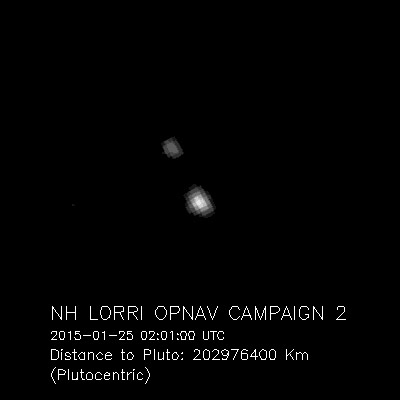
Headed towards Pluto, NASA’s New Horizons spacecraft has captured this new image of Pluto and its moon Charon.
NASA’s New Horizons spacecraft returned its first new images of Pluto on Wednesday, as the probe closes in on the dwarf planet. Although still just a dot along with its largest moon, Charon, the images come on the 109th birthday of Clyde Tombaugh, who discovered the distant icy world in 1930.
“My dad would be thrilled with New Horizons,” said Clyde Tombaugh’s daughter Annette Tombaugh, of Las Cruces, New Mexico. “To actually see the planet that he had discovered, and find out more about it — to get to see the moons of Pluto– he would have been astounded. I’m sure it would have meant so much to him if he were still alive today.”
New Horizons was more than 126 million miles (nearly 203 million kilometers) away from Pluto when it began taking images. The new images, taken with New Horizons’ telescopic Long-Range Reconnaissance Imager (LORRI) on January 25 and January 27, are the first acquired during the spacecraft’s 2015 approach to the Pluto system, which culminates with a close flyby of Pluto and its moons on July 14.
“This is our birthday tribute to Professor Tombaugh and the Tombaugh family, in honor of his discovery and life achievements — which truly became a harbinger of 21st-century planetary astronomy,” said Alan Stern, New Horizons principal investigator at the Southwest Research Institute (SwRI) in Boulder, Colorado. “These images of Pluto, clearly brighter and closer than those New Horizons took last July from twice as far away, represent our first steps at turning the pinpoint of light Clyde saw in the telescopes at Lowell Observatory 85 years ago, into a planet before the eyes of the world this summer.”
Over the next few months, LORRI will take hundreds of pictures of Pluto, against a starry backdrop, to refine the team’s estimates of New Horizons’ distance to Pluto. As in these first images, the Pluto system will resemble little more than bright dots in the camera’s view until late spring. However, mission navigators can still use such images to design course-correcting engine maneuvers to direct the spacecraft for a more precise approach. The first such maneuver based on these optical navigation images, or OpNavs, is scheduled for March 10.
“Pluto is finally becoming more than just a pinpoint of light,” said Hal Weaver, New Horizons project scientist at the Johns Hopkins University Applied Physics Laboratory in Laurel, Maryland. “LORRI has now resolved Pluto, and the dwarf planet will continue to grow larger and larger in the images as New Horizons spacecraft hurtles toward its targets. The new LORRI images also demonstrate that the camera’s performance is unchanged since it was launched more than nine years ago.”
Closing in on Pluto at about 31,000 mph (13,900 meters per second), New Horizons already has covered more than 3 billion miles (since it launched on January 19, 2006. Its journey has taken it past each planet’s orbit, from Mars to Neptune, in record time, and it is now in the first stage of an encounter with Pluto that includes long-distance imaging as well as dust, energetic particle, and solar wind measurements to characterize the space environment near Pluto.
“The U.S. has led the exploration of the planets and continues to do so with New Horizons,” said Curt Niebur, New Horizons program scientist at NASA Headquarters in Washington. “This mission will obtain images to map Pluto and its moons better than has ever been achieved by any previous planetary mission.”
APL manages the New Horizons mission for NASA’s Science Mission Directorate in Washington. Alan Stern, of SwRI, is the principal investigator and leads the mission. SwRI leads the science team, payload operations, and encounter science planning. New Horizons is part of the New Frontiers Program, managed by NASA’s Marshall Space Flight Center in Huntsville, Alabama. APL designed, built, and operates the spacecraft.
Never miss a breakthrough: Join the SciTechDaily newsletter.
Follow us on Google and Google News.