
Close Menu
    Facebook X (Twitter) Instagram
    SciTechDaily
    • Biology
    • Chemistry
    • Earth
    • Health
    • Physics
    • Science
    • Space
    • Technology
    Facebook X (Twitter) Pinterest YouTube RSS
    SciTechDaily
    Home»Technology»New Molybdenum Sulfide Transistor Significantly Outperforms Existing Models
    Technology

    New Molybdenum Sulfide Transistor Significantly Outperforms Existing Models

    By Shaun Mason, University of California - Los AngelesOctober 29, 2014No Comments3 Mins Read
    Facebook Twitter Pinterest Telegram LinkedIn WhatsApp Email Reddit
    Share
    Facebook Twitter LinkedIn Pinterest Telegram Email Reddit
    New Transistor Significantly Outperforms Current Models
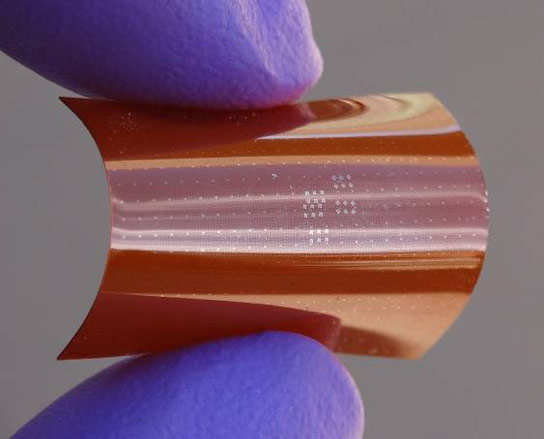
    The transistor developed at UCLA could mean vastly more powerful and sensitive wearable devices. Credit: Xiangfeng Duan

    A team of researchers has fabricated field effect transistors made from molybdenum sulfide that demonstrated the best performance to date, exceeding existing molybdenum sulfide transistor cut-off and maximum oscillation frequencies by 40 to 50 times.

    With their special electronic and optical properties, nanomaterials such as graphene and molybdenum sulfide have created excitement among scientists for their potential to revolutionize transistors and circuits.

    Research is underway that could vastly increase the efficiency and capabilities of the two-dimensional layered semiconductors used in high-speed, flexible electronic devices. But graphene’s structure lacks a feature called a band gap, which allows current through the material to be turned on and off. Unlike graphene, molybdenum sulfide has a band gap and can function as an atomically thin semiconductor and allow atomically thin transistors with high on-off ratios and high voltage gain.

    Now, a team of researchers led by Xiangfeng Duan at UCLA’s California NanoSystems Institute have fabricated field effect transistors made from molybdenum sulfide that demonstrated the best performance to date in a transistor of this type. In the near future, their invention could mean vastly more powerful and sensitive fitness and health trackers, smartphones, computer-interface eyewear, and other wearable applications.

    Transistors’ performance is judged in part by their cut-off and maximum oscillation frequencies. The UCLA transistors, just a few atoms thick, had cut-off and maximum oscillation frequencies that exceeded by 40 to 50 times the frequencies for existing molybdenum sulfide transistors.

    The paper was recently published in the journal Nature Communications; UCLA graduate student Rui Cheng was the study’s first author.

    The scientists found that electronic devices such as logic inverters or radio frequency amplifiers can be formed by integrating multiple molybdenum sulfide transistors on quartz or flexible plastic substrates with voltage gain in the gigahertz regime. The transistors they produced had a cut-off frequency of up to 42 gigahertz and a maximum oscillation frequency up to 50 gigahertz. Existing transistors have achieved readings of 0.9 gigahertz and 1 gigahertz, respectively.

    “Besides the significant increases in intrinsic performance of the transistors, the layered semiconductor molybdenum sulfide represents a highly flexible atomically thin membrane,” said Duan, who is also an associate professor of chemistry and biochemistry in UCLA College. “And it can be used to make flexible or stretchable circuitry that could be of great importance for wearable electronics of all kinds.”

    Reference: “Few-layer ​molybdenum disulfide transistors and circuits for high-speed flexible electronics” by Rui Cheng, Shan Jiang, Yu Chen, Yuan Liu, Nathan Weiss, Hung-Chieh Cheng, Hao Wu, Yu Huang and Xiangfeng Duan, 8 October 2014, Nature Communications.
    DOI: 10.1038/ncomms6143


    Never miss a breakthrough: Join the SciTechDaily newsletter.
    Follow us on Google and Google News.

    Nanomaterials Nanotechnology Transistors UCLA
    Share. Facebook Twitter Pinterest LinkedIn Email Reddit

    Related Articles

    Innovative New Magneto-Electric Transistor Could Cut 5% From World’s Digital Energy Budget

    Balancing Between Life and Research

    Automated System Has Promising Uses in Battery and Fuel Cell Production

    Exploring Graphene-Based THz Devices

    Graphene Center Laboratory is State of the Art “Nano-Factory”

    Nanosponges May Help With Environmental Cleanup

    Analyzing the Environmental Costs and Impacts of Technology

    Nanoparticles in 3-D Atomic-Scale Resolution

    Quantum Computers to Arrive with Single-Atom-Sized Transistors

    Leave A Reply Cancel Reply

    • Facebook
    • Twitter
    • Pinterest
    • YouTube

    Don't Miss a Discovery

    Subscribe for the Latest in Science & Tech!

    Trending News

    Scientists May Have Found the Key to Jupiter and Saturn’s Moon Mystery

    Scientists Uncover Brain Changes That Link Pain to Depression

    Saunas May Do More Than Raise Body Temperature – They Activate Your Immune System

    Exercise in a Pill? Metformin Shows Surprising Effects in Cancer Patients

    Hidden Oceans of Magma Could Be Protecting Alien Life

    New Study Challenges Alzheimer’s Theories: It’s Not Just About Plaques

    Artificial Sweeteners May Harm Future Generations, Study Suggests

    Splashdown! NASA Artemis II Returns From Record-Breaking Moon Mission

    Follow SciTechDaily
    • Facebook
    • Twitter
    • YouTube
    • Pinterest
    • Newsletter
    • RSS
    SciTech News
    • Biology News
    • Chemistry News
    • Earth News
    • Health News
    • Physics News
    • Science News
    • Space News
    • Technology News
    Recent Posts
    • Researchers Capture Quantum Interference in One of Nature’s Rarest Atoms
    • Ancient DNA Reveals Irish Goats Have a 3,000-Year-Old Lineage Still Alive Today
    • Historians Reveal Secrets of the Strange Hat Wars That Shook Early Modern England
    • “A Plague Is Upon Us”: The Mass Death That Changed an Ancient City Forever
    • This Strange Material Can Turn Superconductivity on and off Like a Switch
    Copyright © 1998 - 2026 SciTechDaily. All Rights Reserved.
    • Science News
    • About
    • Contact
    • Editorial Board
    • Privacy Policy
    • Terms of Use

    Type above and press Enter to search. Press Esc to cancel.