
Close Menu
    Facebook X (Twitter) Instagram
    SciTechDaily
    • Biology
    • Chemistry
    • Earth
    • Health
    • Physics
    • Science
    • Space
    • Technology
    Facebook X (Twitter) Pinterest YouTube RSS
    SciTechDaily
    Home»Space»New Observations Show Clumps of Gas Swirling Around Black Hole
    Space

    New Observations Show Clumps of Gas Swirling Around Black Hole

    By Harvard-Smithsonian Center For AstrophysicsFebruary 28, 2019No Comments3 Mins Read
    Facebook Twitter Pinterest Telegram LinkedIn WhatsApp Email Reddit
    Share
    Facebook Twitter LinkedIn Pinterest Telegram Email Reddit
    Simultaneous X Ray and Infrared Observations of the Galactic Center
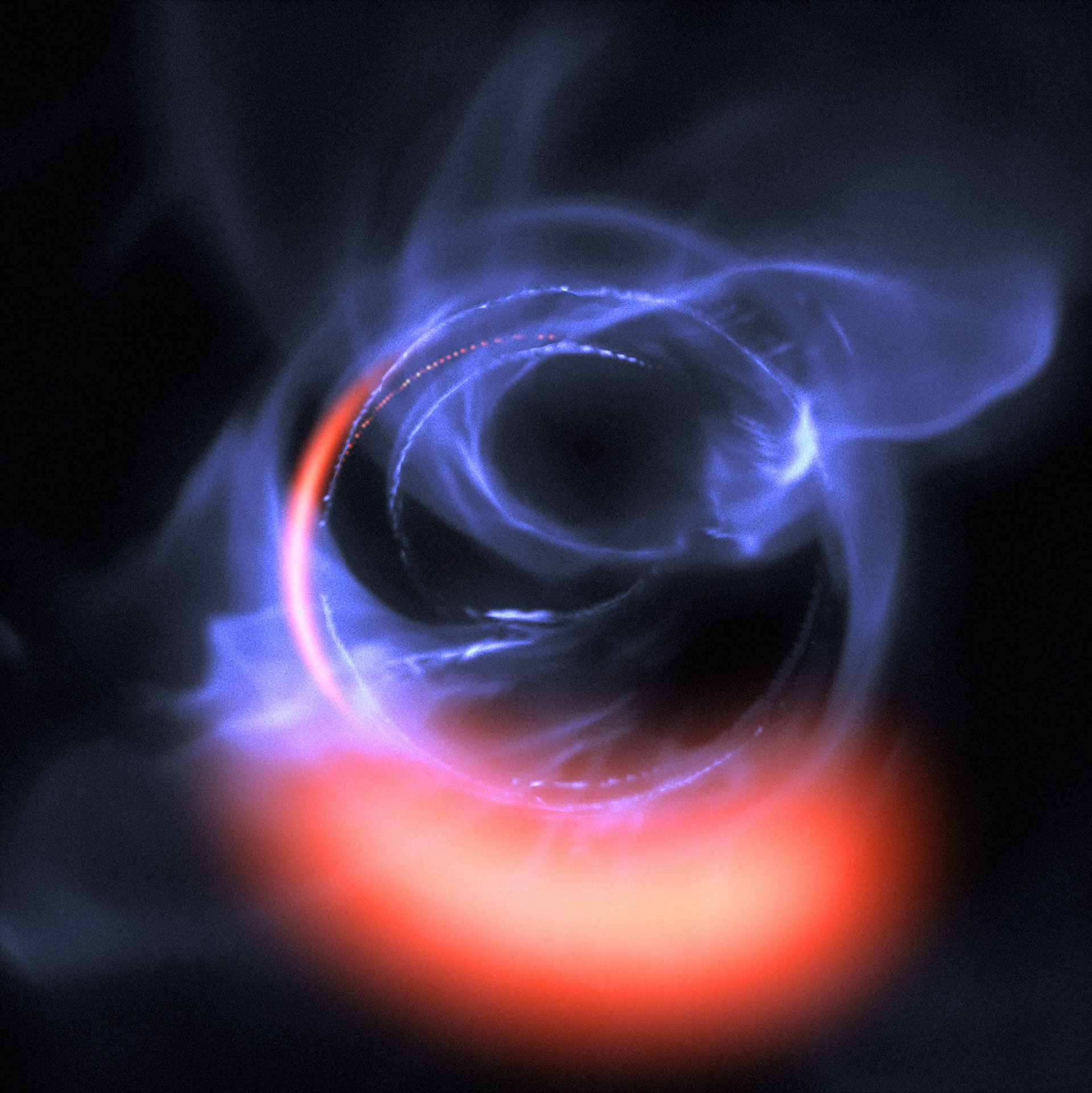
    ESO’s exquisitely sensitive GRAVITY instrument has added further evidence to the long-standing assumption that a supermassive black hole lurks in the center of the Milky Way. New observations show clumps of gas swirling around at about 30% of the speed of light on a circular orbit just outside a four million solar mass black hole — the first time material has been observed orbiting close to the point of no return, and the most detailed observations yet of material orbiting this close to a black hole. This visualization uses data from simulations of orbital motions of gas swirling around at about 30% of the speed of light on a circular orbit around the black hole. Credit: ESO/Gravity Consortium/L. Calçada

    The supermassive black hole (SMBH) at the center of our Milky Way galaxy, Sagittarius A*, is by far the closest such object to us, only about 25 thousand light-years away. Although not nearly as active or luminous as other SMBHs, its relative proximity provides astronomers with a unique opportunity to probe what happens close to the “edge” of a black hole.

    Monitored in the radio since its discovery and more recently in the infrared and the X-ray, Sgr A* appears to be accreting material at a very low rate, only a few hundredths of an Earth mass per year. Its X-ray emission is persistent, probably resulting from the rapid motions of electrons in the hot accretion flow associated with the black hole. Once a day there are also flares of emission that are highly variable; they appear more often in the infrared than in X-rays. Some submillimeter wavelength flares have also been tentatively linked to IR flares, although their timing seems to be delayed with respect to infrared events.

    Despite these intensive observational efforts, the physical mechanisms producing flaring around this SMBH are still unknown and are the topic of intense theoretical modeling.

    Harvard-Smithsonian Center For Astrophysics (CfA) astronomers Steve Willner, Joe Hora, Giovanni Fazio, and Howard Smith joined their colleagues in undertaking a systematic campaign of simultaneous multiwavelength observations of flaring in SagA* using the Spitzer and Chandra observatories (the Submillimeter Array was also used in some of the series).

    In over one hundred hours of data taken over four years (the longest such dataset ever obtained), the team observed four flare events in both X-ray and infrared in which the X-ray event appears to lead the infrared by ten to twenty minutes. The correlation between the observed peaks implies there is some physical connection between them, and the slight timing difference is in agreement with models that describe the flares as coming from magnetically driven particle acceleration and shocks. Exactly simultaneous events can’t be completely ruled out, however, but the results are nevertheless inconsistent with some of the more exotic models that involve the relativistic motion of electrons.

    If future simultaneous observations planned for the summer of 2019 also see flaring, they can provide new constraints on the time lag and on associated physical models.

    Reference: “Simultaneous X-Ray and Infrared Observations of Sagittarius A*’s Variability” by H. Boyce1, D. Haggard, G. Witzel, S. P. Willner, J. Neilsen, J. L. Hora, S. Markoff, G. Ponti, F. Baganoff, E. E. Becklin, G. G. Fazio, P. Lowrance, M. R. Morris and H. A. Smith, 29 January 2019, The Astronomical Journal.
    DOI: 10.3847/1538-4357/aaf71f

    Never miss a breakthrough: Join the SciTechDaily newsletter.
    Follow us on Google and Google News.

    Astronomy Black Hole Cosmology Harvard-Smithsonian Center for Astrophysics
    Share. Facebook Twitter Pinterest LinkedIn Email Reddit

    Related Articles

    Invisible Storm Lights Up Galaxy Cluster With Record-Breaking Radio Glow

    Radio Weak Blazars Challenge the Basic Explanation of Blazars

    Astronomers Discover a Cosmic Particle Accelerator in Abell 3411 and 3412

    NASA’s Chandra Views a Stellar Circle of Life, Cygnus X-3

    Astrophysicists Show Milky Way Had a Blowout Bash 6 Million Years Ago

    Astronomers Discover Evidence of a ‘Direct-Collapse Black Hole’

    New Research Shows LIGO’s Twin Black Holes Might Have Been Born Inside a Single Star

    Astronomers Use G1 and G2 to Probe the Accretion Flow Feeding Sgr A*

    A Significant Step Towards Explaining the Cosmic Origins of the Seeds of Galaxies

    Leave A Reply Cancel Reply

    • Facebook
    • Twitter
    • Pinterest
    • YouTube

    Don't Miss a Discovery

    Subscribe for the Latest in Science & Tech!

    Trending News

    Bone-Strengthening Discovery Could Reverse Osteoporosis

    Scientists Uncover Hidden Trigger Behind Stem Cell Aging

    Scientists Find Way to Reverse Fatty Liver Disease Without Changing Diet

    Could Humans Regrow Limbs? New Study Reveals Promising Genetic Pathway

    Scientists Reveal Eating Fruits and Vegetables May Increase Your Risk of Lung Cancer

    Scientists Reverse Brain Aging With Simple Nasal Spray

    Scientists Uncover Potential Brain Risks of Popular Fish Oil Supplements

    Scientists Discover a Surprising Way To Make Bread Healthier and More Nutritious

    Follow SciTechDaily
    • Facebook
    • Twitter
    • YouTube
    • Pinterest
    • Newsletter
    • RSS
    SciTech News
    • Biology News
    • Chemistry News
    • Earth News
    • Health News
    • Physics News
    • Science News
    • Space News
    • Technology News
    Recent Posts
    • Why Are Giant Ants Letting Tiny Ants Crawl All Over Them?
    • Revolutionary Technique Sends Healthy Mitochondria Exactly Where They’re Needed
    • This Student Recreated the Universe in a Bottle. What She Discovered Could Help Reveal How Life Started on Earth
    • Alzheimer’s Symptoms May Start Outside the Brain, Study Finds
    • Cancer’s Secret Weapon? Scientists Reveal How Tumors “Learn” To Survive Treatment
    Copyright © 1998 - 2026 SciTechDaily. All Rights Reserved.
    • Science News
    • About
    • Contact
    • Editorial Board
    • Privacy Policy
    • Terms of Use

    Type above and press Enter to search. Press Esc to cancel.