
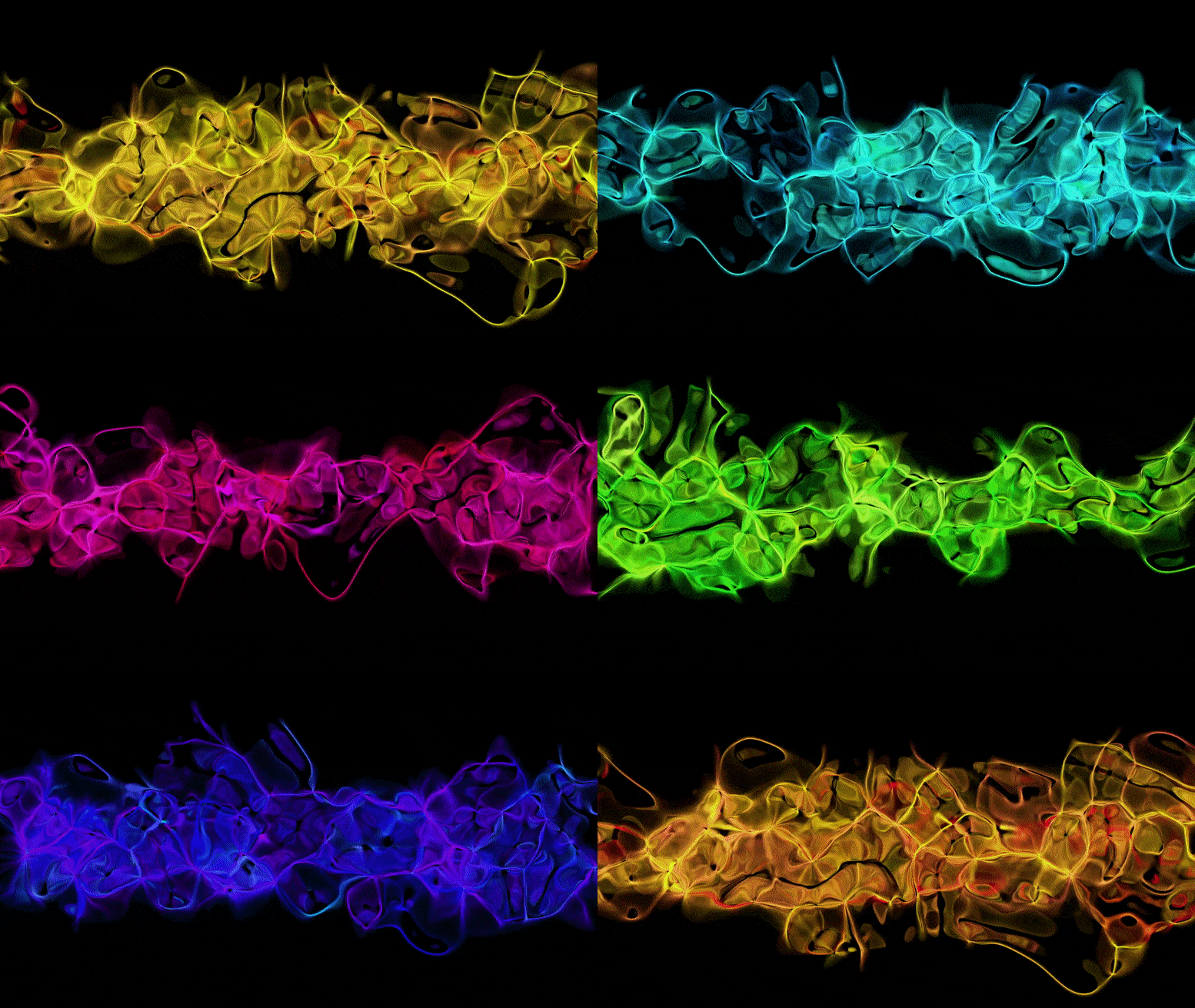
A new sort of optical device allows engineers to change the frequencies of individual photons, putting new capabilities in engineers’ hands.
Among the first lessons any grade school science student learns is that white light is not white at all, but rather a composite of many photons, those little droplets of energy that make up light, from every color of the rainbow – red, orange, yellow, green, blue, indigo, violet.
Now, researchers at Stanford University have developed an optical device that allows engineers to change and fine-tune the frequencies of each individual photon in a stream of light to virtually any mixture of colors they want. The result, published on April 23, 2021, in Nature Communications, is a new photonic architecture that could transform fields ranging from digital communications and artificial intelligence to cutting-edge quantum computing.
“This powerful new tool puts a degree of control in the engineer’s hands not previously possible,” said Shanhui Fan, a professor of electrical engineering at Stanford and senior author of the paper.
The Clover-Leaf Effect
The structure consists of a low-loss wire for light carrying a stream of photons that pass by like so many cars on a busy throughway. The photons then enter a series of rings, like the off-ramps in a highway cloverleaf. Each ring has a modulator that transforms the frequency of the passing photons – frequencies which our eyes see as color. There can be as many rings as necessary, and engineers can finely control the modulators to dial in the desired frequency transformation.
Among the applications that the researchers envision include optical neural networks for artificial intelligence that perform neural computations using light instead of electrons. Existing methods that accomplish optical neural networks do not actually change the frequencies of the photons, but simply reroute photons of a single frequency. Performing such neural computations through frequency manipulation could lead to much more compact devices, say the researchers.
“Our device is a significant departure from existing methods with a small footprint and yet offering tremendous new engineering flexibility,” said Avik Dutt, a post-doctoral scholar in Fan’s lab and second author of the paper.
Seeing the Light
The color of a photon is determined by the frequency at which the photon resonates, which, in turn, is a factor of its wavelength. A red photon has a relatively slow frequency and a wavelength of about 650 nanometers. At the other end of the spectrum, blue light has a much faster frequency with a wavelength of about 450 nanometers.
A simple transformation might involve shifting a photon from a frequency of 500 nanometers to, say, 510 nanometers – or, as the human eye would register it, a change from cyan to green. The power of the Stanford team’s architecture is that it can perform these simple transformations, but also much more sophisticated ones with fine control.
To further explain, Fan offers an example of an incoming light stream comprised of 20 percent photons in the 500-nanometer range and 80 percent at 510 nanometers. Using this new device, an engineer could fine-tune that ratio to 73 percent at 500 nanometers and 27 percent at 510 nanometers, if so desired, all while preserving the total number of photons. Or the ratio could 37 and 63 percent, for that matter. This ability to set the ratio is what makes this device new and promising. Moreover, in the quantum world, a single photon can have multiple colors. In that circumstance, the new device actually allows changing of the ratio of different colors for a single photon.
“We say this device allows for ‘arbitrary’ transformation but that does not mean ‘random,’” said Siddharth Buddhiraju, who was a graduate student in Fan’s lab during the research and is first author of the paper and who now works at Facebook Reality Labs. “Instead, we mean that we can achieve any linear transformation that the engineer requires. There is a great amount of engineering control here.”
“It’s very versatile. The engineer can control the frequencies and proportions very accurately and a wide variety of transformations are possible,” Fan added. “It puts new power in the engineer’s hands. How they will use it is up to them.”
Reference: “Arbitrary linear transformations for photons in the frequency synthetic dimension” by Siddharth Buddhiraju, Avik Dutt, Momchil Minkov, Ian A. D. Williamson and Shanhui Fan, 23 April 2021, Nature Communications.
DOI: 10.1038/s41467-021-22670-7
Additional authors include postdoctoral scholars Momchil Minkov, now at Flexcompute, and Ian A. D. Williamson, now at Google X.
This research was supported by the U.S. Air Force Office of Scientific Research.
Never miss a breakthrough: Join the SciTechDaily newsletter.
Follow us on Google and Google News.