
A newly published study from the Max Planck Institute reveals that the satisfaction levels of parents depend not only on the number of children they have, but also on the point in time when they start a family.
“All happy families are alike; each unhappy family is unhappy in its own way,” according to one of the most famous first sentences in world literature. To explore the question of why this is the case, Leo Tolstoy wrote a novel of around 1,000 pages. In their new study, Mikko Myrskylä of the Max Planck Institute for Demographic Research in Rostock and his colleague Rachel Margolis of the University of Western Ontario also tackle this issue, albeit in a more narrow, but much more precise way.
Using two of the longest panel datasets in the world, the Socio-Economic Panel (SOEP) from Germany and the British Household Panel Survey (BHPS), the demographers analyzed the satisfaction levels of around 7,000 survey respondents before the birth of their first child, and for a long period thereafter. In addition to comparing the satisfaction levels of various parents, they investigated how the satisfaction level of each individual changed over the life course with the birth of a first or of subsequent children. They also looked at whether other factors—such as age at the time of birth, education, income, or partnership status—influenced satisfaction.
Generally, they found that the results for Great Britain and Germany were quite similar: a parent’s satisfaction level starts to rise one year before the birth of a child, remains high in the year the child was born, and then quickly returns to the base level reported three to five years previously. However, the parent’s overall satisfaction level is also higher if he or she is in good health, has a job, has a high income, and is well educated. Moreover, the satisfaction levels of women tend to rise more than those of men before and immediately after the birth, and one year after the birth the tendency to return to the previous level of satisfaction is more pronounced among fathers than among mothers.
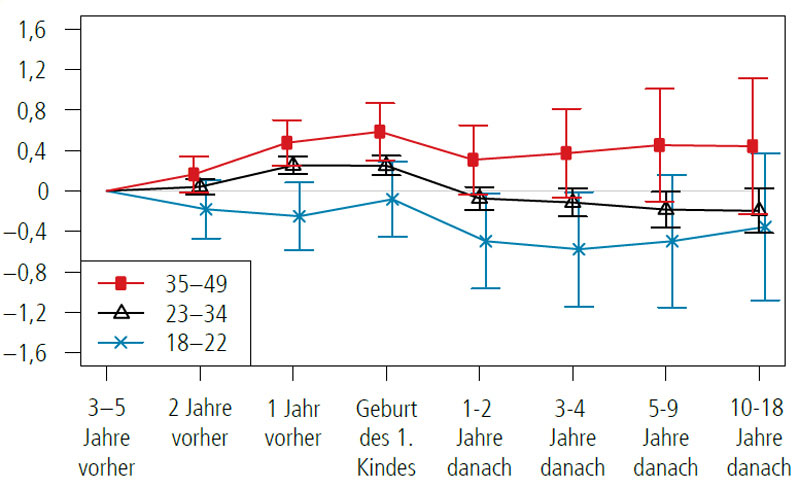
In addition to these sex-specific differences, which could be attributed to differing degrees of involvement in child care and hormonal adjustments, another important factor in the level of satisfaction after the birth of a child becomes apparent: the age of the parents. Among young parents between the ages of 18 to 22 the level of satisfaction falls even before the birth of the child, and does not rise above the base level in the year after the birth. Among 23- to 34-year-old parents satisfaction increases before and during the year of the birth, but then very quickly declines to the previous or an even lower level. Among parents over age 34 satisfaction rises before and during the year of the birth, and then falls slightly. Overall, however, the level of satisfaction among parents ages 34+ is consistently above the base level.
The second most important factor in happiness levels is the number of children. Whereas the fluctuations in satisfaction around the birth of the second child tend to occur at a somewhat lower level, the pattern is still very similar to the shifts observed around the birth of the first child. By contrast, the birth of a third child has no positive influence on the satisfaction of the parents; indeed, it even appears to have negative effects on satisfaction, although the decline is not statistically significant. These results were confirmed even after the demographers took into account changes in job, income, health, or family status.
These patterns in satisfaction levels thus reflect to an astonishing extent the fertility behavior patterns of recent years: namely, the trend toward late family formation and the decline in three-, four-, and five-child families. Previously, these developments in industrialized countries have generally been attributed to individual values or the difficulties parents face in combining career and family. Meanwhile, little attention has been paid to subjective satisfaction. But as these results show, satisfaction levels may provide a good basis for explaining these trends: if an individual observes that satisfaction increases if family formation is delayed to a later phase in life associated with greater social and financial security, and if couples have no more than two children, the individual may behave similarly.
Future studies could examine these associations in greater detail, and take into account circumstances not considered here, such as adoptions, miscarriages, and the quality of the partnership. It may be the case that partnership quality in particular has a non-negligible influence on the number of children and the satisfaction levels of the parents. Yet it is worth noting that although Anna Karenina had two children, they did make her happy.
Reference: “Happiness: Before and After the Kids” by M. Myrskylä and R. Margolis, 21 August 2014, Demography.
DOI: 10.1007/s13524-014-0321-x
Never miss a breakthrough: Join the SciTechDaily newsletter.
Follow us on Google and Google News.